Facts
The plaintiffs (Respondents 1 & 2) filed a suit for partition claiming a 2/3 share in the suit property, asserting it was joint family property inherited from their grandfather, Mariappa Pandaram
Source reference: para 2.1, 4They alleged their father, the 3rd defendant (Arumugam), sold the western portion to Defendants 1 & 2 (Appellants) without their consent in 2000
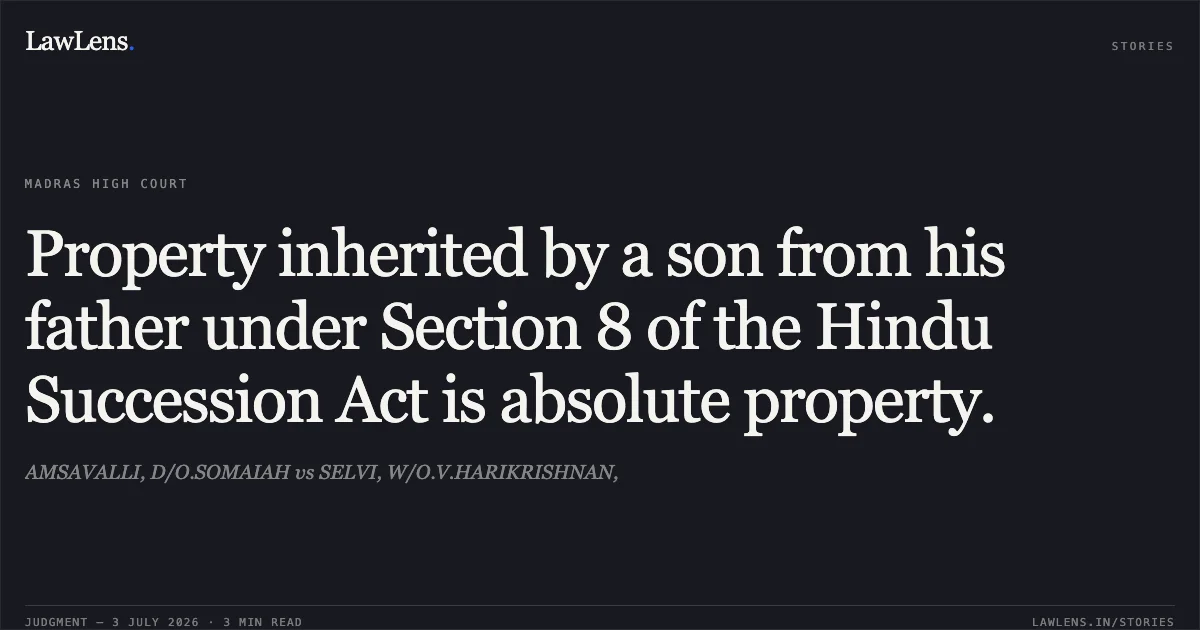
Source reference: para 4The Defendants contended the property was the absolute property of Arumugam inherited under Section 8 of the Hindu Succession Act, the suit was bad for non-joinder of a third sister (Seethalakshmi), and the matter was previously settled via a consent letter (Ex.B.7)
Source reference: para 5The Trial Court dismissed the suit citing non-joinder, limitation, and Ex.B.7
Source reference: para 9The First Appellate Court reversed this, holding that the impleading of the sister as a legal representative (LR) after the father's death cured the non-joinder
Source reference: para 11Issues
1. Whether the inheritance of the property by the 3rd defendant (sole son) under Section 8 of the Hindu Succession Act rendered it his absolute property, disentitling his daughters from claiming partition by birth?
Source reference: para 122. Whether the First Appellate Court erred in setting aside the finding of non-joinder on the ground that the necessary party was impleaded only as an LR during the appeal?
Source reference: para 123. Whether the suit for partition was maintainable without seeking a declaration to set aside the registered sale deeds (Ex.B.1 and Ex.B.2)?
Source reference: para 13.14. Whether the consent letter (Ex.B.7) filed by a power of attorney was valid and binding?
Source reference: para 12Law Applied
Section 8 of the Hindu Succession Act, 1956, which governs intestate succession for a male Hindu's separate property
Source reference: para 16The landmark Supreme Court precedent Commissioner of Wealth Tax v. Chander Sen (1986), establishing that property inherited by a son from his father under Section 8 does not become joint family property in the son's hands vis-à-vis his own children
Source reference: para 13, 21Order III Rules 1 and 2 of the CPC regarding the limited power of an attorney to depose on personal knowledge
Source reference: para 13.4, 22The principle from Venkush v. Baskaran that a Karta's alienation is voidable, necessitating a prayer for declaration to set aside the deed in a partition suit
Source reference: para 13.1, 20Reasoning
The Court reasoned that since the property was the self-acquired property of the grandfather, Mariappa Pandaram, it devolved upon his only son (the 3rd defendant) as absolute property under Section 8, not as ancestral coparcenary property
Source reference: para 17Consequently, the plaintiffs acquired no right by birth
Source reference: para 21The Court found the sale by the 3rd defendant to be valid as he was the absolute owner; even if treated as a Karta, the alienation was merely voidable and remained binding as the plaintiffs failed to specifically challenge the sale deeds or prove a lack of legal necessity
Source reference: para 18-20Regarding procedural defects, the Court held that impleading the sister (Seethalakshmi) as an LR did not cure the original defect of non-joinder in a partition suit, as the pleadings were not properly amended to reflect her share as a primary party
Source reference: para 21The Court upheld the Trial Court's reliance on Ex.B.7, noting the plaintiffs' failure to enter the witness box to rebut the settlement reached by their attorney was fatal to their case
Source reference: para 22Holding
Property inherited under Section 8 is absolute in nature and grandchildren cannot claim partition during the father's lifetime
The High Court allowed the Second Appeal and set aside the First Appellate Court's judgment, restoring the Trial Court's dismissal of the suit
Source reference: para 24The suit was barred by limitation and maintainability for failing to challenge the registered sale deeds of 2000, and that the non-joinder of a necessary party was not cured by mere impleadment as an LR
Source reference: para 19-20, 21Acts & Sections Cited
6 provisions across 4 statutes referred to in this judgment. Each provision opens on LawLens.
Code of Civil Procedure, 19081
Indian Contract Act, 18721
Specific Relief Act, 19631
Original Court PDF
AMSAVALLI, D/O.SOMAIAHvsSELVI, W/O.V.HARIKRISHNAN,
Click to open original judgment
Original judgment, available to read, download and summarize on LawLens.in