Facts
The appellant was prosecuted for allegedly demanding and accepting ₹6,000 from Lal Singh in connection with the admission of students to NIOS examinations.
Source reference: para. 2; pp. 2–6The prosecution case was supported by a trap involving phenolphthalein-treated currency notes, recovery of the notes from the appellant, and a positive chemical analysis of the hand-wash samples.
Source reference: para. 2; pp. 2–6The Trial Court convicted the appellant under Section 420 IPC and Section 13(2) of the Prevention of Corruption Act, sentencing her to two years’ rigorous imprisonment and fine under each provision, with the substantive sentences to run concurrently.
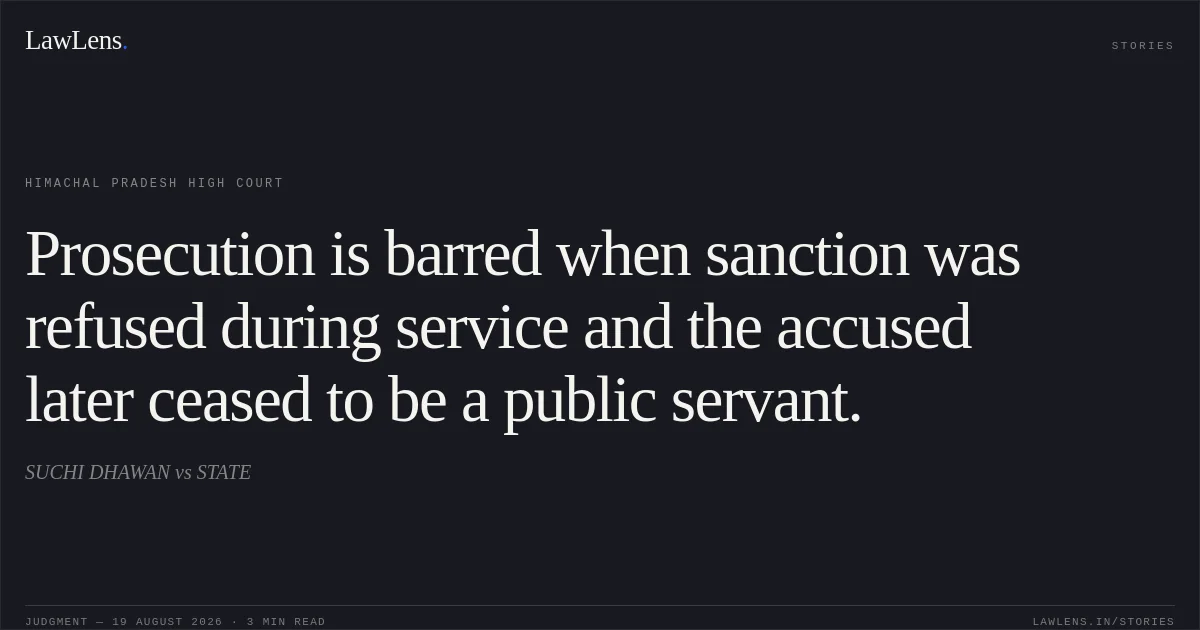
Source reference: paras. 3–6; pp. 6–8In appeal, the appellant contended, inter alia, that NIOS had refused sanction for her prosecution while she was in service and that the prosecution was therefore impermissible even though she had subsequently left the job.
Source reference: paras. 7, 9The State conceded that sanction had been refused but argued that sanction was unnecessary after the appellant ceased to be a public servant and that the objection had not been raised before the Trial Court.
Source reference: para. 10; p. 9Issues
Whether the appellant could be prosecuted after she had ceased to be a public servant when the competent authority had refused sanction for prosecution while she was still in service.
Source reference: paras. 9–15; pp. 9–14Whether the plea regarding absence of valid prosecution sanction could be raised for the first time before the appellate court.
Source reference: paras. 16–17; p. 14Whether the prosecution proceedings and conviction could stand in the absence of the requisite sanction under the Prevention of Corruption Act.
Source reference: para. 18; p. 15Law Applied
The Court applied the sanction requirement under Section 19 of the Prevention of Corruption Act, treating valid sanction as a condition precedent for taking cognizance of offences under the Act.
Source reference: paras. 12–16; pp. 10–14Relying on Chittaranjan Das v. State of Orissa , (2011) 7 SCC 167, and D.L. Rangotha v. State of M.P. , (2015) 12 SCC 733, it held that where sanction is refused while the accused is in service, the accused cannot subsequently be prosecuted merely because sanction is no longer required after retirement or cessation of service.
Source reference: paras. 12–16; pp. 10–14The Court also relied on State of M.P. v. Ram Manohar Pandey , (2015) 12 SCC 726, and the principles concerning the sanctioning authority’s duty to apply its mind as stated in Subramanian Swamy v. Manmohan Singh , (2012) 3 SCC 64.
Source reference: paras. 12–16; pp. 10–14Under State of Karnataka v. C. Nagarajaswamy , (2005) 8 SCC 370, the objection regarding absence of sanction may be raised for the first time before an appellate court, and the court may record the defect even if cognizance was earlier taken erroneously.
Source reference: paras. 12–16; pp. 10–14Reasoning
The charge-sheet itself recorded that NIOS had refused sanction for prosecuting the appellant and that the prosecution was initiated on the assumption that sanction was unnecessary because she had left the post in 2010.
Source reference: para. 12; p. 10The Court held that this approach was legally impermissible.
Source reference: paras. 12–15; pp. 10–14The relevant consideration was that sanction had been refused while the appellant was still a public servant; her subsequent cessation of service could not retrospectively remove the protection attached to the refusal of sanction.
Source reference: paras. 12–15; pp. 10–14Otherwise, the statutory safeguard would become illusory.
Source reference: paras. 12–15; pp. 10–14The State’s objection that the plea had not been taken before the Trial Court was rejected because lack of sanction goes to the competence of the court to take cognizance and may be urged at the appellate stage.
Source reference: paras. 16–17; p. 14Consequently, the proceedings conducted without proper sanction were held to be legally non est, making it unnecessary to determine the evidentiary challenges concerning demand, acceptance, recovery, or the hostile witnesses.
Source reference: para. 18; p. 15Holding
The High Court allowed the appeal, set aside the judgment of conviction and order of sentence, and discharged the appellant because the prosecution had been instituted without valid sanction after sanction had been refused during her service.
Any deposited fine was directed to be refunded after expiry of the limitation period, subject to further appellate orders.
Source reference: para. 19; p. 15The appellant was also directed to furnish a bond of ₹25,000 with one surety under Section 437-A CrPC, corresponding to Section 481 BNSS, valid for six months.
Source reference: para. 20; p. 16Acts & Sections Cited
7 provisions across 4 statutes referred to in this judgment. Each provision opens on LawLens.
Indian Penal Code, 18601
Prevention of Corruption Act, 19883
Code of Criminal Procedure, 19732
Bharatiya Nagarik Suraksha Sanhita, 20231
Original Court PDF
SUCHI DHAWANvsSTATE
Click to open original judgment
Original judgment, available to read, download and summarize on LawLens.in