01Facts
The petitioners invoked Section 482 of the Code of Criminal Procedure, 1973, seeking quashing of the FIR in Khunti P.S. Case No. 130 of 2014, corresponding to G.R. No. 435 of 2014, registered under Sections 420, 406 and 34 of the Indian Penal Code and Section 3 of the Dowry Prohibition Act, as well as the order taking cognizance dated 05.11.2015.
¶ 2The prosecution arose from Complaint Case No. 44 of 2014, which was referred to the police under Section 156(3) Cr.P.C.
¶ 5It was alleged that the petitioners, acting in furtherance of a common intention with the co-accused, represented Manoj Kumar, son of Madan Prasad, as an eligible prospective groom willing to marry without dowry and thereby induced the complainant to transfer ₹5,00,000 towards marriage expenses.
¶ 4Subsequently, the accused allegedly demanded ₹10,00,000 as dowry, caused the proposed marriage to fail when the demand was not met, and did not return the ₹5,00,000.
¶ 4Although the petitioners were not named in the original complaint/FIR, the police found the allegations against them true during investigation and submitted a chargesheet; the Chief Judicial Magistrate, Khunti thereafter took cognizance.
¶ 5The complainant did not appear despite valid service of notice.
¶ 302Issues
i.1. Whether the FIR, chargesheet and order taking cognizance should be quashed under Section 482 Cr.P.C. on the ground that the allegations against the petitioners were general or omnibus and that they were not named in the FIR.
¶ 6–7ii.2. Whether the allegations, if accepted as unrebutted at the threshold stage, disclosed offences under Sections 420, 406 and 34 IPC and Section 3 of the Dowry Prohibition Act against the petitioners.
¶ 8–9iii.3. Whether the principles concerning omnibus allegations in matrimonial prosecutions, stated in Kahkashan Kausar @ Sonam v. State of Bihar and Dara Laxmi Narayana v. State of Telangana, applied to the present case.
¶ 6–903Law Applied
The Court considered the inherent jurisdiction under Section 482 Cr.P.C., which may be exercised to prevent abuse of process or secure the ends of justice, but not ordinarily to undertake a detailed evaluation of evidence at the nascent stage of prosecution.
The alleged conduct attracted Sections 420, 406 and 34 IPC, concerning cheating, criminal breach of trust and acts done in furtherance of common intention, respectively, and Section 3 of the Dowry Prohibition Act, concerning giving or taking dowry.
The Court considered Amar Nath Goswami v. State of Jharkhand, relying on Kahkashan Kausar @ Sonam v. State of Bihar, (2022) 6 SCC 599, for the principle that general and omnibus allegations may not justify prosecution.
¶ 6It also considered Dara Laxmi Narayana v. State of Telangana, (2025) 3 SCC 735, which held that, in matrimonial disputes involving Section 498A IPC, mere naming of family members without specific allegations of active involvement may warrant quashing.
¶ 7Provisions in the judgment · 6 · Linked ones open on LawLens
Code of Criminal Procedure, 1973 Section 482Section 156
Indian Penal Code, 1860 Section 420Section 406Section 34
Dowry Prohibition Act, 1961 Section 3
04Reasoning
The Court distinguished the authorities relied upon by the petitioners because they concerned matrimonial disputes, particularly prosecutions under Section 498A IPC, whereas the present case involved an alleged pre-marital scheme to deceive the complainant by projecting a co-accused as a prospective groom, obtaining ₹5,00,000 on the representation that the marriage would be dowry-free, and thereafter demanding ₹10,00,000 as dowry.
¶ 9The fact that the petitioners were not named in the FIR was not considered sufficient for quashing, since the police had implicated them after investigation and had submitted a chargesheet based on the materials in the case diary.
¶ 5, 9At the stage of cognizance and consideration under Section 482 Cr.P.C., the Court assessed whether the allegations, if unrebutted, disclosed the commission of an offence, rather than determining the ultimate truth of the prosecution case.
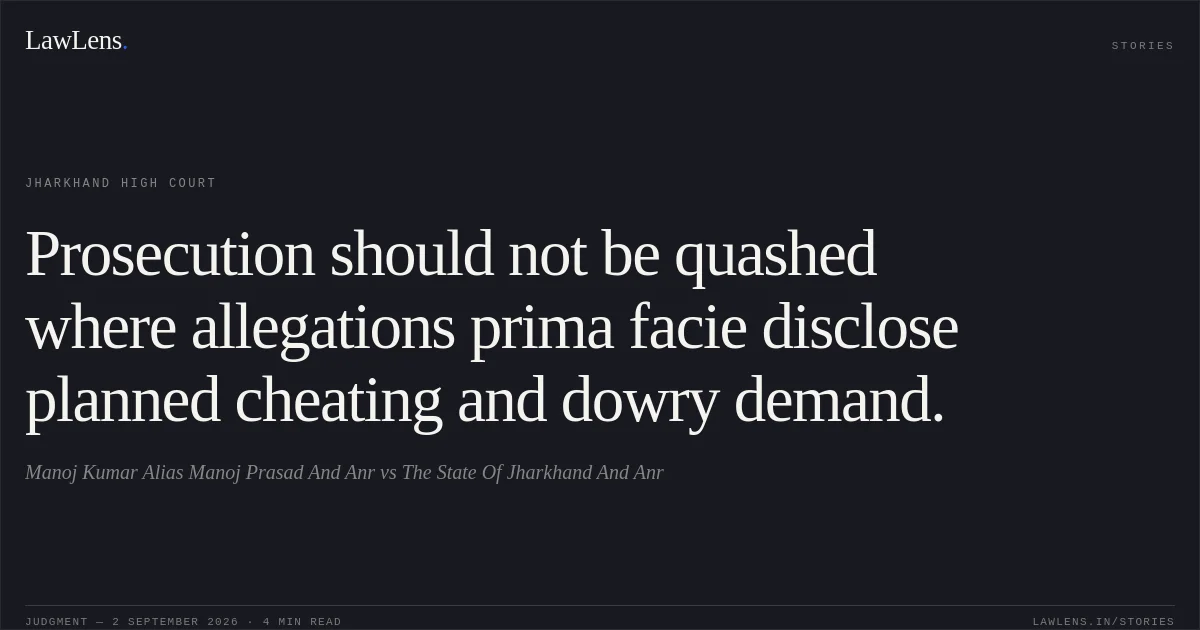
It concluded that the allegations prima facie disclosed cheating under Section 420 IPC and an offence under Section 3 of the Dowry Prohibition Act, and found no justifiable basis to interfere with the criminal proceeding.
¶ 9The Court held that those principles were not applicable where the allegations disclosed a planned deception and a specific financial inducement connected with a proposed marriage.
¶ 905Holding
The High Court held that the principles relating to vague or omnibus allegations in matrimonial cases did not apply to the alleged planned deception and financial inducement in the present case.
¶ 9It found no merit in the petitioners’ challenge and dismissed the criminal miscellaneous petition seeking quashing of the FIR and the order taking cognizance.
¶ 10The interim relief granted on 24.03.2017 was vacated, and the Registry was directed to intimate the concerned court.
¶ 11–12Original Court PDF
Manoj Kumar Alias Manoj Prasad And AnrvsThe State Of Jharkhand And Anr
Click to open original judgment
Original judgment, available to read, download and summarize on LawLens.in