Facts
The applicant (original accused) was convicted under Section 138 of the Negotiable Instruments (NI) Act, 1881, by the JMFC, Dwarka, which was confirmed by the Sessions Court
Source reference: p. 1-2The original complainant alleged he invested ₹30 Lakhs in a petrol pump business belonging to the accused, against which the accused issued five cheques of ₹5 Lakhs each
Source reference: p. 3The cheques were returned for "insufficient funds," and the accused allegedly refused the statutory legal notice
Source reference: p. 4During the trial, the accused raised defenses regarding the financial capacity of the complainant and claimed the cheques were given as security for a partnership firm, Vrachraj Petrol Pump
Source reference: p. 9-10Crucially, the disputed cheques were issued from the account of "R.R. Enterprise" under the authorized signature of the accused, but the complaint was filed against the accused in his individual capacity only
Source reference: p. 21-22, 67Issues
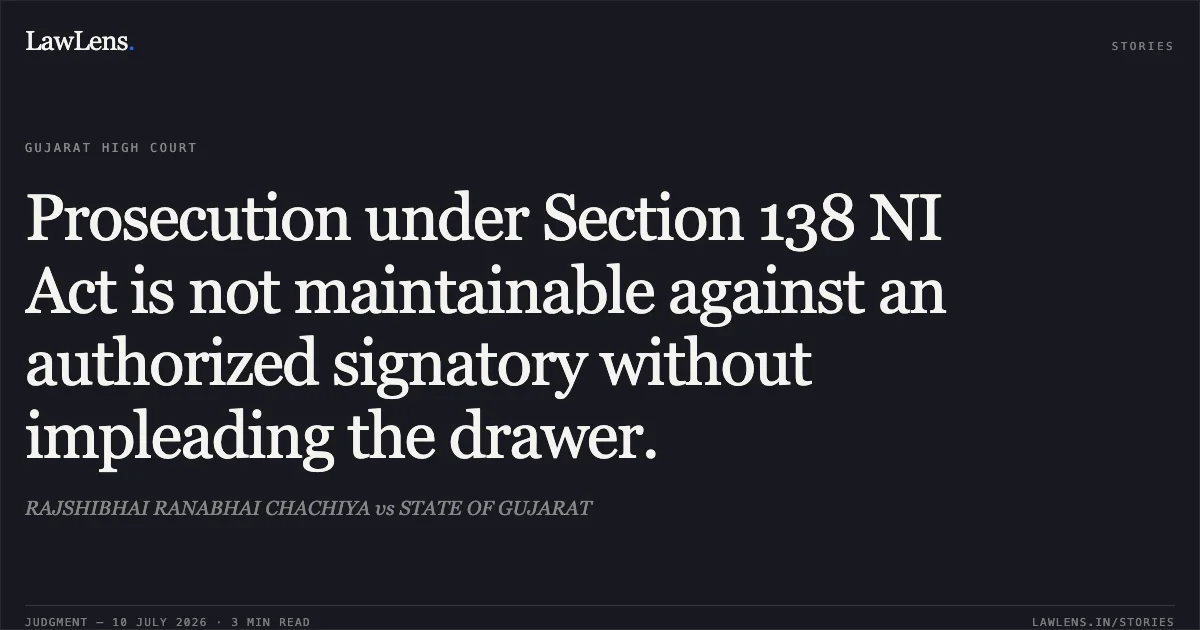
1. Whether a complaint under Section 138 of the NI Act is maintainable against an authorized signatory in his individual capacity when the actual drawer of the cheque (the proprietorship concern/firm) has not been joined as an accused
Source reference: p. 232. Whether the authorized signatory of an enterprise can be treated as the "drawer" of the cheque under Section 7 of the Act to fasten personal liability
Source reference: p. 31, 57Law Applied
Section 138 of the NI Act, which requires that a cheque must be drawn by a person on an "account maintained by him"
Source reference: p. 25Aneeta Hada v. Godfather Travels & Tours (P) Ltd., which established that arraigning the company/firm as a principal offender is a condition precedent for vicarious liability
Source reference: p. 48, 62Bijoy Kumar Moli v. Paresh Manna, which clarified that an authorized signatory is not the "drawer" under Section 7 and does not "maintain" the account of the entity; therefore, the signatory cannot be prosecuted individually if the entity (the drawer) is not impleaded
Source reference: p. 24, 57-58Section 141 regarding vicarious liability and Section 27 of the General Clauses Act regarding the presumption of service of notice
Source reference: p. 17, 30Reasoning
The High Court observed that while the lower courts focused on the merits of the debt and the service of notice, they failed to notice that the cheques were drawn on the account of "R.R. Enterprise"
Source reference: p. 22, 67Applying the principle of strict construction of penal statutes, the Court reasoned that under Section 138, only the "drawer"—the person maintaining the account—can be held liable
Source reference: p. 28, 60Since "R.R. Enterprise" was the account holder and the drawer, and the complainant failed to join the enterprise as an accused, the prosecution against the applicant in his individual capacity was fundamentally flawed
Source reference: p. 67-68The Court noted that an authorized signatory is merely a "physical limb" and does not assume the legal identity of the drawer
Source reference: p. 39Consequently, even if a personal debt existed, the statutory requirement of the cheque being drawn on an account "maintained by" the accused was not satisfied
Source reference: p. 68-69Holding
The Court held that the complaint was not maintainable due to the non-joinder of the actual drawer (the Enterprise) and the failure to satisfy the "account maintained by him" criteria under Section 138
The High Court allowed the Revision Applications, quashing the judgments of the JMFC (dated 30.12.2016) and the Sessions Court (dated 13.12.2018). The applicant was acquitted of all charges. However, the Court left it open for the complainant to pursue appropriate criminal remedies for cheating (IPC Section 420) if the facts supported such a claim
Source reference: p. 70, 62Acts & Sections Cited
20 provisions across 5 statutes referred to in this judgment. Each provision opens on LawLens.
Negotiable Instruments Act, 1881
Code of Criminal Procedure, 19734
Indian Partnership Act, 19323
General Clauses Act, 18971
Religious Institutions (Prevention of Misuse) Act, 19881
Original Court PDF
RAJSHIBHAI RANABHAI CHACHIYAvsSTATE OF GUJARAT
Click to open original judgment
Original judgment, available to read, download and summarize on LawLens.in