Facts
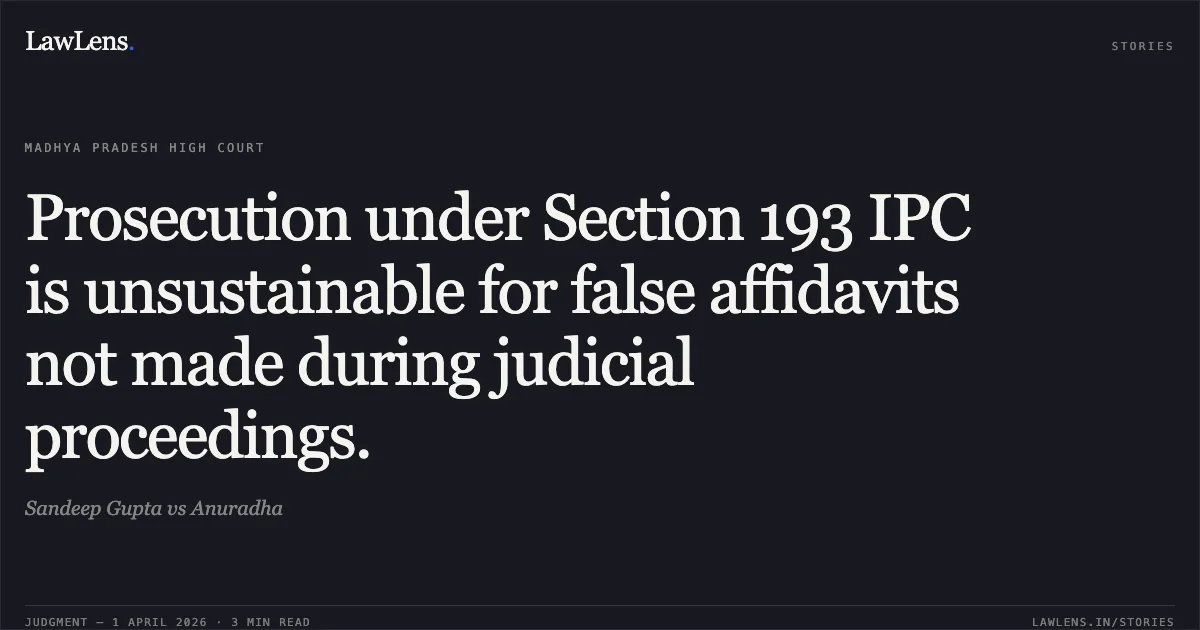
The Respondent (complainant) filed a private complaint against her husband, the Petitioner, alleging that at the time of their marriage on 17/07/2013, he executed a notarized affidavit falsely stating he was never married, despite being a divorcee
Source reference: para 2aShe further alleged that the Petitioner unauthorizedly transferred her bank account from Shajapur to Patan
Source reference: para 2aBased on these allegations, the Judicial Magistrate First Class (JMFC), Shajapur, issued a summoning order on 06/08/2022, taking cognizance under Sections 193, 200, 417, and 468 of the IPC
Source reference: para 2bThis order was affirmed by the Revisional Court on 24/06/2023
Source reference: para 2cThe Petitioner moved the High Court under Section 482 of the Cr.P.C., contending the charges were a result of matrimonial vengeance, noting that a decree of divorce had already been passed between the parties in 2019
Source reference: para 3, 14Issues
1. Whether the execution of a false affidavit for marriage purposes, not used in a judicial proceeding, attracts criminal liability under Sections 193 and 200 of the IPC.
Source reference: para 152. Whether a prima facie case under Sections 417 and 468 of the IPC is established regarding the transfer of a bank account without evidence of forgery or wrongful loss.
Source reference: para 163. Whether the criminal proceedings were initiated with an ulterior motive to wreak personal vengeance, warranting quashment under Section 482 Cr.P.C.
Source reference: para 17Law Applied
The court primarily applied Section 482 of the Cr.P.C. (corresponding to Section 528 of the BNSS, 2023) to prevent the abuse of the process of any court
Source reference: para 1, 18It relied on the principles from Delhi Race Club (1940) Ltd. v. State of U.P., which mandates that a Magistrate must apply judicial mind to ensure "sufficient grounds" exist before summoning an accused
Source reference: para 7The court invoked the doctrine from Mahmood Ali & Ors. v. State of U.P., requiring courts to scrutinize frivolous or vexatious proceedings instituted with ulterior motives more closely
Source reference: para 8Regarding false declarations, it applied the rule from Jotish Chandra Chaudhury v. State of Bihar, which requires that a false statement be material to the object of the declaration and used corruptly to attract Section 200 IPC
Source reference: para 12Reasoning
The court found that the affidavit in question was neither submitted nor utilized in any judicial proceeding, a prerequisite for Section 193 IPC
Source reference: para 15It noted that the complainant’s brother admitted to preparing the affidavit and that there was no evidence the marriage was contingent upon the Petitioner’s prior marital status
Source reference: para 15Regarding the bank transfer, the court observed that bank officials confirmed transfers require the account holder's consent; thus, no forgery or cheating was prima facie evident, especially as no wrongful loss was established
Source reference: para 16The court highlighted the history of matrimonial discord and the fact that the complaint was filed after the marriage had already been dissolved by a divorce decree, leading to the conclusion that the litigation was an attempt to settle personal scores rather than seek justice
Source reference: para 14, 17Holding
The court answered the issues in favor of the Petitioner, holding that the lower courts committed a manifest error by failing to identify the lack of essential ingredients for the alleged offenses
The High Court allowed the petition, quashed the summoning order dated 06/08/2022, the revisional order dated 24/06/2023, and all consequential proceedings in RCT No. 718/2022
Source reference: para 18-19Acts & Sections Cited
16 provisions across 4 statutes referred to in this judgment. Each provision opens on LawLens.
Code of Criminal Procedure, 19736
Bharatiya Nagarik Suraksha Sanhita, 20231
Indian Penal Code, 18607
Hindu Marriage Act, 19552
Original Court PDF
Sandeep GuptavsAnuradha
Click to open original judgment
Original judgment, available to read, download and summarize on LawLens.in