Facts
The appellant, Pitambar Das, was the in-charge of a wheat purchasing centre for the U.P. Food Corporation of India
Source reference: para. 12On 30.05.1984, the Sub-Divisional Magistrate (PW-1) conducted an inspection and found 1263 quintals of wheat in stock against a recorded 1251 quintals
Source reference: para. 12Finding 12 quintals in excess without a satisfactory explanation, the police charged the appellant under Sections 3/7 of the Essential Commodities (E.C.) Act, 1955
Source reference: para. 3The trial court convicted the appellant on 20.05.1988, sentencing him to two years’ rigorous imprisonment and a fine of Rs. 2,000/-
Source reference: para. 2The appellant challenged this on grounds that no specific "Control Order" was cited as violated and that as an employee of a government undertaking, he was not a "dealer"
Source reference: para. 28, 30Issues
1. Whether a conviction under Section 7 of the E.C. Act can be sustained in the absence of a specific notification or violation of a "Control Order" issued under Section 3.
Source reference: para. 4, 302. Whether the prosecution proved mens rea and physical contravention beyond reasonable doubt given the contradictions in witness testimonies.
Source reference: para. 28, 303. Whether the mandatory provisions regarding forfeiture under Section 7(1)(b) were complied with.
Source reference: para. 8, 29Law Applied
The court primarily applied Section 3 of the E.C. Act, 1955, which empowers the government to issue "Control Orders" for essential commodities
Source reference: para. 4Section 7, which prescribes penalties for the contravention of such orders
Source reference: para. 6mens rea is an essential ingredient for an offence under the Act unless the statute expressly excludes it. Nathulal v. State of Madhya Pradesh (AIR 1966 SC 43)
Source reference: para. 26Section 7(1)(b) is mandatory, requiring the forfeiture of property in respect of which an order was contravened. Shambhu Dayal v. State of West Bengal (1990)
Source reference: para. 29Reasoning
The Court observed that Section 3 is merely an enabling provision; for a crime to exist, there must be a violation of a specific Control Order promulgated under that section. In this case, the prosecution failed to identify any such order or prove how the appellant, a mere in-charge (not a licensee), violated it
Source reference: para. 4, 30The Court found significant procedural lapses: the SDM (PW-1) admitted he did not inspect all records and acted in haste [para. 17], and the Supply Inspector (PW-2) gave contradictory testimony regarding his presence during the search
Source reference: para. 19Furthermore, no evidence was produced regarding the grade/nature of the wheat or any forfeiture proceedings under Section 7(1)(b). Since the prosecution could not demonstrate an intentional contravention of a specific legal order, it failed to meet the burden of proof required for a criminal conviction
Source reference: para. 8, 30Holding
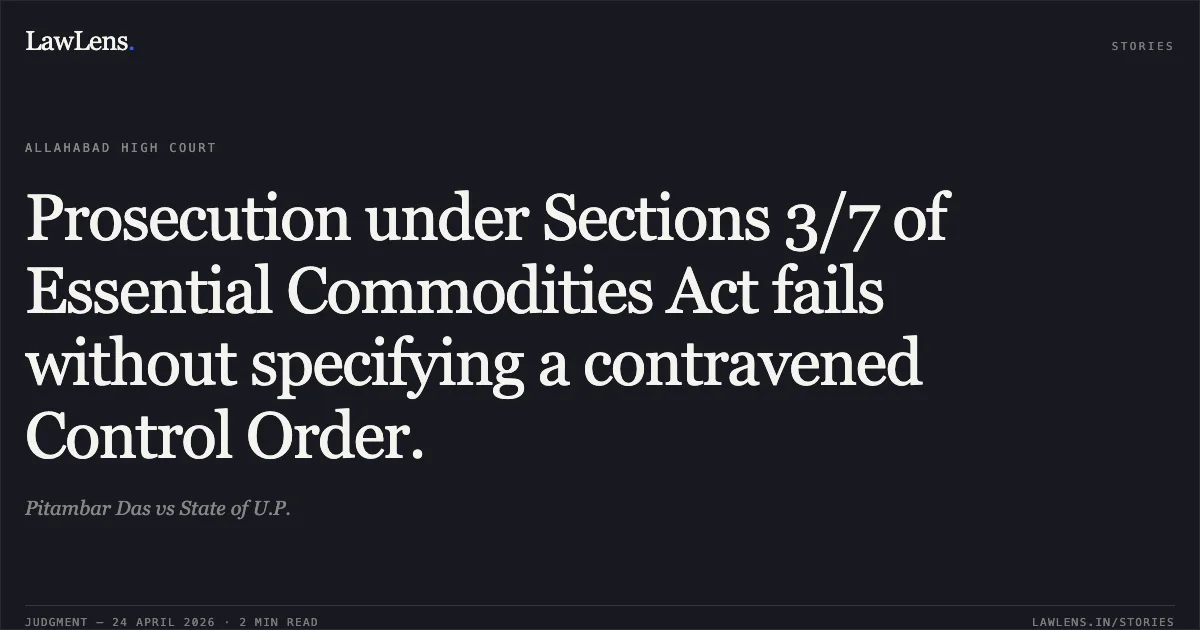
The Court answered the issues in the negative, holding that prosecution under the E.C. Act is unsustainable without proving the contravention of a specific Control Order
the appeal was allowed, the judgment of the trial court dated 20.05.1988 was set aside, and the appellant was acquitted of all charges
Source reference: para. 31, 32Acts & Sections Cited
3 provisions across 2 statutes referred to in this judgment. Each provision opens on LawLens.
Code of Criminal Procedure, 19731
Original Court PDF
Pitambar DasvsState of U.P.
Click to open original judgment
Original judgment, available to read, download and summarize on LawLens.in


