Facts
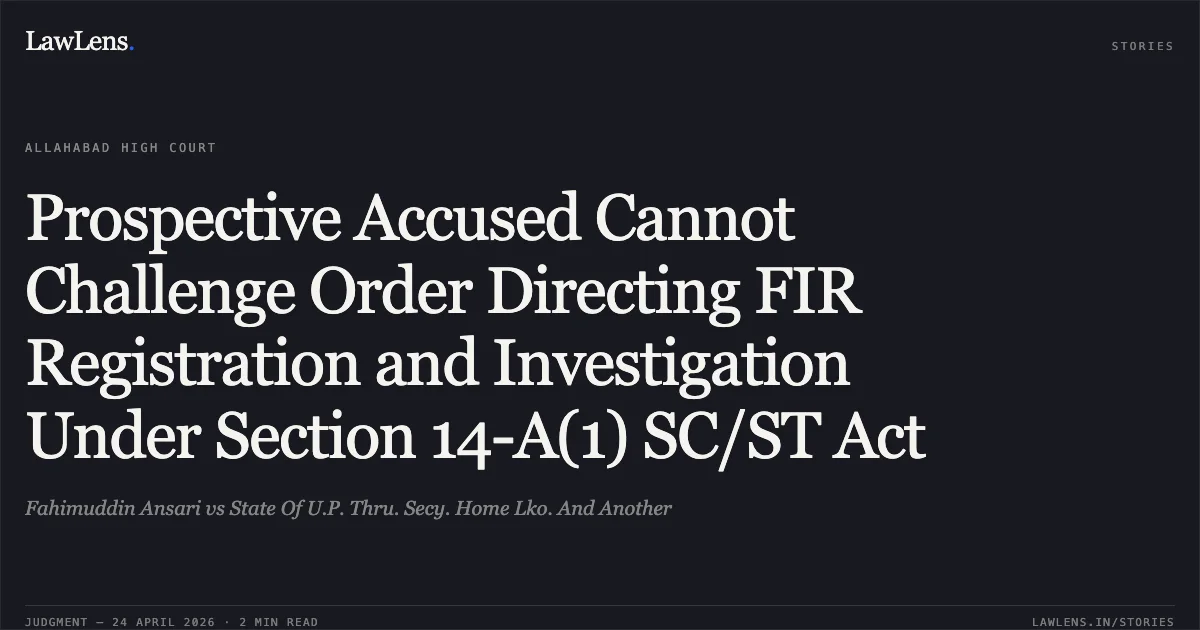
The respondent no. 2 (complainant) moved an application under Section 173(4) of the Bharatiya Nagarik Suraksha Sanhita (BNSS) before the Special Judge, SC/ST Act, Sitapur, alleging that the appellant molested her under the pretext of showing her a shop.
Source reference: para. 3The appellant contested this, asserting that the distance between their residences made the incident improbable and that the complaint was a retaliatory measure regarding a dispute over photocopying charges.
Source reference: para. 4By an order dated 26/03/2026, the Special Judge directed the SHO, Tambour, to register an FIR and investigate the matter.
Source reference: para. 2The appellant challenged this order through a statutory appeal under Section 14-A(1) of the SC/ST Act.
Source reference: para. 2Issues
1. Whether an order passed by a Special Judge under Section 173(4) of the BNSS directing the registration of an FIR and investigation is an "interlocutory order".
Source reference: para. 7 / para. 142. Whether a prospective accused has the locus standi to maintain a statutory appeal under Section 14-A(1) of the SC/ST Act against an order directing the registration of an FIR.
Source reference: para. 21Law Applied
Section 14-A(1) of the SC/ST Act, which bars appeals against "interlocutory orders".
Source reference: para. 18-19The court relied on the Full Bench decisions in Father Thomas v. State of UP and Jagannath Verma v. State of UP, which established that a direction to the police to register an FIR and investigate is an ancillary step in aid of investigation, purely interlocutory, and not amenable to revision or appeal by a prospective accused.
Source reference: para. 14-15The court also considered Section 173(4) and 175(3) of the BNSS (corresponding to Section 156(3) CrPC) as interpreted in Om Prakash Ambadkar v. State of Maharashtra, which codifies procedural safeguards but does not alter the interlocutory nature of such orders.
Source reference: para. 11 / para. 20Reasoning
The court reasoned that although the BNSS introduced new procedural safeguards—such as requiring the Magistrate to consider police submissions and the complainant's affidavit before ordering an FIR—these changes merely codified existing judicial practices aimed at preventing misuse of the law.
Source reference: para. 11 / para. 34Applying the Father Thomas precedent, the court found that since no cognizance had been taken and no process (summons) had been issued against the appellant, his substantial rights remained untouched at this stage.
Source reference: para. 14 / para. 21The court noted that while an order rejecting a 173(4) application is a final order amenable to revision, an order granting it is purely interim/temporary.
Source reference: para. 15-16Consequently, even under the new BNSS framework, the direction to investigate remains an interlocutory step.
Source reference: para. 13 / para. 21Holding
The court held that the impugned order directing the registration of an FIR is an interlocutory order.
Under Section 14-A(1) of the SC/ST Act, appeals against interlocutory orders are expressly barred.
Source reference: para. 19The court further concluded that a prospective accused has no locus standi to challenge such a direction prior to the summoning/cognizance stage.
Source reference: para. 13 / para. 21Accordingly, the appeal was dismissed as not maintainable.
Source reference: para. 22Acts & Sections Cited
10 provisions across 2 statutes referred to in this judgment. Each provision opens on LawLens.
Bharatiya Nagarik Suraksha Sanhita, 20235
Code of Criminal Procedure, 19735
Original Court PDF
Fahimuddin AnsarivsState Of U.P. Thru. Secy. Home Lko. And Another
Click to open original judgment
Original judgment, available to read, download and summarize on LawLens.in