Facts
On May 24, 2015, the claimant, a bus conductor, was injured while assisting a driver (Respondent No. 2) in parking a bus.
Source reference: p. 1-2The bus hit the claimant, resulting in the amputation of his left leg below the knee.
Source reference: p. 2The claimant suffered 60% permanent disability.
Source reference: p. 2The Motor Accidents Claims Tribunal (MACT) awarded compensation, concluding the accident occurred due to the rash and negligent driving of the offending vehicle.
Source reference: p. 2The Insurance Company appealed the judgment, arguing that their liability should be limited under the Workmen’s Compensation Act and challenging the 30% functional disability assessment.
Source reference: p. 1-3Issues
1. Whether the liability of the Insurance Company is limited by the provisions of the Workmen's Compensation Act, 1923, in light of Section 167 of the Motor Vehicles Act.
Source reference: p. 1, 32. Whether the assessment of 30% functional disability was excessive given the award for a prosthetic limb.
Source reference: p. 33. Whether recovery rights can be granted despite the death of the driver and the appellant's decision not to implead legal heirs.
Source reference: p. 2Law Applied
Statement identifying a key statute, principle, or precedent: The court applied Section 167 of the Motor Vehicles Act, 1988, which provides a claimant the option to seek compensation under either the Motor Vehicles Act or the Workmen's Compensation Act, 1923, but prohibits claiming under both.
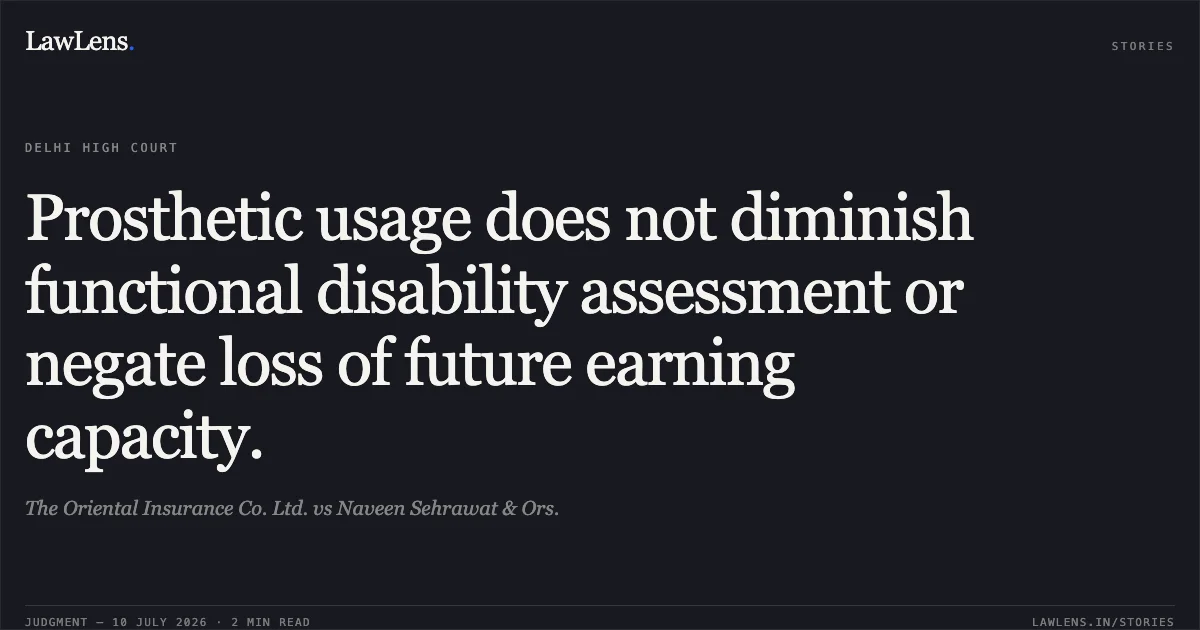
Source reference: p. 3Statement on the doctrine derived from a case: Regarding disability, the court followed established principles that the use of a prosthetic limb does not diminish the legal assessment of loss of future earning capacity or functional disability resulting from amputation.
Source reference: p. 3The court also applied the principle of "preponderance of probabilities" to establish negligence in motor accident claims.
Source reference: p. 2Reasoning
The court rejected the appellant’s first contention regarding the Workmen's Compensation Act, noting that Section 167 of the MV Act grants the claimant the option to choose the forum; since there was no evidence that compensation was already sought or granted under the 1923 Act, the MACT's jurisdiction was valid.
Source reference: p. 3Regarding the driver, the court noted that since the appellant chose not to implead the legal heirs of the deceased driver (Respondent No. 2), the plea for recovery rights became unsustainable.
Source reference: p. 2-3On the issue of disability, the court held that receiving a prosthetic limb (even if conservative costs were awarded) does not negate the physical reality of amputation for the purpose of calculating functional disability.
Source reference: p. 3The court found that assessing 30% functional disability for a 60% physical disability was reasonable and not excessive.
Source reference: p. 3Holding
The court held that the Insurance Company is liable for the full awarded amount, as the statutory limitation under the Workmen's Compensation Act did not apply.
The High Court dismissed the appeal and upheld the MACT’s award.
Source reference: p. 4The court directed the release of the balance amount with accrued interest to the claimant and ruled that the statutory deposit would only be refunded to the insurer after full satisfaction of the award.
Source reference: p. 4Acts & Sections Cited
4 provisions across 2 statutes referred to in this judgment. Each provision opens on LawLens.
Motor Vehicles Act, 19881
Indian Penal Code, 18603
Original Court PDF
The Oriental Insurance Co. Ltd.vsNaveen Sehrawat & Ors.
Click to open original judgment
Original judgment, available to read, download and summarize on LawLens.in