Facts
The appellant, an Upper Divisional Clerk in the CMPF office, was accused of demanding ₹2,000 from the complainant for providing a nominee certificate relating to the complainant’s deceased father. Following the complainant’s report, the CBI arranged a trap on 1 April 2003. The complainant and shadow witnesses testified that the appellant demanded and accepted the treated currency notes, which were recovered from a drawer in his office; the appellant’s right-hand wash tested positive for phenolphthalein and sodium carbonate.
Source reference: para. 3–5, 22–23The Special Judge convicted the appellant under Sections 7 and 13(1)(d) read with Section 13(2) of the Prevention of Corruption Act, 1988, and imposed concurrent sentences of two and three years’ rigorous imprisonment, respectively.
Source reference: para. 2The appellant challenged that judgment in appeal.
Source reference: para. 12–13Issues
Whether the conviction and sentence suffered from an error of law warranting appellate interference
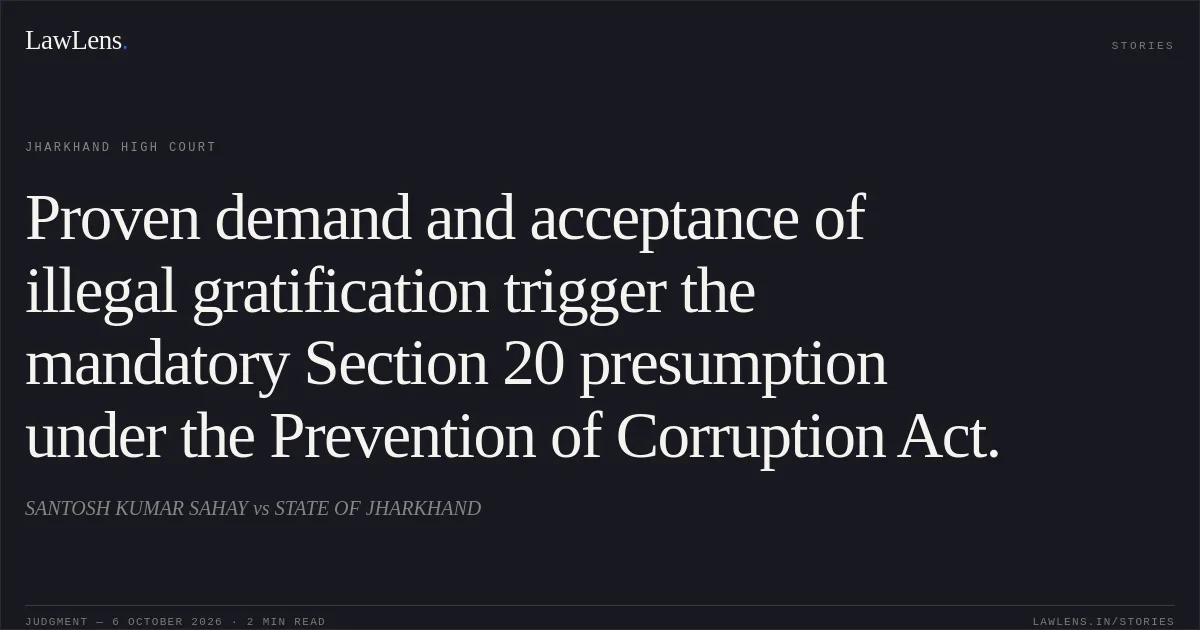
Source reference: para. 17Whether the prosecution proved the demand and acceptance of illegal gratification, thereby establishing the foundational facts for the applicable presumption under Section 20 of the Prevention of Corruption Act
Source reference: para. 20–22Law Applied
The Court applied Sections 7, 13(1)(d) and 13(2) of the Prevention of Corruption Act, 1988, as applicable before the 2018 amendment.
Source reference: para. 18–19Relying on the Constitution Bench decision in Neeraj Dutta v. State (NCT of Delhi), (2023) 4 SCC 731, it stated that proof of demand and acceptance is essential to establish the relevant offences; those facts may be proved by direct or circumstantial evidence.
Source reference: para. 20Once the foundational facts of acceptance or obtainment are proved, Section 20 requires a presumption, for a Section 7 charge, that the gratification was received as a motive or reward, subject to rebuttal. The Court also noted that Section 20 does not apply to offences under Section 13(1)(d)(i) and (ii).
Source reference: para. 20Reasoning
The Court found that the complainant’s testimony about the prior demand and the trap-day transaction was corroborated by the shadow witnesses, who testified that the appellant asked for the money, received it, and placed it in his table drawer. The recovery of the pre-recorded currency notes and the positive right-hand wash further supported the prosecution case.
Source reference: para. 21–23The appellant’s objections—including the non-examination of certain trap-team members, alleged animus arising from an earlier trap, the claim that another employee used the drawer, and the negative left-hand wash—did not, in the Court’s view, displace that evidence.
Source reference: para. 25–28It therefore held that the foundational facts had been proved and that the appellant had not satisfactorily rebutted the Section 20 presumption applicable to the Section 7 charge.
Source reference: para. 22Holding
The High Court held that the appeal lacked merit and affirmed the conviction and sentence.
It dismissed the appeal, cancelled the appellant’s bail bond, and directed him to surrender before the trial court within two months to serve the sentence, failing which coercive steps could be taken.
Source reference: para. 32Acts & Sections Cited
7 provisions across 1 statute referred to in this judgment. Each provision opens on LawLens.
Prevention of Corruption Act, 19887
Original Court PDF
SANTOSH KUMAR SAHAYvsSTATE OF JHARKHAND
Click to open original judgment
Original judgment, available to read, download and summarize on LawLens.in