Facts
The applicant served as Guest Faculty (2003) and was later appointed as Assistant Professor on a contractual basis (2008) at the National Institute of Fashion Technology (NIFT)
Source reference: p. 2Despite several extensions, her services were terminated effective 30.06.2020 due to alleged performance deficiencies, negative student feedback (92.4% negative remarks), and behavioral issues
Source reference: p. 3, 11The applicant previously challenged her disengagement and sought regularization in OA 12/2021 and OA 06/2022, both of which resulted in findings against her
Source reference: p. 10-11In 2022, she applied for the post of Professor under a new recruitment notification and was declared "provisionally eligible" for the interview stage
Source reference: p. 8-9She filed the present application seeking regularization of her services from 2003 and a direction for appointment to the regular post of Professor, alleging discrimination and arbitrary exclusion from the final selection
Source reference: p. 1, 6Issues
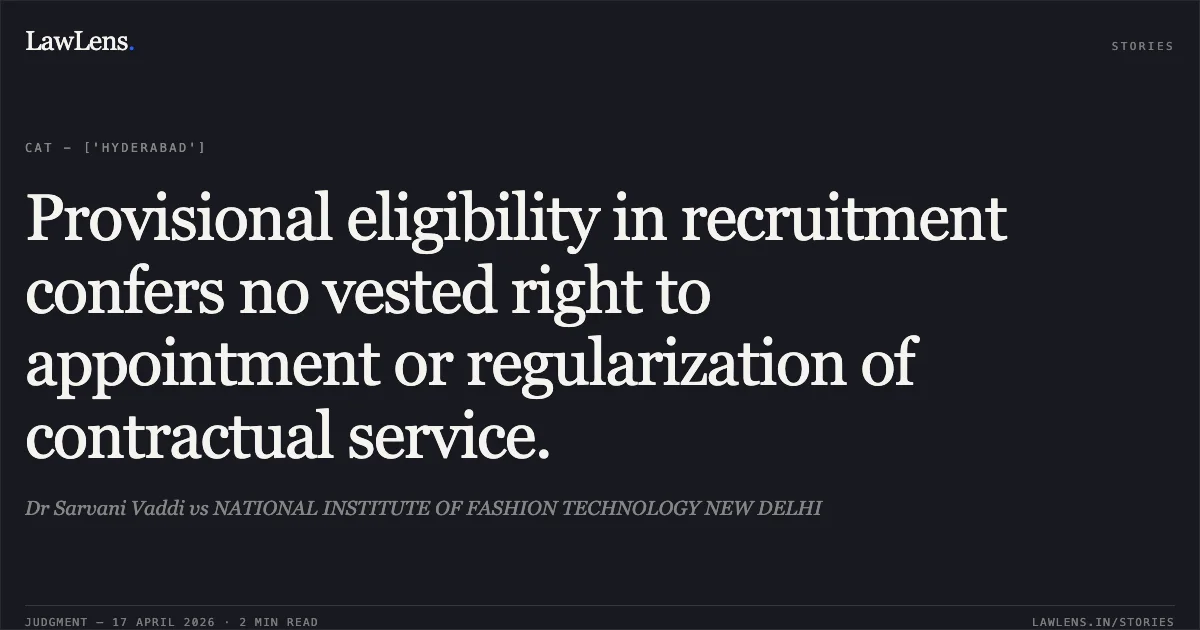
1. Whether the declaration of "provisional eligibility" in a recruitment process confers a legal right upon the applicant to be appointed to the post of Professor
Source reference: p. 122. Whether the applicant is entitled to regularization of service from 2003 despite a documented history of performance issues and the dismissal of prior litigations on the same grounds
Source reference: p. 11-12Law Applied
The court primarily applied the principles of Articles 14 and 16 of the Constitution of India regarding equality of opportunity in public employment and non-discrimination
Source reference: p. 6It relied on the doctrine that "provisional eligibility" represents a preliminary screening stage and does not constitute a final selection or a vested right to appointment
Source reference: p. 12The court also adhered to the selection criteria approved by the Board of Governors of NIFT, which mandated a weighted evaluation: Presentation (30%), Interview (30%), and Academic Work/Research (40%)
Source reference: p. 13Additionally, the principle of finality of administrative and judicial findings regarding performance was applied to the applicant’s prior failed attempts at regularization
Source reference: p. 11-12Reasoning
The Tribunal observed that the applicant's claim for regularization had already been adjudicated and dismissed in OA 06/2022, which confirmed that her contract non-renewal was justified by poor teaching quality, lack of empathy for students, and unauthorized foreign travel
Source reference: p. 11-12Regarding the new claim for appointment as Professor, the Tribunal clarified that the applicant's "provisional eligibility" was merely a status allowing her to participate in the interview process
Source reference: p. 12The court found that the respondents followed a structured, merit-based selection process involving specific weightage for presentations and interviews
Source reference: p. 13The applicant failed to clear this final assessment.
Source reference: p. 13The Tribunal noted that the applicant provided no evidence of bias or procedural irregularity to overcome the fact that she did not meet the established merit criteria for the final list
Source reference: p. 13Consequently, her lengthy service, being contractual and performance-deficient, did not entitle her to the relief sought
Source reference: p. 13Holding
The Tribunal dismissed the Original Application, holding that the applicant failed to establish any merit in her claims for regularization or appointment
It ruled that the selection process for the post of Professor was conducted lawfully and the applicant's provisional status did not guarantee employment
Source reference: p. 13The prayer for regularization was rejected as a repetitive attempt to litigate issues already decided in previous proceedings
Source reference: p. 13No order as to costs was made
Source reference: p. 13Acts & Sections Cited
1 provisions across 1 statute referred to in this judgment. Each provision opens on LawLens.
Right to Information Act, 20051
Original Court PDF
Dr Sarvani VaddivsNATIONAL INSTITUTE OF FASHION TECHNOLOGY NEW DELHI
Click to open original judgment
Original judgment, available to read, download and summarize on LawLens.in