Facts
The assessee, Cairn Energy India Pvt. Limited (now Vedanta Limited), is a non-resident company engaged in the prospecting and production of mineral oil and gas in India under a joint venture agreement with the Government of India and ONGC
Source reference: p. 5For Assessment Years (AY) 2002-03 and 2004-05, the assessee claimed deductions for "site restoration" provisions, totaling approximately ₹6.84 crore and ₹6.82 crore respectively, which were debited as operating expenses
Source reference: p. 7-8The Assessing Officer disallowed these claims, asserting they were future liabilities that were not yet incurred and were unascertainable
Source reference: p. 8The Income Tax Appellate Tribunal (ITAT) dismissed the assessee's appeal by following its own previous order for earlier years
Source reference: p. 8-9Consequently, both the assessee and the Revenue filed cross-appeals before the High Court
Source reference: p. 4Issues
1. Whether the provision for site restoration cost was an allowable deduction under Section 37(1) read with Section 42 of the Income Tax Act, 1961
Source reference: p. 6 / para. 6(i)2. Whether such provision represented an ascertained liability based on principles laid down by the Supreme Court
Source reference: p. 6 / para. 6(i)3. Whether the provision for site restoration could be treated as an "unascertained liability" for the purpose of computing book profits under Section 115-JB
Source reference: p. 7 / para. 6(ii)Law Applied
Section 37(1) of the Income Tax Act, 1961, which serves as a residuary clause for business expenditure deductions
Source reference: p. 9Bharat Earth Movers v. CIT (245 ITR 428) and Calcutta Co. Ltd. v. CIT (37 ITR 1), which establish that if a business liability has definitely arisen in the accounting year, it is deductible even if it is to be discharged at a future date, provided it is capable of being estimated with reasonable certainty
Source reference: p. 6, 8Distinguished between Section 33-ABA (incentive-based deductions requiring pre-deposit) and mandatory contractual obligations
Source reference: p. 9-10Reasoning
The Court noted that site restoration is a mandatory contractual requirement for companies engaged in petroleum exploration
Source reference: p. 10Relying on its own prior decision in T.C.A.Nos. 1299 to 1301 of 2010, the Court held that since the obligation to restore the site is certain and stems from the business contract, the provision made for it constitutes an ascertained liability rather than a contingent one
Source reference: p. 9It reasoned that while Section 33-ABA offers an incentive via pre-deposit, it does not preclude an assessee from claiming a deduction under the residuary provision of Section 37(1) for a mandatory expenditure
Source reference: p. 10Therefore, the Tribunal erred in confirming the disallowance, as the liability was not "unascertained" and met the criteria for business expenditure
Source reference: p. 10Holding
The High Court answered the substantial questions of law in favor of the assessee and against the Revenue
It held that the provision for site restoration is an allowable deduction under Section 37(1) as an ascertained business liability
Source reference: p. 10Consequently, the Court allowed the assessee’s appeals (T.C.A.Nos. 96 & 97 of 2013), dismissed the Revenue’s appeals (T.C.A.Nos. 456 & 457 of 2013), and set aside the order of the ITAT
Source reference: p. 10Acts & Sections Cited
7 provisions across 1 statute referred to in this judgment. Linked provisions open on LawLens.
Income Tax Act, 19617
Original Court PDF
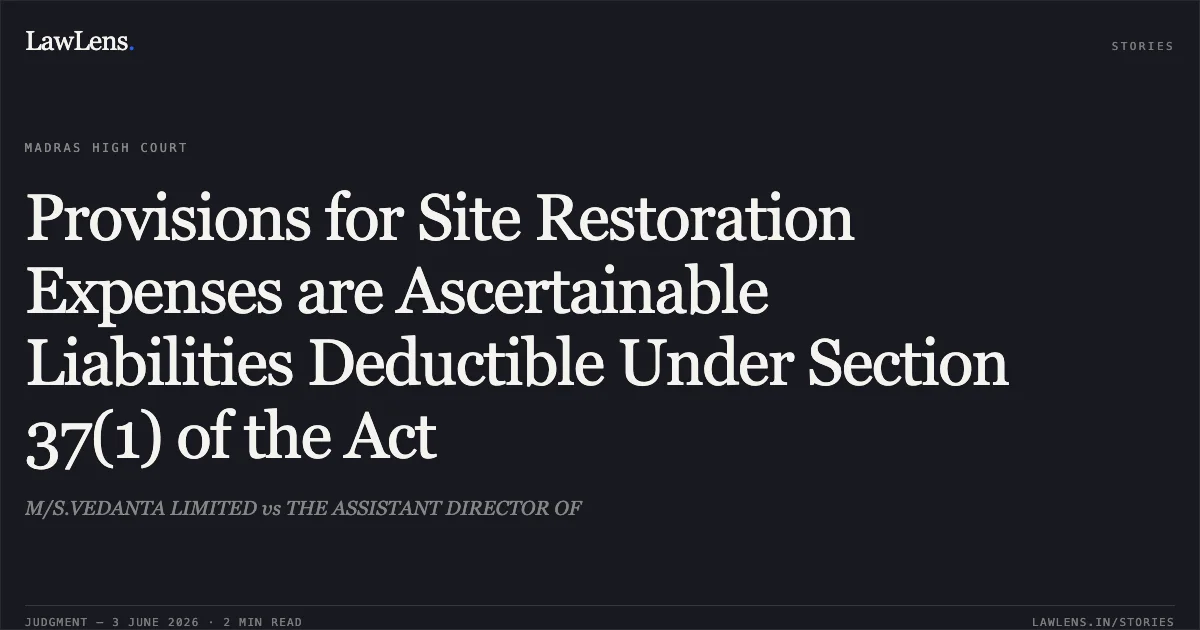
M/S.VEDANTA LIMITEDvsTHE ASSISTANT DIRECTOR OF
Click to open original judgment
Original judgment, available to read, download and summarize on LawLens.in