Facts
The respondent-assessee is a public charitable trust registered under the Bombay Public Trust Act, 1950.
Source reference: para 3.1In May 2021, the CIT(E) granted provisional registration under the Income Tax Act for AY 2020-21 to 2023-24.
Source reference: para 3.2When the trust applied for final registration under Section 12AB on April 5, 2023, the CIT(E) rejected it and cancelled the provisional registration.
Source reference: para 3.3The rejection was based on the ground that the trust's fund-raising activities—specifically coupon sales and a "mega lucky draw"—constituted business activities not incidental to its objects, violating Section 12AB(4).
Source reference: para 3.3The Income Tax Appellate Tribunal (ITAT) reversed this decision, holding that one-time fund-raising for medical equipment (Blood/Skin Banks) is not "business" and that Section 13 violations are relevant only during assessment, not registration.
Source reference: para 3.4, 3.5Issues
1. Whether a one-time fund-raising programme using lottery-style mechanics constitutes an organized business activity under Section 2(15), thereby disqualifying a trust from registration under Section 12AB(4).
Source reference: para 22. Whether the CIT(E) can invoke Section 13(1)(b) or "specified violations" under Section 12AB(4) to deny registration at the application stage, rather than during the assessment of income.
Source reference: para 2, 7Law Applied
The Court applied Section 12AB(4) of the Income Tax Act, which outlines the procedure for cancelling registration upon "specified violations".
Source reference: para 4It relied heavily on the precedent CIT (Exemption) v. United Way of Baroda (Tax Appeal No. 95 of 2020), which established that activities like organizing Garba events via ticket sales are not "trade, commerce, or business" if the dominant object is charitable and profit is not the driving force.
Source reference: para 5It further applied the principle from CIT (Exemption) v. Bayath Kutchhi Dasha Oswal Jain Mahajan Trust (2016), stating that the prohibitive provisions of Section 13 are to be examined by the Assessing Officer during assessment and are not grounds for denying registration by the Commissioner.
Source reference: para 3.5, 6Reasoning
The Court affirmed the ITAT’s findings that the trust’s activities were not business ventures. It reasoned that because the surplus funds from the "lucky draw" were utilized for buying medical equipment and establishing Blood and Skin Banks in Gujarat and Rajasthan, the activity remained incidental to the charitable objects.
Source reference: para 3.4, 6.2Applying the United Way of Baroda test, the Court found no "profit motive" or "sound business principle" that would transform a one-time fund-raiser into a commercial enterprise.
Source reference: para 5, 6.2Regarding the legal timing of such inquiries, the Court held that the CIT(E) overstepped by invoking Section 12AB(4) violations at the registration stage; such scrutiny is reserved for the assessment process where the application of income is verified.
Source reference: para 3.5, 7.0Holding
The High Court dismissed the Revenue's appeal, holding that no substantial question of law arose.
The Court answered the issues by affirming that a one-time fund-raising event for charitable purposes does not constitute a "specified violation" of business activity.
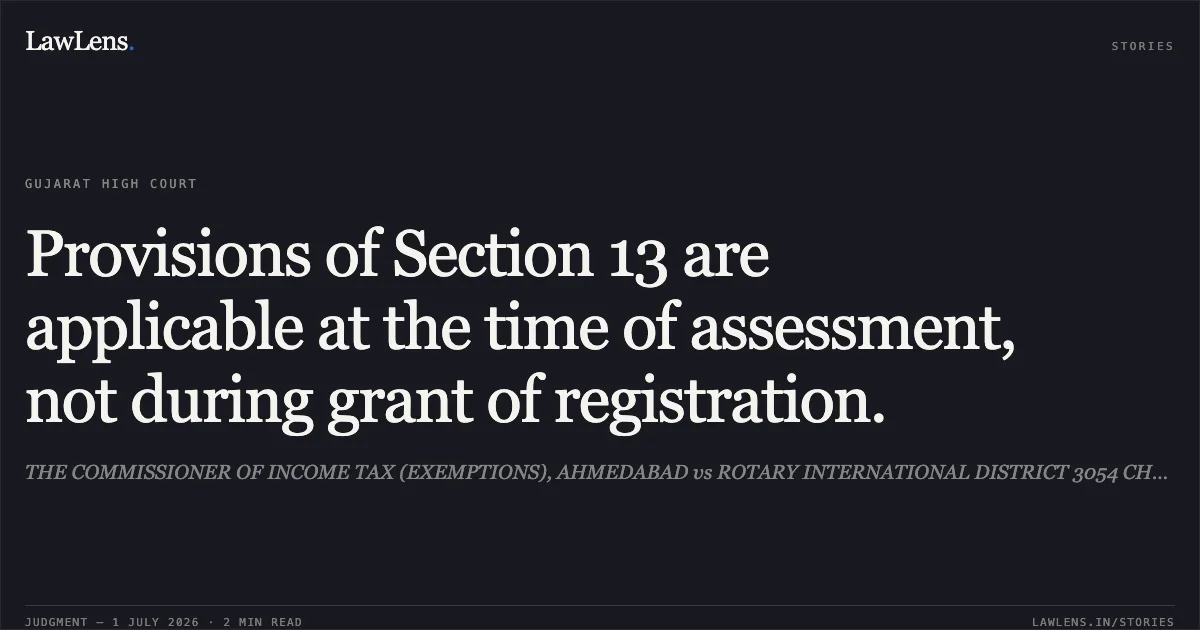
Source reference: para 6.2It upheld the holding that the eligibility for registration under Section 12AB must focus on the objects and genuineness of the trust, while statutory disqualifications under Section 13 or business-related exemptions are matters for the Assessing Officer.
Source reference: para 7Acts & Sections Cited
9 provisions across 1 statute referred to in this judgment. Linked provisions open on LawLens.
Income Tax Act, 1961
Original Court PDF
THE COMMISSIONER OF INCOME TAX (EXEMPTIONS), AHMEDABADvsROTARY INTERNATIONAL DISTRICT 3054 CHARITABLE TRUST
Click to open original judgment
Original judgment, available to read, download and summarize on LawLens.in