Facts
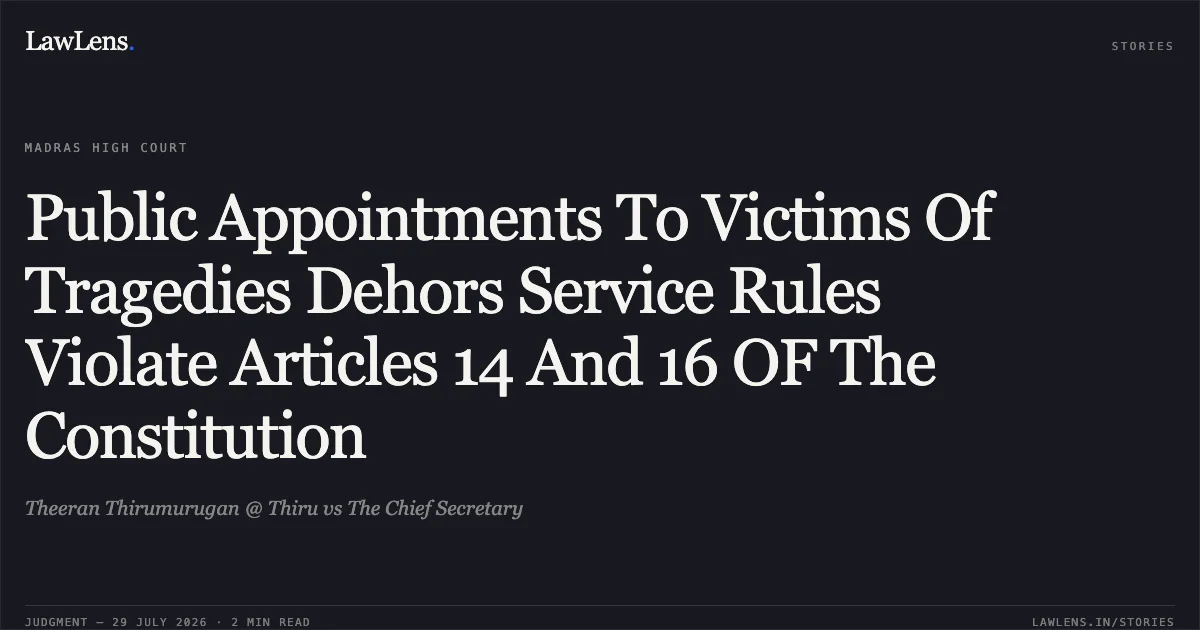
Three Public Interest Litigations (PILs) were filed seeking a Writ of Mandamus to restrain the Government of Tamil Nadu from granting public employment to the next of kin of 41 victims of the "Karur stampede"
Source reference: para 1-2The State issued G.O.Ms.No.544 on 06.07.2026, granting appointments to 32 individuals on compassionate grounds
Source reference: para 3The petitioners argued these appointments violated Articles 14 and 16, especially since an ex gratia payment of Rs. 10 Lakhs had already been disbursed
Source reference: para 2, 31The Court allowed a distribution function to proceed on 10.07.2026 only on the condition that employment would be temporary and subject to judicial review
Source reference: para 4Issues
1. Whether a Public Interest Litigation is maintainable in service matters when questioning the validity of public appointments
Source reference: para 6, 172. Whether the Court can exercise its power under Article 226 to treat a Mandamus petition as a Certiorari to strike down a Government Order not specifically challenged in the prayer
Source reference: para 163. Whether the grant of public employment to victims of a tragedy, via executive power, violates the constitutional mandate of equality and established rules for compassionate appointment
Source reference: para 52, 55Law Applied
Articles 14 and 16 of the Constitution of India, which guarantee equality before the law and equality of opportunity in public employment
Source reference: para 49-51The High Court's power under Article 226 is plenary and not bound by rigid technicalities regarding the "moulding of relief" (Dwarka Nath v. ITO; Union of India v. Bali Ram)
Source reference: para 12, para 9Canara Bank v. Ajithkumar G.K. (2025), which established that compassionate appointments are exceptions to equality rules, must strictly follow existing schemes, and require proof of indigence
Source reference: para 44-45Article 162, noting that executive power is subject to the provisions of the Constitution
Source reference: para 54-55Reasoning
The Court first dismissed the maintainability objection, holding that while PILs are generally barred in service matters involving private disputes, they are maintainable when challenging a "larger cause" involving the arbitrary distribution of public offices as largesse
Source reference: para 29-31The Court observed that unlike "fallen war heroes" or victims of "State excess" (e.g., Sterlite shooting), the Karur victims had not been proven to be in indigent circumstances following the receipt of Rs. 10 Lakhs ex gratia
Source reference: para 34, 38, 41The Court reasoned that bypass-entry appointments for one group of victims directly infringe upon the rights of those already on the official waiting list for compassionate appointment
Source reference: para 48, 52The Court found G.O.Ms.No.544 lacked subjective satisfaction regarding penury and violated the State’s own guidelines (G.O.Ms.No.18, 2020)
Source reference: para 37, 46It emphasized that public employment must be earned and cannot be thrown away as a largesse by the State under Article 162
Source reference: para 56, 60Holding
The Court allowed the Writ Petitions and issued a Writ of Certiorari striking down G.O.Ms.No.544 (dated 06.07.2026) and the amendatory G.O.Ms.No.558 (dated 09.07.2026)
The appointments were in direct violation of the fundamental rights guaranteed under Articles 14 and 16 of the Constitution; those granted employment could not claim vested interest as the appointments were made expressly subject to judicial review before the disbursement of the first salary
Source reference: para 52, para 4, 62Original Court PDF
Theeran Thirumurugan @ ThiruvsThe Chief Secretary
Click to open original judgment
Original judgment, available to read, download and summarize on LawLens.in