Facts
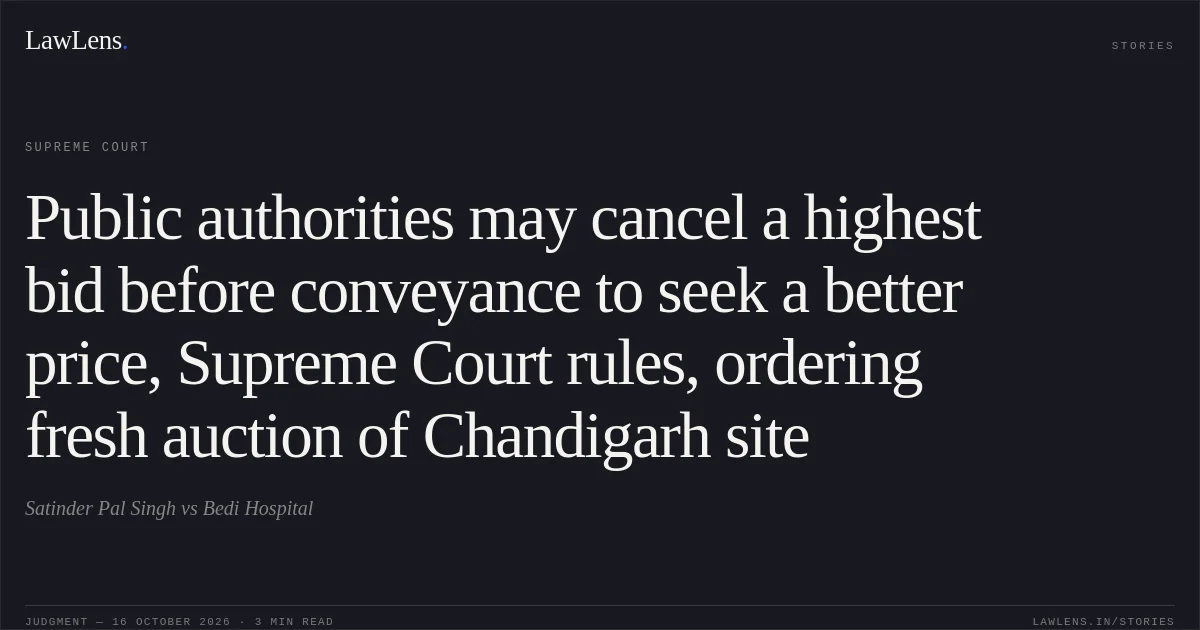
The Chandigarh Administration auctioned two nursing-home sites in Sector 33C, Chandigarh.
Source reference: p. 2–4, paras. 3–8Bedi Hospital was declared the highest bidder for Site No. 4 at ₹12.58 crore, paid the full amount, and received an Agreement to Sell.
Source reference: p. 2–4, paras. 3–8Before issuing the allotment letter or executing a conveyance deed, the Administration cancelled the bid contract and Agreement to Sell, reasoning that the adjacent, similarly sized Site No. 3 had fetched ₹18.25 crore and that Site No. 4’s bid did not reflect market trends; it refunded Bedi Hospital’s payment and proposed re-auction.
Source reference: p. 2–4, paras. 3–8Bedi Hospital challenged the cancellation in the High Court.
Source reference: p. 4–6, paras. 9–11While the writ petition was pending, the Administration conducted a fresh auction pursuant to the High Court’s interim order; the appellant became the highest bidder at ₹18.30 crore, while Bedi Hospital did not participate.
Source reference: p. 4–6, paras. 9–11The High Court allowed Bedi Hospital’s petition and quashed the cancellation letters.
Source reference: p. 6, para. 12The appellant and the Administration appealed.
Source reference: p. 6, para. 12Issues
1. Whether the Administration could cancel the bid contract and Agreement to Sell before issuing an allotment letter and executing a conveyance deed, in order to secure a better price for public property.
Source reference: pp. 11–14, paras. 19–202. Whether the subsequent auction and the rights arising from it could be disregarded when deciding Bedi Hospital’s challenge to the cancellation.
Source reference: pp. 16–18, paras. 24–27Law Applied
Rule 5 of the Chandigarh Estate Rules, 2007, framed under Sections 3 and 22 of the Capital of Punjab (Development and Regulation) Act, 1952, and the applicable e-auction terms permit the Estate Officer to withdraw a site or reject the highest bid before completion of the allotment process; the rules provide for an allotment letter after receipt of the full consideration, followed by execution of the conveyance deed.
Source reference: pp. 7–11, 15, paras. 15–18The Court held that the Agreement to Sell, in the circumstances, was not itself an enforceable contract under Section 2(h) of the Indian Contract Act, 1872; absent an allotment letter and conveyance deed, the Administration could exercise its reserved power to revisit the auction, subject to the public-law requirement that its action not be arbitrary or unreasonable.
Source reference: pp. 11–14, paras. 19–20In a sale of public property, securing the best price is a dominant consideration, and a fresh auction may be justified to maximise price before an enforceable contract is concluded, consistent with *Chairman and Managing Director, SIPCOT v. Contromix Pvt. Ltd.*, (1995) 4 SCC 595.
Source reference: p. 13, para. 20The Court distinguished *Vice-Chairman and Managing Director, CIDCO v. Shishir Realty Pvt. Ltd.*, (2022) 16 SCC 527, and *Golden Food Products India v. State of Uttar Pradesh & Ors.*, 2026 SCC OnLine 24, on their facts.
Source reference: pp. 14–15, para. 21Reasoning
The Administration cancelled the bid before issuing the allotment letter or executing the conveyance deed, and the applicable rules and auction conditions reserved its power to withdraw the site or reject the bid at that stage.
Source reference: pp. 12–15, paras. 19–21The Court considered the substantial difference between the bids for the adjacent sites a relevant basis for seeking price maximisation; the Administration gave Bedi Hospital the reason for cancellation, refunded the full amount, and invited it to participate in the fresh auction.
Source reference: pp. 12–15, paras. 19–21However, the High Court’s interim arrangement permitted a fresh auction, which concluded with the appellant’s bid of ₹18.30 crore.
Source reference: pp. 16–18, paras. 24–27Because the High Court did not consider the consequences of that completed auction, and because the subsequent price discovery materially affected the public interest, the Court concluded that a fresh auction—not restoration of Bedi Hospital’s earlier bid or substitution by its offer to match the appellant’s price—was the appropriate outcome.
Source reference: pp. 16–18, paras. 24–27Holding
The Court allowed the appeals and set aside the High Court’s judgment.
It directed the Chandigarh Administration to conduct a fresh e-auction for Site No. 4, Sector 33C, in accordance with the Chandigarh Estate Rules, 2007, and to commence and conclude the process within three months.
Source reference: p. 18, para. 28No order as to costs was made.
Source reference: p. 18, para. 29Acts & Sections Cited
1 provisions across 1 statute referred to in this judgment. Each provision opens on LawLens.
Indian Contract Act, 18721
Original Court PDF
Satinder Pal SinghvsBedi Hospital
Click to open original judgment
Original judgment, available to read, download and summarize on LawLens.in