Facts
Pursuant to administrative approval, technical sanction, and a successful bidding process, the petitioner was issued a work order dated 29.08.2017 for construction of the proposed office building for all CHC Office Complexes in Kokrajhar District under the One Time Special Grant for 2017–2018, at a bid amount of ₹10,62,31,000.
Source reference: p. 3The petitioner claimed to have completed and handed over the work, supported by a Completion Certificate and a Handing Over and Taking Over Certificate issued by the respondent authorities.
Source reference: p. 3Against bills amounting to ₹8,02,86,449, the petitioner was paid ₹4,82,68,911, leaving an alleged balance of ₹3,20,17,538.
Source reference: p. 3After an unsuccessful representation dated 09.08.2024 seeking payment of the outstanding amount, the petitioner approached the Gauhati High Court under Article 226 of the Constitution.
Source reference: p. 3The BTC authorities contended that completion of the work and the petitioner’s actual entitlement required verification.
Source reference: p. 4Issues
1. Whether the respondent authorities were required to verify whether the petitioner had completed the contracted works in accordance with the work order.
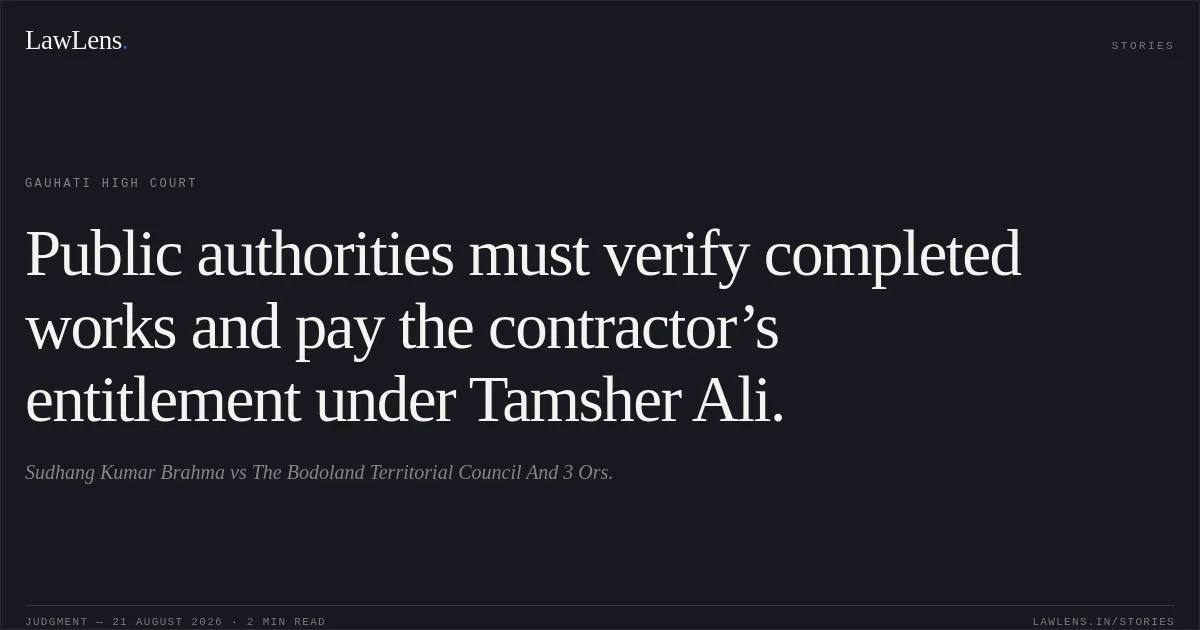
Source reference: pp. 4–52. Whether, upon such verification, the petitioner was entitled to payment of any outstanding amount, and whether such payment should be made in accordance with Tamsher Ali v. State of Assam, 2008 (4) GLT 1.
Source reference: pp. 4–5Law Applied
The Court exercised its jurisdiction under Article 226 of the Constitution to secure a fair consideration of the petitioner’s claim for payment.
Source reference: pp. 3–5It applied the principle that, where the contractor’s completion of works and precise monetary entitlement are disputed or require factual verification, the competent departmental authorities should first verify the execution of the work and ascertain the amount lawfully payable.
Source reference: pp. 3–5The Court directed that any amount found payable be released in accordance with the Full Bench decision in Tamsher Ali and Others v. State of Assam and Others, 2008 (4) GLT 1.
Source reference: pp. 3–5Reasoning
The Court noted that the petitioner relied on the Completion Certificate, Handing Over and Taking Over Certificate, submitted bills, and the alleged unpaid balance.
Source reference: p. 3However, the BTC disputed that the petitioner’s completion of the works and exact entitlement could be accepted without departmental verification.
Source reference: p. 4Since determination of the completed work and the amount payable required factual examination by the technical authorities, the Court considered it appropriate not to directly order payment of the claimed sum.
Source reference: pp. 4–5Instead, it directed Respondent Nos. 2, 3, and 4 to verify compliance with the work order and calculate the petitioner’s actual entitlement, applying the principles in Tamsher Ali if any amount was found due.
Source reference: pp. 4–5Holding
The writ petition was disposed of with a direction to Respondent Nos. 2, 3, and 4 to verify whether the petitioner had completed the works in accordance with the work order and to ascertain the amount, if any, payable to him.
The verification was to be completed within one month from service of a certified copy of the order upon Respondent No. 1.
Source reference: p. 5Any amount found payable was directed to be released in accordance with Tamsher Ali, 2008 (4) GLT 1.
Source reference: p. 5Original Court PDF
Sudhang Kumar BrahmavsThe Bodoland Territorial Council And 3 Ors.
Click to open original judgment
Original judgment, available to read, download and summarize on LawLens.in