Facts
The petitioner, a proprietorship concern, was awarded the work of “Construction of Marketing Shed at Kawaimari under Lawkhowa Development Block,” valued at ₹1,80,00,000.
Source reference: p.2–3It claimed to have completed approximately 55% of the work and incurred expenditure of ₹97,23,640, for which a Running Account Bill was acknowledged by the Chief Executive Officer, Nagaon Zila Parishad, on 16 March 2016.
Source reference: p.2–3As payment was not released, the petitioner earlier instituted WP(C) No. 3413/2017.
Source reference: p.3By order dated 24 November 2023, the High Court directed the Secretary, Panchayat & Rural Development Department, to verify the petitioner’s entitlement and disburse the amount due within four months of receipt of the certified order.
Source reference: p.3The petitioner served the order on the authorities on 5 December 2023, but neither verification nor payment was made, leading to the present writ petition under Article 226 of the Constitution.
Source reference: p.3–4The respondents did not deny the award of the work but submitted that the petitioner’s entitlement required verification.
Source reference: p.4Issues
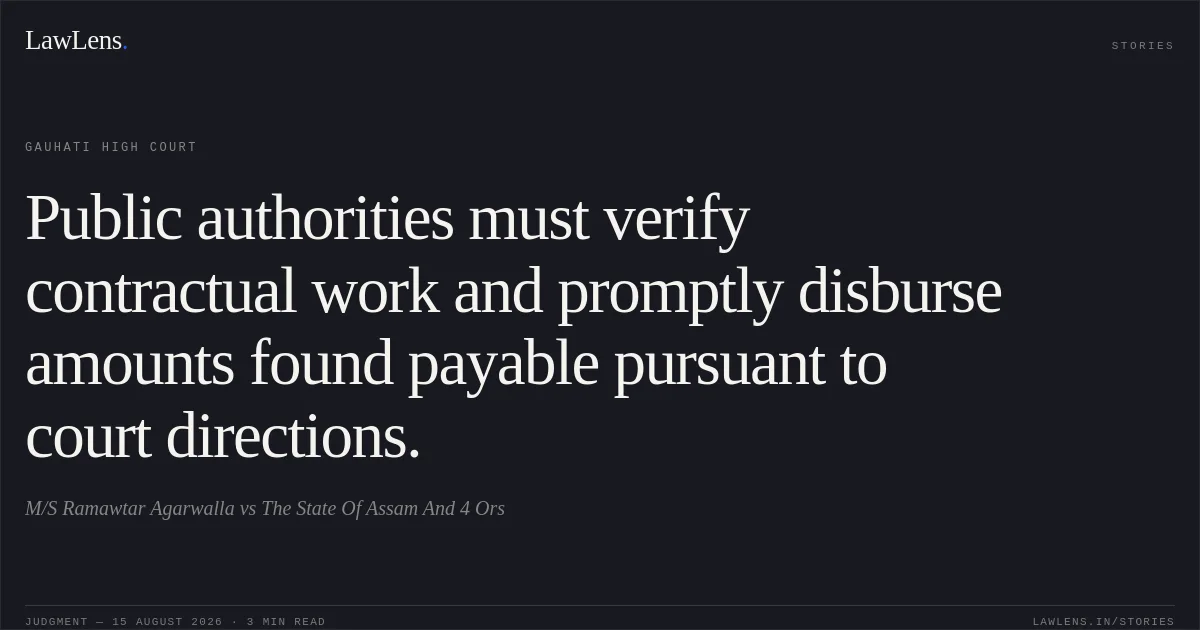
Whether the respondent authorities were required to verify the petitioner’s claim for payment for the work executed and release the amount found payable
Source reference: p.4–6 / paras. 5–7Whether the respondents’ failure to comply with the earlier order dated 24 November 2023 justified further directions under Article 226 of the Constitution
Source reference: p.5–6 / para. 6Law Applied
The Court exercised its jurisdiction under Article 226 of the Constitution to require public authorities to perform their legal and administrative obligations and to enforce compliance with its earlier directions.
Source reference: p.4–6 / paras. 5–7The governing principle was that a contractor is entitled to payment for work actually executed and certified or found payable upon verification, while the authorities may verify the extent of work and the amount due before disbursement.
Source reference: p.4–6 / paras. 5–7The Court further applied the principle that deliberate or unexplained non-compliance with a prior judicial direction constitutes a serious failure of public duty and warrants appropriate supervisory directions.
Source reference: p.5 / para. 6No specific statutory provision or judicial precedent was cited.
Source reference: no citationReasoning
The Court accepted that the petitioner had been awarded the construction work and that its claim could not be rejected without verification, particularly since the respondents had not filed an affidavit denying the material allegations.
Source reference: p.4–5 / para. 6Although the respondents contended that entitlement depended on verification, the Court noted that verification had already been directed in the earlier writ proceedings but had neither been undertaken nor followed by payment.
Source reference: p.4–5 / para. 6Accordingly, the Court treated the matter not merely as delayed payment under a contract but also as a case of disregard of an earlier judicial order.
Source reference: p.5–6 / para. 7It therefore directed the competent authorities to verify the petitioner’s entitlement and act within defined timelines.
Source reference: p.5–6 / para. 7Holding
The writ petition was disposed of with directions to Respondent Nos. 2 to 5 to verify the amount payable to the petitioner for the work executed.
The verification was to be completed within one month of service of the certified judgment upon the Commissioner, Panchayat & Rural Development Department.
Source reference: p.5–6 / para. 7(i)–(ii)If any amount was found payable, it was to be released within five months after completion of verification, with no delay beyond six months from service of the certified judgment.
Source reference: p.6 / para. 7(iii)–(iv)If the petitioner was found entitled to no amount or to a lesser amount than claimed, it was to be informed within one month.
Source reference: p.6 / para. 7(iii)–(iv)The Commissioner was further directed to file an affidavit of compliance within eight months, failing which the matter would be placed before the Court for further orders.
Source reference: p.6–7 / para. 7(v)Original Court PDF
M/S Ramawtar AgarwallavsThe State Of Assam And 4 Ors
Click to open original judgment
Original judgment, available to read, download and summarize on LawLens.in