Facts
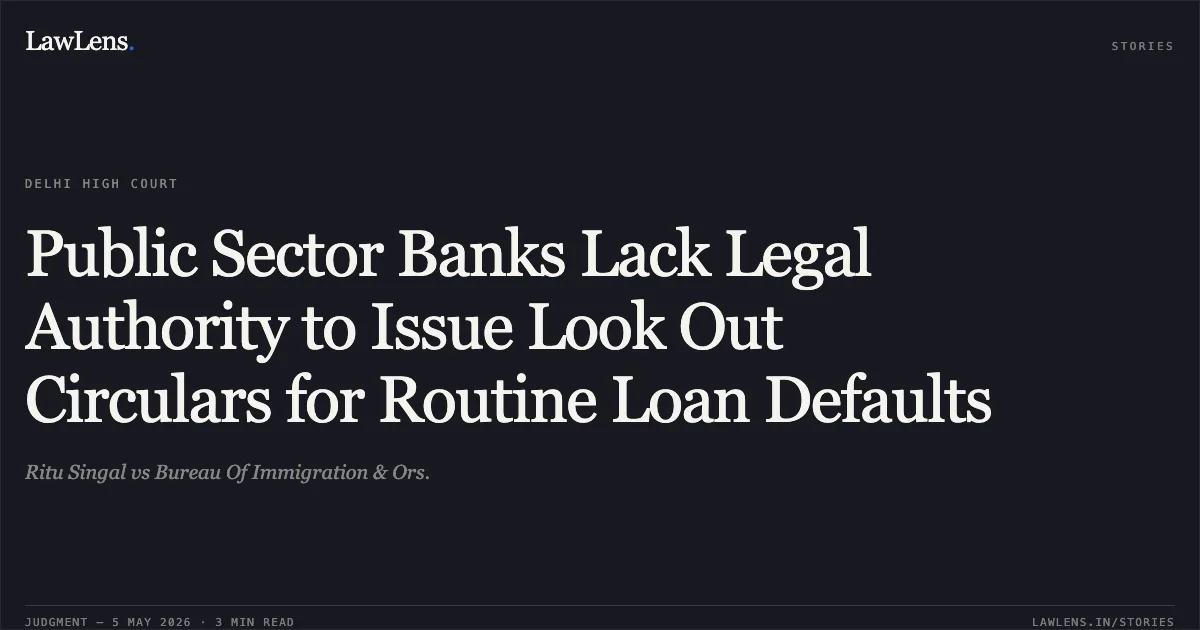
This batch of 33 writ petitions challenged the legality of Look Out Circulars (LOCs) issued against various individuals.
Source reference: p. 17The petitioners were categorized into three groups: (A) LOCs issued solely by Public Sector Banks (PSBs) for loan defaults; (B) LOCs issued by investigating agencies (CBI, ED, SFIO) or the Income Tax Department; and (C) cases where criminal chargesheets had already been filed in trial courts.
Source reference: p. 18In most cases, petitioners were prevented from traveling abroad despite no evidence of absconding; many had traveled previously under interim court orders and returned as directed.
Source reference: p. 17-18Issues
1. Whether the issuance and continuation of LOCs, as a coercive executive measure, is legally sustainable when it restricts the fundamental right to travel abroad under Article 21
Source reference: p. 17 / para. 12. Whether Public Sector Banks (PSBs) possess the legal authority to request LOCs against defaulting borrowers in the absence of a cognizable criminal offence
Source reference: p. 25-26 / para. 213. Whether the phrase "detrimental to the economic interests of India" can be invoked for individual commercial defaults or bank loan failures
Source reference: p. 27 / para. 244. Whether a Writ Court should intervene when a chargesheet is already pending before a Trial Court
Source reference: p. 65-66 / para. 142-143Law Applied
The court primarily applied Article 21 of the Constitution, asserting that the right to travel abroad is a fundamental facet of personal liberty.
Source reference: p. 19It relied on the "Triple Test" from Maneka Gandhi v. Union of India (law, fair procedure, and non-violation of other rights).
Source reference: p. 19The court applied the framework from Sumer Singh Salkan v. Asst. Director, which restricts LOCs to cognizable offences where the accused is evading arrest.
Source reference: p. 21Following Viraj Chetan Shah v. Union of India (Bombay HC) and Bank of Baroda v. Sahil Chugh (Delhi HC), the court held that PSBs lack the authority to trigger LOCs.
Source reference: p. 25-27It further held that "economic interest" must involve grave systemic impact, not routine defaults, as per the MHA Office Memorandum (2021).
Source reference: p. 23, 27Reasoning
The court reasoned that an LOC is a measure of "last resort" and cannot be used as an "arm-twisting tactic" for debt recovery.
Source reference: p. 33For Category A (Banks), the court found that Clause 6(B)(xv) of the 2021 OM, which empowered PSBs, had been judicially invalidated; therefore, LOCs based solely on bank requests without criminal proceedings were void ab initio.
Source reference: p. 33-35For Category B (Agencies), the court observed that where petitioners had cooperated, were not named as accused, or where investigations had stagnated without charges, the continuation of LOCs was disproportionate and lacked "contemporaneous justification".
Source reference: p. 31, 57For Category C, the court applied the principle of institutional primacy, noting that once a Trial Court is seized of a chargesheet, it is the competent forum to decide on coercive measures like LOCs under its jurisdiction to cancel NBWs.
Source reference: p. 66-67, 71Holding
The Court quashed the LOCs in Categories A and B (29 petitions), holding that the right to travel cannot be curtailed by executive fiat for civil defaults.
In Category C (4 petitions: Neeraj Singal, Ritu Singal, Kunwer Sachdev, Dharamvir Singh), the Court refused to quash the LOCs but relegated the petitioners to the respective Trial Courts where chargesheets were pending to seek modification or cancellation.
Source reference: p. 71-72Petitioners in Categories A and B were permitted to travel subject to notifying the agencies/banks 48 hours in advance; The Bureau of Immigration was directed to update its records accordingly.
Source reference: p. 51, 63, 52, 64Acts & Sections Cited
8 provisions across 4 statutes referred to in this judgment. Each provision opens on LawLens.
Indian Penal Code, 18602
Prevention of Corruption Act, 19881
Companies Act, 20134
Insolvency and Bankruptcy Code, 2016.1
Original Court PDF
Ritu SingalvsBureau Of Immigration & Ors.
Click to open original judgment
Original judgment, available to read, download and summarize on LawLens.in