Facts
The respondent claimed that he worked as a daily-wage peon with UCO Bank from 9 November 1988 to 9 May 1997, including service at the Bank’s Divisional Office, Habibganj Branch and Arera Colony Branch, and that his services were terminated without notice from 10 May 1997.
Source reference: para. 3He applied for gratuity under Section 7 of the Payment of Gratuity Act, 1972.
Source reference: para. 3The Controlling Authority directed the Bank to pay ₹7,800 with 9% interest by order dated 23 September 2008.
Source reference: para. 3On appeal, the Appellate Authority set aside that order on 20 April 2009, holding that the respondent had not proved continuous service under Section 2A and that the claim was delayed by approximately nine years.
Source reference: para. 4The writ court subsequently quashed the Appellate Authority’s order and restored the Controlling Authority’s order, leading the Bank to file the present writ appeal.
Source reference: paras. 3–4The Bank also relied on subsequent CGIT proceedings concerning the respondent’s termination and service as a daily wager.
Source reference: para. 6Issues
Whether the writ court was justified in setting aside the Appellate Authority’s order and restoring the Controlling Authority’s direction for payment of gratuity despite the Bank’s objections regarding continuous service and delay.
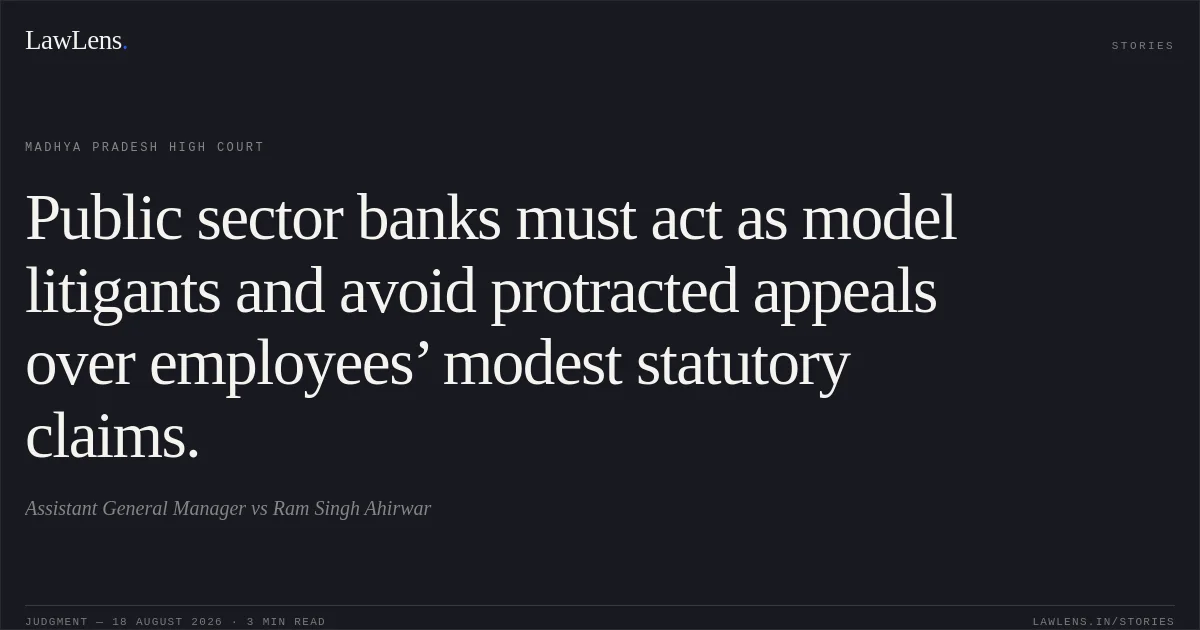
Source reference: paras. 4–5, 8–9Whether the Bank’s writ appeal against payment of ₹7,800 to a Class-IV employee warranted interference by the appellate court, particularly in light of the obligation of public-sector instrumentalities to act as model litigants.
Source reference: para. 9Law Applied
The Court applied the Payment of Gratuity Act, 1972, particularly Section 2A concerning continuous service, Section 4 concerning entitlement to gratuity, and Section 7 concerning the procedure for claiming gratuity.
Source reference: paras. 4–5It relied on the model-litigant principle governing State instrumentalities and public-sector bodies, as stated in Urban Improvement Trust, Bikaner v. Mohan Lal, (2010) 1 SCC 512, which requires public bodies to avoid frivolous or unnecessary litigation.
Source reference: para. 9Dilbagh Rai Jarry v. Union of India, (1974) 3 SCC 554, cautions State instrumentalities against litigating like private parties merely because public funds are available.
Source reference: para. 9Reasoning
The Court noted that the Appellate Authority had rejected the gratuity claim principally on the grounds of delay and alleged failure to establish continuous service, resulting in the respondent’s continued litigation before the High Court.
Source reference: para. 9Although the Bank reiterated objections based on Section 2A, limitation, the respondent’s status as an employee, and the authority of the association representing him, the Court focused on the Bank’s conduct in pursuing multi-tiered litigation over a relatively small gratuity amount.
Source reference: para. 5Applying the model-litigant principle, the Court held that a public-sector bank should take a responsible decision on the merits and should not prolong litigation merely to avoid administrative accountability or audit objections.
Source reference: para. 9The Court therefore found no justification to interfere with the writ court’s restoration of the Controlling Authority’s order.
Source reference: para. 9Holding
The application for condonation of 47 days’ delay was allowed.
The writ appeal was dismissed, thereby leaving undisturbed the writ court’s order dated 3 February 2026 and the Controlling Authority’s direction dated 23 September 2008 requiring UCO Bank to pay ₹7,800 with 9% interest to the respondent.
Source reference: paras. 3–4, 10The Court further directed that a copy of the order be sent to the Bank’s Chairman-cum-Managing Director for issuing instructions to its branches or framing a comprehensive litigation policy to prevent and control frivolous litigation.
Source reference: para. 10Acts & Sections Cited
4 provisions across 1 statute referred to in this judgment. Linked provisions open on LawLens.
PAYMENT OF GRATUITY ACT, 19724
Original Court PDF
Assistant General ManagervsRam Singh Ahirwar
Click to open original judgment
Original judgment, available to read, download and summarize on LawLens.in