Facts
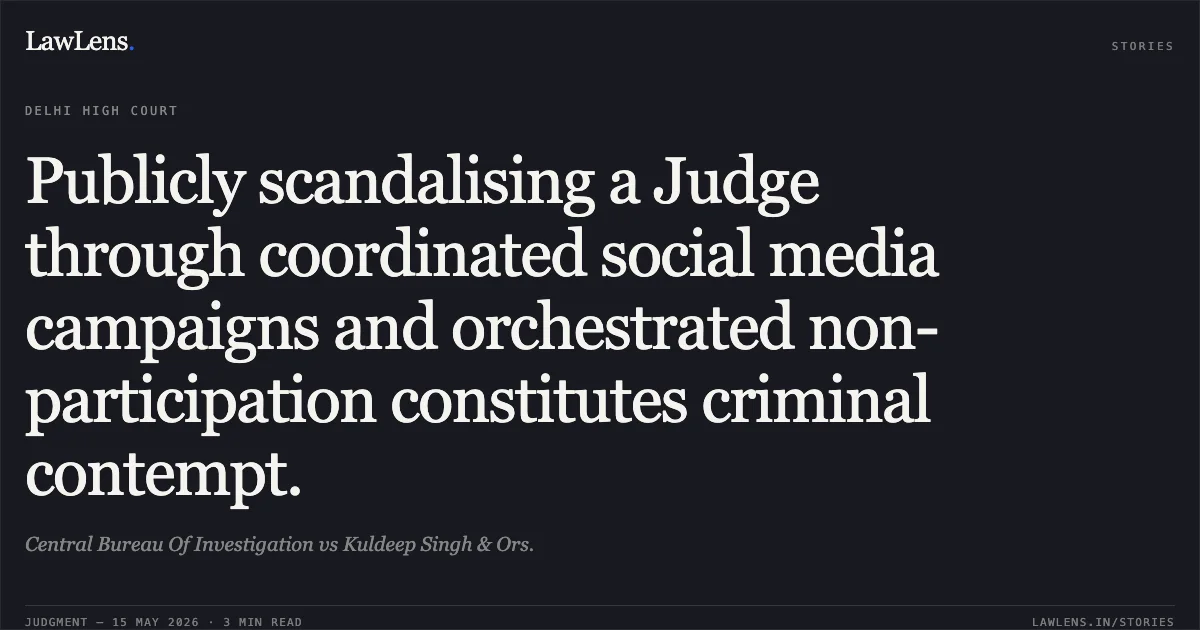
Following the rejection of a judicial recusal application on 20.04.2026, several respondents—primarily high-ranking political figures—and their associates initiated an organized social media campaign against the presiding judge
Source reference: paras. 1-6The material included public letters, press conferences, and truncated/edited videos of the Judge delivering an academic lecture in Varanasi, falsely framed as a political event
Source reference: paras. 7, 70-72Respondent No. 18 (Arvind Kejriwal) published a letter on social media platform ‘X’ declaring the court biased and announcing his refusal to participate in further proceedings under the guise of "Satyagraha"
Source reference: paras. 40-42, 47Similar declarations were made by Respondents No. 8 and 19
Source reference: paras. 57-58Various party functionaries posted insinuations regarding the Judge’s integrity and alleged political affiliations
Source reference: paras. 62, 78, 85Consequently, the Court took suo motu cognizance of criminal contempt while hearing the main revision petition
Source reference: para. 27Issues
1. Whether the organized publication of social media content and public declarations of non-participation by the respondents amount to "criminal contempt" by scandalizing the court or obstructing the administration of justice under Section 2(c) of the Contempt of Courts Act, 1971
Source reference: para. 562. Whether judicial propriety requires the presiding judge to transfer the main revision petition to another bench after initiating contempt proceedings against the respondents in that case
Source reference: paras. 132-135Law Applied
Section 2(c) of the Contempt of Courts Act, 1971, which defines criminal contempt as any act or publication that scandalizes, lowers the authority of the court, or obstructs the administration of justice
Source reference: para. 26Precedent in Brahma Prakash Sharma v. State of Uttar Pradesh, distinguishing between personal libel of a judge and contempt that causes public injury by shaking confidence in the judiciary
Source reference: para. 28The "clear and present danger" to the administration of justice test from Haridas Das v. Usha Rani Banik
Source reference: para. 29Principles from In re: Prashant Bhushan (2021), holding that malicious attacks on the judiciary as an institution must be dealt with firmly to protect the bedrock of rule of law
Source reference: para. 30Court On Its Own Motion v. Shiv Narayan Sharma (2026) regarding scandalous YouTube content
Source reference: para. 31Reasoning
The Court reasoned that the respondents' actions were not "fair criticism" but a "calculated campaign of vilification" intended to achieve a forum-hunt through intimidation
Source reference: paras. 7, 100By circulating a truncated video of an academic lecture to falsely imply political patronage, the proposed contemnors deliberately manufactured a narrative of bias
Source reference: paras. 71-75The Court observed that Respondent No. 18’s public declaration that justice could not be expected and his refusal to participate in the trial traveled beyond personal choice, threatening to cause "anarchy" if other litigants followed such a path
Source reference: paras. 50-52The statements made by Saurabh Bhardwaj and Vinayy Mishra questioning the "relationship" between the Judge and a political party were found to be direct attacks on judicial independence
Source reference: paras. 81, 88The Court analyzed the movement termed "Satyagraha" as a "cleverly clothed" attempt to derail the system, noting that truth should be taken to a higher court, not the "marketplace of public narratives"
Source reference: paras. 124-126Holding
The Court held that the acts of the proposed contemnors prima facie constitute criminal contempt as they were calculated to scandalize the institution, lower its authority, and intimidate the independent exercise of judicial functions
The Court initiated suo motu criminal contempt proceedings and directed the Registry to place the matter before the Hon’ble Chief Justice for assignment to an appropriate Bench for the issuance of show-cause notices. Simultaneously, as a matter of judicial propriety and to ensure a fair trial—lest the contemnors claim further bias—the Court directed that the main revision petition (CRL.REV.P. 134/2026) be transferred to another Bench.
Source reference: paras. 135, 139, 140Acts & Sections Cited
3 provisions across 2 statutes referred to in this judgment. Each provision opens on LawLens.
Contempt of Courts Act, 19712
Code of Criminal Procedure, 19731
Original Court PDF
Central Bureau Of InvestigationvsKuldeep Singh & Ors.
Click to open original judgment
Original judgment, available to read, download and summarize on LawLens.in


