Facts
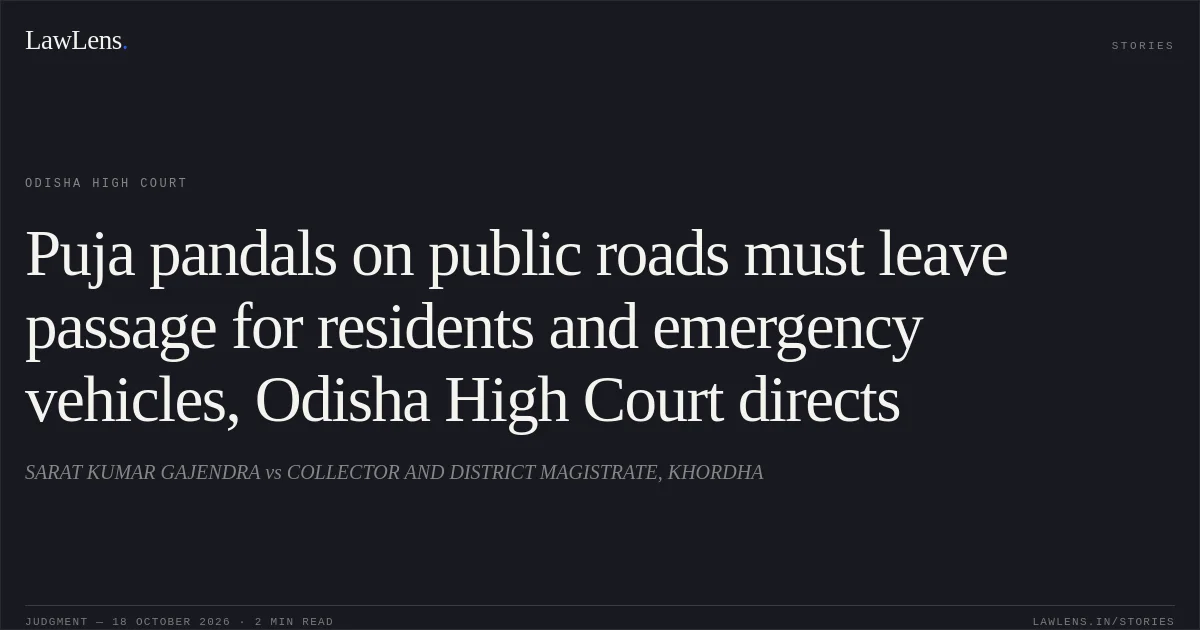
The petitioner filed a public interest litigation alleging that a temporary Ganesh or Durga Puja pandal, situated about 50 metres from his house, completely blocked the road and prevented access to his home.
Source reference: para. 15The State’s affidavits stated that a 22-foot passage remained open for vehicular movement and that permissions for festivals required the road not to be blocked entirely.
Source reference: paras. 16, 18Local residents sought to intervene in support of the festivals.
Source reference: para. 18The petitioner disputed the State’s account.
Source reference: paras. 17, 19Issues
Whether the religious festival and temporary pandal could be permitted on a public road consistently with residents’ rights of access and movement.
Source reference: paras. 13–14, 19–21Whether the petitioner had established a basis for a writ of mandamus to stop or restrict the festival.
Source reference: paras. 19–20Law Applied
Article 25(1) protects freedom of conscience and the right to profess, practise and propagate religion, subject to public order, morality, health and the other provisions of Part III of the Constitution.
Source reference: paras. 7–9The Court read that guarantee alongside the rights to movement and life under Articles 19 and 21, and recognised the State’s authority concerning public order under Entry 1 of the State List.
Source reference: paras. 3, 8, 13–14It held that religious festivals may be accommodated on public roads, but permissions must preserve reasonable access and movement, including passage for emergency vehicles, and comply with applicable sound limits and time restrictions.
Source reference: paras. 14, 20–22The Court also relied on *Tarak Singh v. Jyoti Basu*, (2005) 1 SCC 201, for the proposition that public interest prevails over conflicting private interest.
Source reference: para. 6It referred to Government guidelines and statutory provisions concerning festival permissions, without identifying them by name.
Source reference: paras. 14, 20Reasoning
The Court balanced the petitioner’s asserted loss of access against the community’s interest in conducting religious festivals.
Source reference: no citationIt accepted the State’s account that the road was not entirely blocked and that a 22-foot passage remained for vehicular movement, while emphasising the State’s duty to preserve residents’ ingress and egress.
Source reference: paras. 16–18In the Court’s view, the asserted obstruction did not justify stopping the festival where access remained available; however, permissions had to ensure adequate space for ordinary and emergency movement and compliance with sound and timing limits.
Source reference: paras. 19–22Holding
The Court declined to issue a writ of mandamus and disposed of the petition with observations and directions.
It directed the Government, when granting permissions for religious festivals, to prevent complete disruption of vehicular movement, preserve residents’ ingress and egress, maintain adequate passage for emergency vehicles, and enforce applicable sound limits and deadlines.
Source reference: paras. 21–22Original Court PDF
SARAT KUMAR GAJENDRAvsCOLLECTOR AND DISTRICT MAGISTRATE, KHORDHA
Click to open original judgment
Original judgment, available to read, download and summarize on LawLens.in