Facts
The petitioner, initially appointed as Assistant Grade-III on compassionate grounds and later promoted to Assistant Grade-II in 2009, was subjected to a disciplinary inquiry regarding misconduct
Source reference: para. 2On 29.11.2002, respondent no. 4 passed an order imposing a punishment of stoppage of four increments with cumulative effect
Source reference: para. 3The petitioner accepted this punishment without objection for over two decades, only filing an appeal on 31.01.2025
Source reference: para. 4Respondent no. 3 dismissed the appeal on 02.06.2025 on the grounds of limitation, as it was filed after a delay of 23 years against the prescribed 45-day period
Source reference: para. 4The petitioner subsequently filed this writ petition challenging both the original punishment order and the appellate order
Source reference: para. 1Issues
1. Whether the writ petition is barred by the doctrine of delay and laches given the 23-year interval between the punishment order and its challenge
Source reference: para. 7-82. Whether an order for stoppage of increments constitutes a "recurring cause of action" that exempts the petitioner from the laws of limitation
Source reference: para. 13Law Applied
The court applied the doctrine of delay and laches governing discretionary powers under Article 226 of the Constitution
Source reference: para. 8It relied on Karnataka Power Corporation Ltd. v. K. Thangappan (2006) 4 SCC 322, which holds that High Courts may refuse extraordinary powers if negligence or omission to assert rights causes prejudice to the opposite party
Source reference: para. 8The court cited State of M.P. v. Nandlal Jaiswal (1986) 4 SCC 566, establishing that writ jurisdiction does not assist the "tardy and the indolent"
Source reference: para. 9The court cited Chennai Metropolitan Water Supply & Sewerage Board v. T.T. Murali Babu (2014) 4 SCC 108, which emphasizes that delay reflects inactivity and "procrastination is the greatest thief of time"
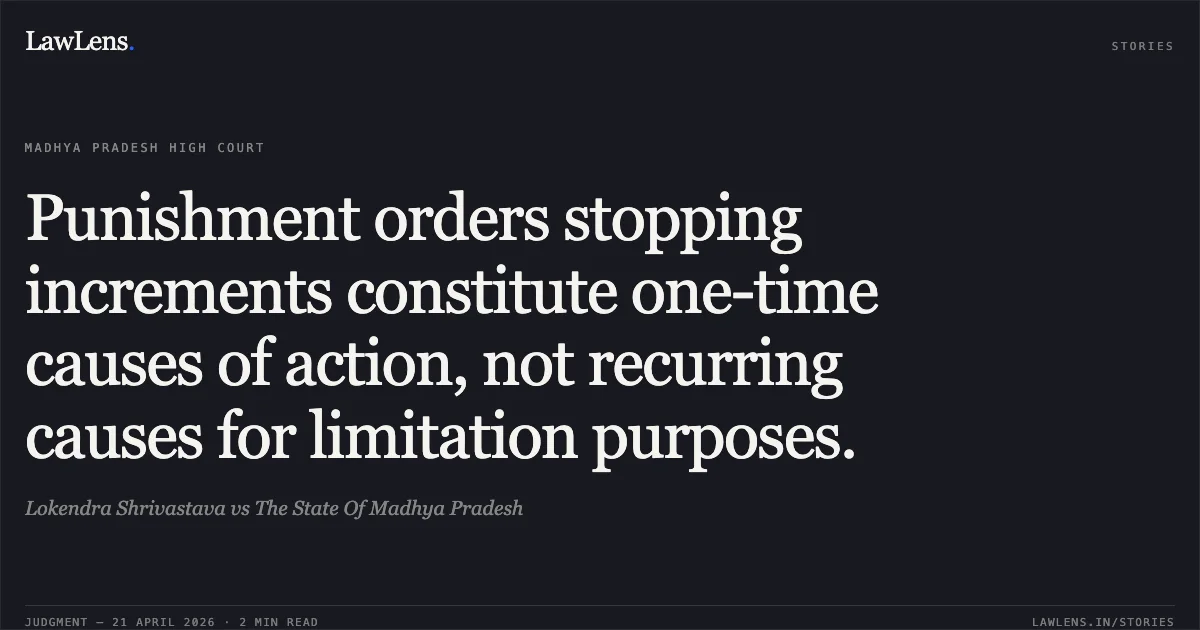
Source reference: para. 11Regarding cause of action, the court distinguished between the simple non-grant of increments and the denial of increments pursuant to a quasi-judicial order
Source reference: para. 13Reasoning
The court found that the 23-year delay in filing the appeal was inordinate and lacked a satisfactory explanation
Source reference: para. 7, 14It rejected the petitioner’s argument that the financial loss caused by the stoppage of increments created a "recurring cause of action"
Source reference: para. 13The court reasoned that while the absence of an order might result in a recurring cause, an administrative or quasi-judicial order makes the grievance a "one-time cause" that must be challenged within a reasonable timeframe
Source reference: para. 13The petitioner’s assertion that the order was void-ab-initio did not exempt him from limitation laws, especially since he failed to provide cogent or persuasive reasons for his long-standing acquiescence
Source reference: para. 14Consequently, the court determined that the appellate authority was justified in dismissing the appeal
Source reference: para. 14Holding
The High Court sustained the preliminary objection regarding delay and laches
The court held that the petition suffered from gross delay and that the petitioner’s inactivity for 23 years precluded the exercise of discretionary writ jurisdiction
Source reference: para. 14-15The writ petition was dismissed
Source reference: para. 15Original Court PDF
Lokendra ShrivastavavsThe State Of Madhya Pradesh
Click to open original judgment
Original judgment, available to read, download and summarize on LawLens.in