Facts
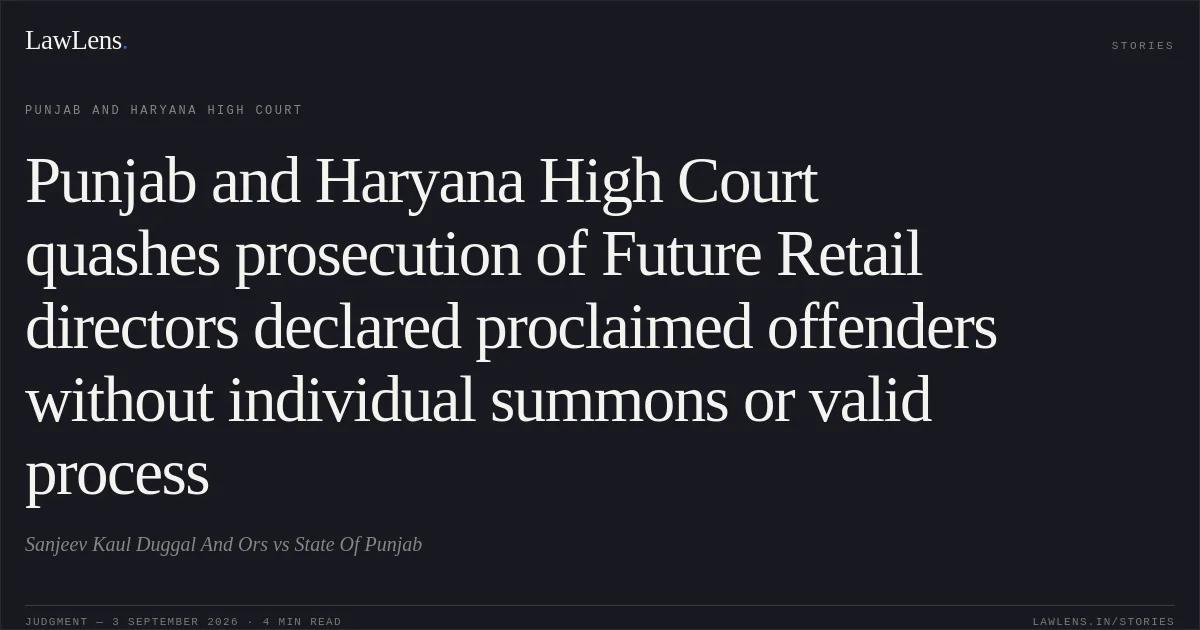
The four petitions arose from Complaint Nos. 41 dated 07.11.2012 and 42 dated 20.11.2012, instituted under Sections 59 and 425 of the Food Safety and Standards Act, 2006, concerning samples collected from two Easy Day Market outlets in Patiala.
Source reference: paras. 1–4The complaints referred generally to the company and its nominee/partner/managing director/proprietor/director, but did not individually name or identify the present petitioners or attribute any specific role to them.
Source reference: paras. 4, 14–16The Chief Judicial Magistrate, Patiala, issued a general summoning order dated 07.11.2012 directing that “accused” be summoned, without naming the petitioners or recording any individual satisfaction regarding their alleged culpability.
Source reference: para. 15.1Nearly five years later, on 29.11.2017, a Food Clerk furnished the petitioners’ names and addresses, allegedly on the basis of information obtained from the internet showing them as directors of Bharti Retail Limited.
Source reference: para. 6The Trial Court thereafter proceeded against them as accused Nos. 2 and 3, issued warrants and initiated proclamation proceedings under Section 82 Cr.P.C.
Source reference: paras. 5–7The proclamation was allegedly effected at the former office premises of Bharti Retail Limited in Gurgaon, although the company had vacated those premises on 04.04.2014.
Source reference: para. 7By order dated 03.01.2018, the petitioners were declared proclaimed offenders.
Source reference: para. 7Issues
Whether criminal proceedings could validly be initiated and continued against persons who were neither named nor individually arrayed as accused in the complaints and whose specific roles were not identified in the summoning order.
Source reference: paras. 14–17Whether the Trial Court could invoke Section 82 Cr.P.C. and declare the petitioners proclaimed offenders without a prior individual judicial process, valid service of summons or warrants, and material showing deliberate abscondence or concealment.
Source reference: paras. 17–18Whether the continuation of the proceedings against the petitioners constituted an abuse of the process of the Court warranting exercise of the High Court’s inherent jurisdiction under Section 482 Cr.P.C.
Source reference: paras. 12–14, 19–23Law Applied
The Court applied Sections 59, 66 and 425 of the Food Safety and Standards Act, 2006, observing that criminal liability against company officers requires a factual and statutory foundation connecting the particular individual with the company’s business and the alleged offence; mere designation as a director is insufficient.
Source reference: paras. 14, 21Section 82 Cr.P.C. presupposes a valid warrant against the particular individual and a judicial satisfaction that the person has absconded or is concealing himself to evade execution of the warrant; proclamation proceedings cannot be initiated against an unnamed or unidentified person.
Source reference: paras. 17.2, 18Under State of Haryana v. Bhajan Lal, 1991 (1) RCR (Criminal) 383, the High Court may quash proceedings where the allegations do not disclose an offence against the accused or where continuation would amount to abuse of process.
Source reference: para. 12R.P. Kapur v. State of Punjab, AIR 1960 SC 866, and Neeharika Infrastructure Pvt. Ltd. v. State of Maharashtra, (2021) 19 SCC 401, establish that inherent powers are extraordinary and must be exercised sparingly, but remain available to secure the ends of justice.
Source reference: para. 13Relying on Pepsi Foods Ltd. v. Special Judicial Magistrate, (1998) 5 SCC 749, Mehmood Ul Rehman v. Khazir Mohammad Tunda, (2015) 12 SCC 420, and M/s J.M. Laboratories v. State of Andhra Pradesh, 2025 INSC 127, the Court reiterated that issuance of criminal process is a serious judicial act requiring demonstrable application of mind to the allegations, material and identity of the person sought to be summoned.
Source reference: para. 16.1Reasoning
The Court found that the complaints did not name the petitioners, individually array them as accused, or contain averments specifying their roles or responsibility for the company’s business.
Source reference: paras. 14–16The summoning order merely directed that “accused” be summoned and did not identify the persons against whom process was issued or record any individual assessment of their culpability.
Source reference: paras. 15.1, 16Their names were introduced only in 2017 through an application based on internet information, which could not retrospectively validate the defective summoning order or create valid prior judicial process.
Source reference: paras. 6, 11Since no summons or warrants were shown to have been individually issued and served, there was no legally sustainable basis to infer that the petitioners had absconded or deliberately concealed themselves.
Source reference: paras. 7, 11The proclamation was additionally carried out at premises vacated by the company in 2014, further undermining any inference of knowledge or evasion.
Source reference: paras. 7, 11Accordingly, the statutory preconditions for Section 82 Cr.P.C. were absent, and the continuation of proceedings lacked the factual and legal substratum necessary to sustain prosecution against the petitioners.
Source reference: paras. 17.2–19The Court also noted that, having regard to the nature of the alleged offences, the petitioners could not in any event have been declared “proclaimed offenders” under the statutory scheme, and at most could have been treated as proclaimed persons if the other statutory requirements were met.
Source reference: para. 18.1Holding
The Court answered the issues in favour of the petitioners.
It held that the petitioners had not been validly arraigned or summoned, that the proceedings under Section 82 Cr.P.C. were fundamentally misconceived, and that their continued prosecution amounted to abuse of the process of the Court.
Source reference: paras. 19–21The four petitions were allowed; the orders dated 03.01.2018 declaring the petitioners proclaimed offenders and the summoning order dated 07.11.2012, insofar as it purported to concern them, were quashed and set aside.
Source reference: para. 22Complaint Nos. 41 and 42, together with all consequential proceedings, were quashed qua the present petitioners only.
Source reference: para. 23Proceedings against the remaining accused were expressly left unaffected.
Source reference: paras. 23–24Acts & Sections Cited
8 provisions across 3 statutes referred to in this judgment. Each provision opens on LawLens.
Code of Criminal Procedure, 19734
Food Safety and Standards Act, 20063
Bharatiya Nagarik Suraksha Sanhita, 20231
Original Court PDF
Sanjeev Kaul Duggal And OrsvsState Of Punjab
Click to open original judgment
Original judgment, available to read, download and summarize on LawLens.in