Facts
The plaintiff (Munisamy Naicker) filed a suit for partition of a 32-cent property in Survey No. 90/2.
Source reference: no citationThe property was originally sold by the plaintiff to his sister (Muniammal) and her husband (Kannappa Naicker) via a 1980 registered Sale Deed.
Source reference: p. 4-5Following Kannappa’s death, the plaintiff purchased 26 1/3 cents (representing the shares of Muniammal and her daughter Kamakshi) via a 1993 Sale Deed.
Source reference: p. 5The defendants (Appellants) contested this, claiming an oral family arrangement in 1980 allotted the entire property to the second defendant (Mohan), who subsequently sold it to the first defendant.
Source reference: p. 6-7The Trial Court and First Appellate Court decreed in favor of the plaintiff, holding the property was self-acquired by Kannappa and Muniammal.
Source reference: p. 10-12Issues
1. Whether the Courts below were correct in law holding that the suit property is not an ancestral property?
Source reference: p. 12, para 122. Whether the Courts below were correct in law holding that the suit property was the self-acquired property of Muniammal and Kannappan?
Source reference: p. 13, para 123. Whether the suit was bad for non-joinder of necessary parties given the existence of other legal heirs?
Source reference: p. 13, para 12Law Applied
Section 45 of the Transfer of Property Act, 1882, which presumes that joint purchasers of immovable property are equally interested in the absence of evidence regarding their respective shares of consideration.
Source reference: p. 20Sections 91 and 92 of the Indian Evidence Act, 1872, which exclude oral evidence that contradicts the terms of a written registered document.
Source reference: p. 18Section 8 of the Hindu Succession Act, 1956, regarding the devolution of a male Hindu's property upon his death intestate.
Source reference: p. 17, 23Order XLI Rule 31 of the CPC regarding the duties of an Appellate Court and Order XX Rule 18 of the CPC, distinguishing between "rendition of accounts" in partition suits versus "mesne profits" under Order XX Rule 12.
Source reference: p. 16, 25Reasoning
The Court determined that since Ex-A.5/Ex-B.1 recited the property as "self-acquired," the defendants were barred by Sections 91 and 92 of the Evidence Act from claiming it was ancestral.
Source reference: p. 18Under Section 45 of the Transfer of Property Act, as the 1980 deed (Ex-A.8) named both Kannappa and Muniammal without specifying shares, they were equal owners of 1/2 each.
Source reference: p. 20Upon Kannappa's death in 1981, his 1/2 share devolved under Section 8 of the Hindu Succession Act among five heirs (widow, two sons, and two daughters), giving each a 1/10 share of the total property.
Source reference: p. 23Consequently, Muniammal (1/2 original + 1/10 inherited) and Kamakshi (1/10 inherited) together held 7/10, not 5/6 as claimed.
Source reference: p. 24The Court found the oral family arrangement unproven as no witnesses/panchayatdhars were examined.
Source reference: p. 21-22Finally, it ruled that in partition suits, the appropriate relief is "rendition of accounts" rather than "mesne profits".
Source reference: p. 25-26Holding
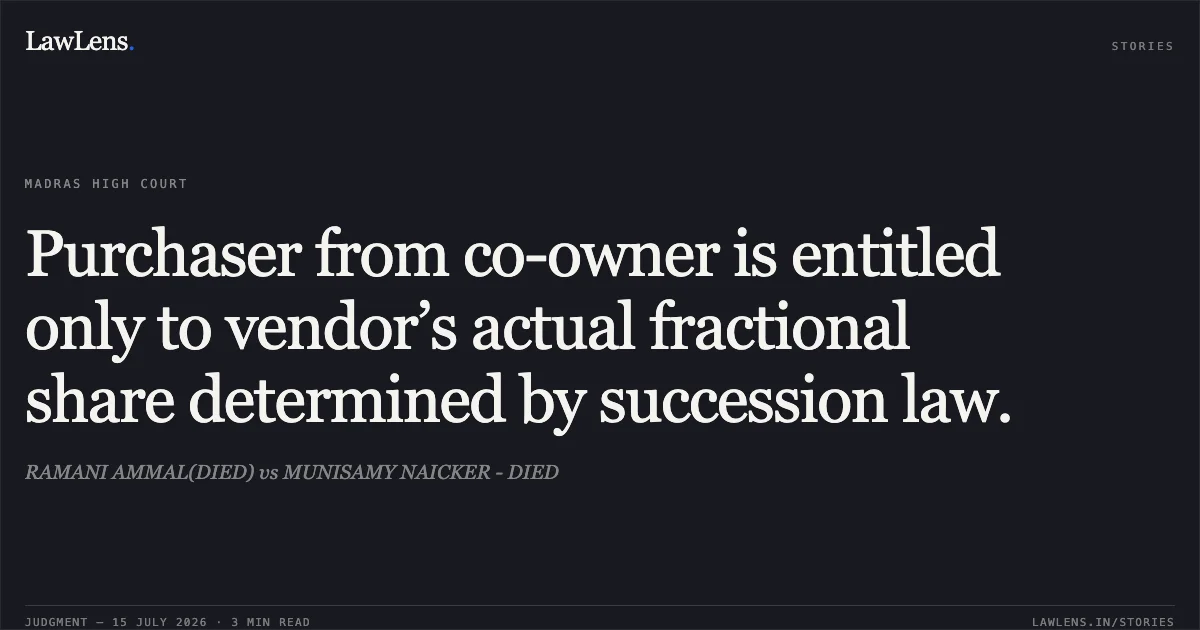
The High Court partly allowed the Second Appeal, modifying the lower courts' decrees. It held that the property was self-acquired and not ancestral.
The Court concluded that the plaintiff was entitled to a preliminary decree for 7/10 shares (rather than 5/6) of the suit property. The Court ordered the division into 10 shares, allotting seven to the plaintiff and granting rendition of accounts under Order XX Rule 18 of the CPC. The suit was held not bad for non-joinder as the necessary parties were impleaded at the appellate stage. No order as to costs.
Source reference: p. 27Acts & Sections Cited
4 provisions across 4 statutes referred to in this judgment. Each provision opens on LawLens.
Prohibition of Benami Property Transactions Act, 19881
Code of Civil Procedure, 19081
Hindu Succession Act, 19561
Transfer of Property Act, 18821
Original Court PDF
RAMANI AMMAL(DIED)vsMUNISAMY NAICKER - DIED
Click to open original judgment
Original judgment, available to read, download and summarize on LawLens.in