Facts
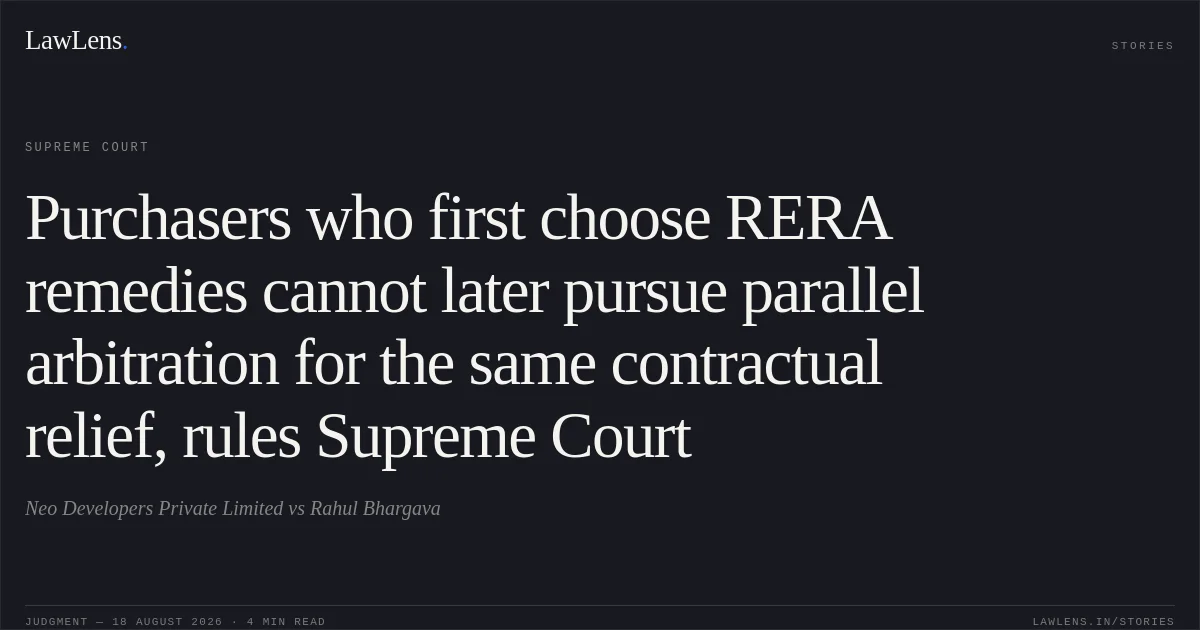
Neo Developers Pvt. Ltd. developed the project “Neo Square” at Sector 109, Dwarka Expressway, Gurugram. The respondents entered into Builder Buyer Agreements (BBAs) and Memoranda of Understanding (MoUs) for the purchase of undivided, undemarcated commercial space, subject to an assured-return scheme. The developer initially paid the assured returns but subsequently defaulted, and the project was delayed.
Source reference: p.1–2The respondents approached the Haryana Real Estate Regulatory Authority (HRERA), seeking, inter alia, payment of assured returns, completion and possession, conveyance, compensation/interest, and a declaration that development and fit-out charges were impermissible. HRERA passed an order dated 14 August 2024 directing payment of assured returns, offering of possession after obtaining the occupation certificate, execution of conveyance, and prohibiting charges outside the agreement.
Source reference: p.5–7The respondents initiated execution proceedings before HRERA in April 2025.
Source reference: p.2–3Thereafter, following communications proposing leasing of the premises and demanding development and fit-out charges, the respondents filed an application under Section 9 of the Arbitration and Conciliation Act, 1996, before the Commercial Court seeking restraint against leasing or creation of third-party interests.
Source reference: p.2–3The Commercial Court declined relief, holding that the respondents, having elected to approach HRERA, could not subsequently invoke arbitration. The High Court, in proceedings under Section 37, restrained the developer from creating third-party interests and directed maintenance of status quo until commencement of arbitration. The developer appealed to the Supreme Court.
Source reference: p.2–3Issues
Whether the respondents could invoke Section 9 of the Arbitration and Conciliation Act, 1996, after having elected to pursue substantive and execution remedies before HRERA under the Real Estate (Regulation and Development) Act, 2016?
Source reference: p.4–6, 10Whether the respondents’ Section 9 application constituted a fresh cause of action based on the proposed leasing of the commercial space and the demand for development and fit-out charges?
Source reference: p.5–6Whether the High Court was justified in restraining the developer from leasing the premises or creating third-party interests despite the contractual assured-return scheme and the pending HRERA proceedings?
Source reference: p.8–10Law Applied
The Court applied Section 9 of the Arbitration and Conciliation Act, 1996, which permits interim measures in aid of arbitration, and Section 37, concerning appeals against orders under the Act.
Source reference: p.4–6It considered the principle that a party who has elected to pursue statutory and contractual remedies before a competent statutory forum cannot initiate parallel arbitral proceedings seeking substantially the same reliefs.
Source reference: p.4–6The Court also considered the Constitution Bench decision in In Re: Interplay between Arbitration Agreements under the Arbitration and Conciliation Act, 1996 and the Indian Stamp Act, 1899, (2024) 6 SCC 1, regarding the limited scope of judicial interference at the referral stage, but held that the present dispute concerned the consequences of the respondents’ prior election and the impermissibility of parallel proceedings.
Source reference: p.4–6The Court further applied the contractual terms of the BBA and MoU: assured returns were payable until commencement of the first lease, while any subsequent rental variation was to be dealt with under the agreed formula.
Source reference: p.8–9It relied on Section 63 of the RERA Act read with Rule 27 of the Haryana RERA Rules, 2017, recognising HRERA’s power to address and enforce the parties’ claims.
Source reference: p.10–11Reasoning
The Court held that the reliefs pursued before HRERA and under Section 9 were substantially connected. Before HRERA, the respondents had already sought enforcement of the developer’s obligations, payment of assured returns, possession, conveyance, and determination of impermissible charges; HRERA had granted relief and execution proceedings were pending.
Source reference: p.5–7The subsequent request to restrain leasing was not an independent cause of action merely because the developer had issued communications proposing a lease and demanding charges. It was intended to protect and enforce the same rights arising under the BBA and MoU that had already been placed before HRERA.
Source reference: p.5–6The Court further found that the High Court’s injunction was inconsistent with the contractual scheme. Under the BBA, assured returns ceased upon commencement of the first lease, and the allottee’s entitlement thereafter depended on the agreed rental-sharing mechanism.
Source reference: p.8–9The arrangement contemplated nominal ownership of an undivided commercial area and did not confer a right to separate physical possession of a demarcated unit.
Source reference: p.8–9Restraining leasing would therefore impede commencement of the Food Court and interfere with the agreed commercial structure, while the respondents’ substantive and execution remedies remained available before HRERA.
Source reference: p.9–10Holding
The Supreme Court allowed the appeals, set aside the High Court’s order, and restored the Commercial Court’s order refusing continuation of the Section 9 proceedings.
The respondents were relegated to HRERA, where they could pursue claims concerning conveyance of the undivided area and the legality of development and fit-out charges; the developer’s contentions regarding amounts due under the BBA and MoU were left open.
Source reference: p.10The Court clarified that, under the contractual assured-return scheme, assured returns were payable until commencement of the first lease and that the respondents had no contractual right to prevent leasing of the premises. The relevant portion of HRERA’s operative direction was modified accordingly.
Source reference: p.10–11Acts & Sections Cited
3 provisions across 2 statutes referred to in this judgment. Each provision opens on LawLens.
Arbitration and Conciliation Act, 19962
Real Estate (Regulation and Development) Act, 2016.1
Original Court PDF
Neo Developers Private LimitedvsRahul Bhargava
Click to open original judgment
Original judgment, available to read, download and summarize on LawLens.in