Facts
The complainant, Mahesh Kumar, alleged that his son and business partner were operating M/s ILMP Technologies Pvt. Ltd., which obtained 19 loan facilities from M/s Karina Fincap Limited, aggregating approximately ₹3.70 crores.
Source reference: p. 2–3, para. 4According to the complaint, only ₹3,29,26,531 was credited in 47 transactions, against which ₹1,82,03,151 was repaid.
Source reference: p. 2–3, para. 4The complainant further alleged that the finance company obtained blank cheques from him and his wife as security and subsequently misused them by initiating multiple proceedings under Section 138 of the Negotiable Instruments Act after dishonour.
Source reference: p. 2–3, para. 4The Judicial Magistrate, Muzaffarpur, took cognizance of the alleged offences on 10 March 2016 in Complaint Case No. 1799 of 2015.
Source reference: p. 2, para. 3The finance company and its directors sought quashing of the cognizance order, contending that the complaint was a malicious counterblast to recovery proceedings and that the dispute was purely contractual and civil in nature.
Source reference: p. 3–7, paras. 5–5.12The complainant opposed the applications, alleging misuse of cheques, irregular disbursement of loans and charging of interest at approximately 110% per annum.
Source reference: p. 7–8, para. 6Issues
Whether the allegations concerning non-compliance with loan agreements, alleged misuse of security cheques and initiation of proceedings under Section 138 of the Negotiable Instruments Act disclosed the offence of cheating under Section 420 IPC or related offences under Sections 120B and 34 IPC?
Source reference: p. 2, para. 3; p. 8–9, para. 8Whether continuation of the criminal complaint, arising out of a commercial loan dispute, constituted an abuse of the process of the court warranting quashing of the cognizance order?
Source reference: p. 8–9, paras. 8–9Law Applied
The Court considered the offences alleged under Sections 420, 120B and 34 of the Indian Penal Code, along with the background proceedings under Section 138 of the Negotiable Instruments Act.
Source reference: p. 2–3, para. 4It applied the principle that a mere breach of contract or failure to fulfil contractual obligations does not constitute cheating unless fraudulent or dishonest intention existed from the inception of the transaction.
Source reference: p. 6–7, paras. 5.10–5.11Relying on Vesa Holdings (P) Ltd. v. State of Kerala, (2015) 8 SCC 293, the Court held that criminal proceedings cannot be used as a mechanism for recovery of contractual dues in the absence of the foundational ingredients of cheating.
Source reference: p. 6–7, paras. 5.10–5.11Relying also on Indian Oil Corpn. v. NEPC India Ltd., (2006) 6 SCC 736, the Court reiterated that purely civil or commercial disputes should not be given a criminal colour as a pressure tactic and that such proceedings may be quashed where they amount to abuse of process.
Source reference: p. 6–7, paras. 5.10–5.12Reasoning
The Court found that the complaint arose from loan transactions, alleged defaults, disputed repayment obligations and the presentation of cheques allegedly furnished as security.
Source reference: p. 8, para. 8These allegations principally concerned the interpretation and performance of contractual terms, including the amount disbursed, repayment liability, interest and the circumstances in which the cheques could be presented.
Source reference: p. 3–6, paras. 5.1–5.9The existence of outstanding debt and the pendency of several Section 138 proceedings demonstrated that the dispute was substantially commercial and contractual.
Source reference: p. 3–6, paras. 5.1–5.9The Court held that the complaint did not establish the necessary dishonest intention at the inception of the loan transaction required for Section 420 IPC.
Source reference: p. 8–9, para. 8In light of the principles in Vesa Holdings and Indian Oil Corporation, the criminal complaint appeared to have been filed with an oblique motive and constituted an attempt to convert a civil dispute into criminal litigation.
Source reference: p. 8–9, para. 8Holding
The Court answered the issues in favour of the petitioners.
It held that the allegations, at their highest, disclosed a contractual and civil dispute rather than the offences alleged under Sections 420, 120B and 34 IPC.
Source reference: p. 8–9, paras. 8–9Continuation of the criminal proceedings would amount to abuse of the process of the court.
Source reference: p. 8–9, paras. 8–9Accordingly, the order dated 10 March 2016 taking cognizance in Complaint Case No. 1799 of 2015 was quashed, and both criminal miscellaneous applications were allowed.
Source reference: p. 9, paras. 9–10Acts & Sections Cited
3 provisions across 2 statutes referred to in this judgment. Each provision opens on LawLens.
Indian Penal Code, 18602
Negotiable Instruments Act, 18811
Original Court PDF
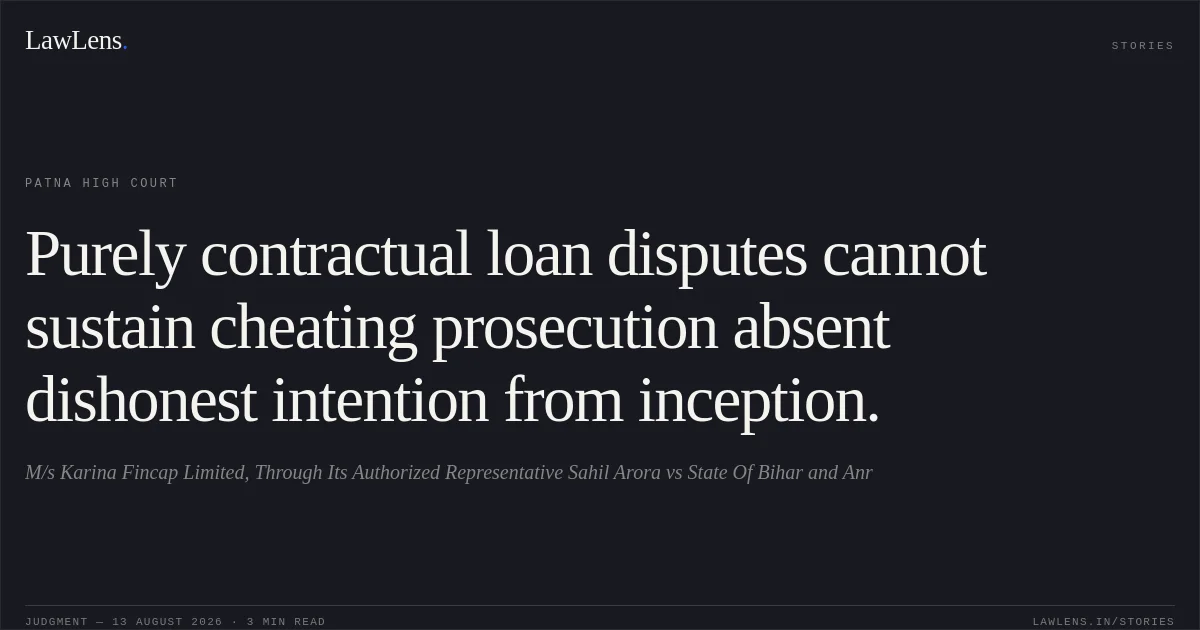
M/s Karina Fincap Limited, Through Its Authorized Representative Sahil AroravsState Of Bihar and Anr
Click to open original judgment
Original judgment, available to read, download and summarize on LawLens.in