Facts
The Supreme Court was monitoring the implementation of the Rights of Persons with Disabilities Act, 2016 (“2016 Act”). Previously, on 12th September 2025, the Court issued directions for the appointment of Nodal Officers by States/UTs to coordinate with National Law Universities (NLUs) under “Project Ability Empowerment”.
Source reference: para. 1By 15th April 2026, several States and UTs remained non-compliant.
Source reference: para. 1Additionally, the Court sought clarification from the Union of India regarding the "upward movement" of meritorious Persons with Benchmark Disabilities (PwBD) into unreserved seats.
Source reference: para. 2The present order reviews the compliance status of these mandates and the broader execution of the 2016 Act.
Source reference: para. 3Issues
1. Whether the defaulting States and Union Territories have complied with the judicial mandate to appoint Nodal Officers for the implementation of disability rights.
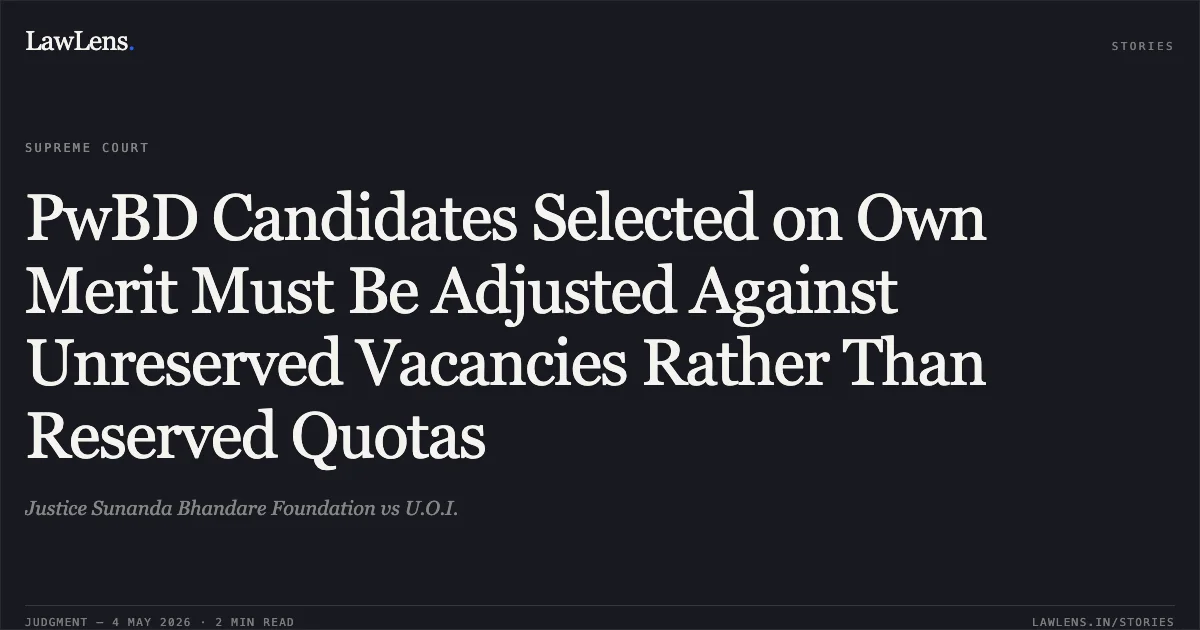
Source reference: para. 42. Whether meritorious PwBD candidates are entitled to "upward movement" (adjustment against unreserved vacancies) if they secure marks higher than the unreserved cut-off without availing relaxations.
Source reference: paras. 8-93. Whether the existing institutional framework is sufficient to ensure faithful implementation of the Rights of Persons with Disabilities Act, 2016.
Source reference: paras. 11-13Law Applied
The Court applied the statutory mandates of the Rights of Persons with Disabilities Act, 2016, which replaced the 1995 Act to provide a more robust framework for inclusion.
Source reference: para. 12It relied on the constitutional principles of equality, dignity, and inclusion.
Source reference: para. 10Regarding reservations, the Court affirmed the principle of "own merit" based on DoPT Office Memoranda dated 15th January 2018, 17th May 2022, and 27th September 2022, which dictate that horizontal reservation for PwBD requires meritorious candidates to be adjusted against unreserved (UR) vacancies unless they benefited from relaxed standards.
Source reference: para. 9The Court also highlighted that facilitative measures like scribes do not constitute "relaxation of standards".
Source reference: para. 9Reasoning
The Court expressed "serious displeasure" at the lackadaisical approach of States that delayed appointing Nodal Officers, noting that such inaction impedes NLUs from discharging their court-ordered mandates.
Source reference: paras. 1, 3Upon reviewing the Union’s affidavit, the Court analyzed the mechanics of horizontal reservation, concluding that treating disability as a "medical fitness" standard rather than a "relaxed standard" ensures that meritorious PwBD candidates are not denied higher placement.
Source reference: para. 9Finally, the Court observed that despite eight years of the 2016 Act, compliance remains "elusive". To bridge this gap, the Court reasoned that the newly appointed Nodal Officers must be integrated into a structured assessment led by NLUs to move beyond "formal" compliance to "substantive evaluation" of statutory enforcement.
Source reference: paras. 13, 14-15Holding
The Court held that meritorious PwBD candidates are entitled to be considered against unreserved vacancies on their "own merit".
Most States/UTs reported compliance regarding Nodal Officers; however, a final opportunity until 15th May 2026 was granted to the UTs of Lakshadweep and Ladakh.
Source reference: para. 6The Court directed NLUs under "Project Ability Empowerment" to conduct a detailed mapping of the 2016 Act’s implementation across all States/UTs. Specifically, NLU Delhi was tasked with mapping the Union of India’s compliance, with a Joint Secretary-rank officer deputed to assist. The matter is listed for 22nd September 2026 for updated status reports.
Source reference: paras. 15, 16, 18Acts & Sections Cited
1 provisions across 1 statute referred to in this judgment. Each provision opens on LawLens.
Rights of Persons with Disabilities Act, 2016.1
Original Court PDF
Justice Sunanda Bhandare FoundationvsU.O.I.
Click to open original judgment
Original judgment, available to read, download and summarize on LawLens.in