Facts
The respondent instituted M.C. No. 77 of 2026 before the Judicial First Class Magistrate Court-IV, Kozhikode, under Section 12 of the Protection of Women from Domestic Violence Act, 2005 (“PWDV Act”), seeking various reliefs.
Source reference: para. 5Her husband was arrayed as respondent No. 1, his parents as respondents Nos. 2 and 3, and the petitioners as respondents Nos. 4 and 5, described respectively as her brother-in-law and sister-in-law.
Source reference: para. 5The petitioners approached the High Court under Section 528 of the Bharatiya Nagarik Suraksha Sanhita, 2023 (“BNSS”), seeking quashing of the proceedings against them.
Source reference: para. 3They contended that they had never lived with the respondent in a shared household, had not been in a domestic relationship with her, and were implicated only through general and omnibus allegations.
Source reference: para. 5The respondent opposed the petition, contending that specific allegations existed and that the truth of those allegations could be determined only after trial.
Source reference: para. 4Issues
1. Whether the High Court could exercise its inherent jurisdiction under Section 528 of the BNSS to quash proceedings arising from an application under Section 12 of the PWDV Act.
Source reference: paras. 6–92. Whether the petitioners could be treated as “respondents” under Section 2(q) of the PWDV Act in the absence of pleadings or material showing that they had lived with the aggrieved person in a shared household.
Source reference: paras. 10–163. Whether the continuation of proceedings against the petitioners, based only on omnibus allegations and without a factual foundation establishing a “domestic relationship” under Section 2(f) of the PWDV Act, amounted to an abuse of process.
Source reference: paras. 16–19Law Applied
Section 528 of the BNSS, corresponding to Section 482 of the Code of Criminal Procedure, 1973, empowers the High Court to prevent abuse of process and secure the ends of justice, though the jurisdiction must be exercised sparingly and in exceptional cases.
Source reference: para. 6In Vijayalekshmi Amma v. Bindu, the Kerala High Court held that proceedings under Section 12 of the PWDV Act are predominantly civil in nature and ordinarily should not be quashed under inherent jurisdiction; however, in Shaurabh Kumar Tripathi v. Vidhi Rawal, the Supreme Court clarified that such proceedings can be quashed where continuation would involve gross illegality or manifest injustice.
Source reference: paras. 7–9Section 2(q) of the PWDV Act defines “respondent” as a person who is or has been in a domestic relationship with the aggrieved person; following Hiral P. Harsora v. Kusum Narottamdas Harsora, a woman may also be arrayed as a respondent.
Source reference: paras. 11–12Section 2(f) requires a relationship between persons who live or have lived together in a shared household and are connected by consanguinity, marriage, a relationship in the nature of marriage, adoption, or membership of a joint family.
Source reference: para. 13In Satish Chander Ahuja v. Sneha Ahuja, the Supreme Court held that shared household living must have some permanence and does not include merely fleeting or casual residence.
Source reference: para. 17Reasoning
The Court accepted that Section 528 of the BNSS could be invoked in an appropriate case to quash proceedings under Section 12 of the PWDV Act, but only where the record clearly demonstrated abuse of process, gross illegality, or the necessity of intervention to secure justice.
Source reference: paras. 8–9Although the petitioners were related to the respondent by marriage, that relationship alone did not establish a “domestic relationship” under Section 2(f).
Source reference: no citationThe application under the PWDV Act contained no pleading that respondents Nos. 4 and 5 had ever lived with the respondent, shared a household with her, or lived with her as members of a joint family.
Source reference: para. 15The Court acknowledged that strict civil pleading standards do not apply to PWDV Act proceedings, but held that the application must nevertheless disclose the basic factual foundation of a domestic relationship.
Source reference: para. 16Since the allegations against the petitioners were omnibus and unsupported by any material indicating shared-household living, the statutory requirement was absent.
Source reference: paras. 16, 18–19Their mere description as brother-in-law and sister-in-law could not, by itself, bring them within Section 2(q).
Source reference: paras. 16, 18–19Holding
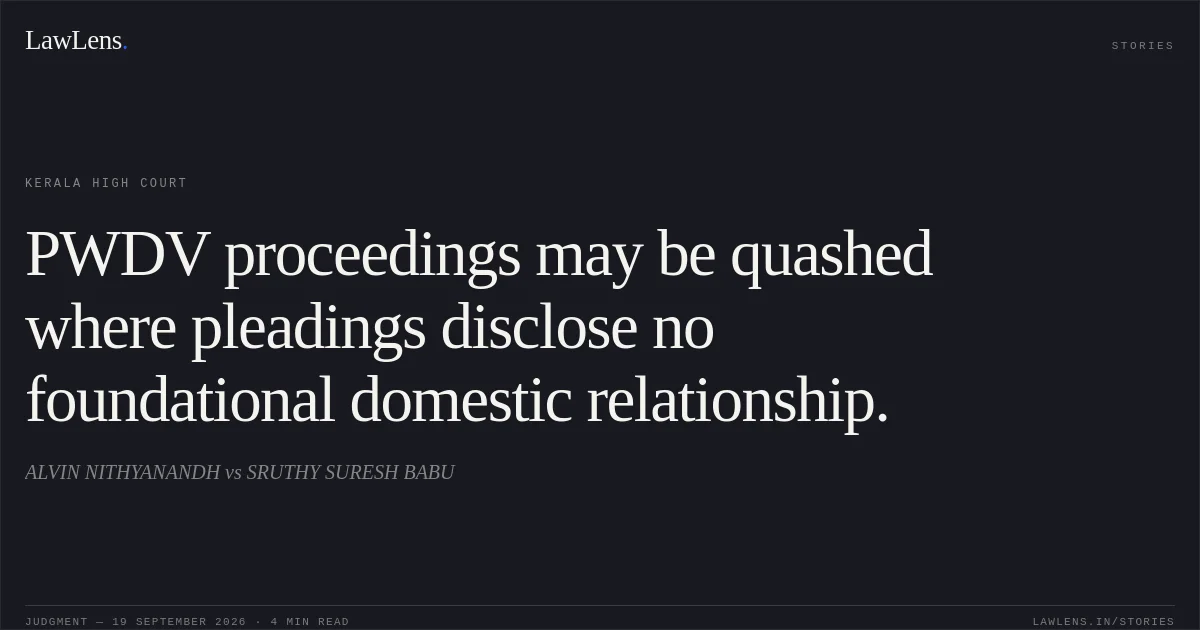
The High Court held that proceedings under Section 12 of the PWDV Act may be quashed under Section 528 of the BNSS in appropriate cases.
It further held that the absence of any pleading or supporting material showing that the petitioners had lived with the respondent in a shared household meant that no domestic relationship under Section 2(f) was disclosed.
Source reference: para. 19Consequently, continuation of the proceedings against them constituted an abuse of process.
Source reference: para. 19The Crl.M.C. was allowed, and the proceedings against the petitioners, respondents Nos. 4 and 5 in M.C. No. 77 of 2026, were quashed.
Source reference: para. 19The proceedings were directed to continue against the remaining respondents in accordance with law.
Source reference: para. 19Acts & Sections Cited
4 provisions across 3 statutes referred to in this judgment. Each provision opens on LawLens.
Protection of Women from Domestic Violence Act, 20052
Bharatiya Nagarik Suraksha Sanhita, 20231
Code of Criminal Procedure, 19731
Original Court PDF
ALVIN NITHYANANDHvsSRUTHY SURESH BABU
Click to open original judgment
Original judgment, available to read, download and summarize on LawLens.in