Facts
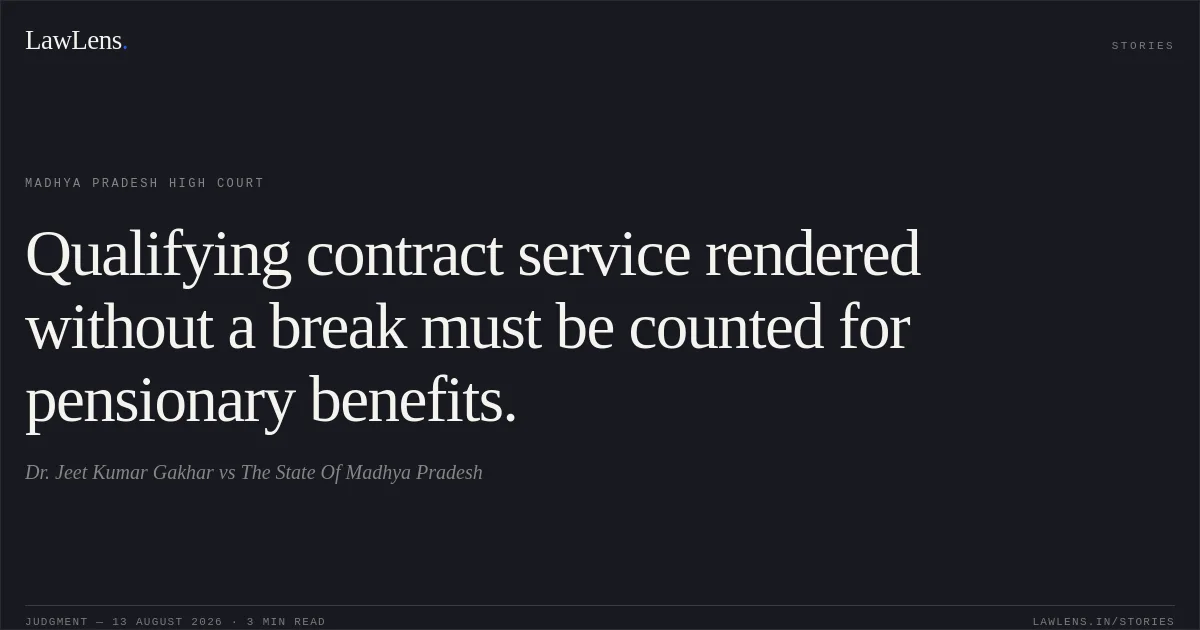
The petitioner, a retired employee, filed a writ petition under Article 226 of the Constitution seeking settlement of retiral dues with interest, inclusion of the period during which he rendered contractual service and received non-practising allowance for pension fixation, refund of alleged excess recovery from leave encashment, and consideration of his pending representations.
Source reference: para. 1The petitioner contended that, under Rule 16 of the Madhya Pradesh Civil Services (Pension) Rules, 1976, his contractual service was required to be counted because he was subsequently appointed to the same or an equivalent post without any break in service.
Source reference: para. 2He relied on the Supreme Court’s judgment in S.D. Jayprakash and Others v. Union of India and Others, dated 29 April 2025, concerning the corresponding Rule 17 of the Central Civil Services (Pension) Rules, 1972.
Source reference: para. 2The State submitted that the non-practising allowance had already been paid, but accepted that any remaining grievance could be considered on the petitioner’s representation.
Source reference: para. 3Issues
Whether the petitioner’s period of contractual service was required to be counted for determining his pensionary benefits under Rule 16 of the Madhya Pradesh Civil Services (Pension) Rules, 1976.
Source reference: para. 2Whether the petitioner was entitled to consideration and payment of any remaining non-practising allowance, with interest for delayed payment.
Source reference: paras. 2–3Whether the respondents were required to refix the petitioner’s pension and clear the consequential dues after counting the contractual service period.
Source reference: para. 6(ii)Law Applied
The Court applied Rule 16 of the Madhya Pradesh Civil Services (Pension) Rules, 1976, under which contractual service may be counted for pensionary purposes where an employee is initially appointed on contract to a specified post and is subsequently appointed, without a break in service, to the same or an equivalent post.
Source reference: para. 2The Court treated this provision as pari materia with Rule 17 of the Central Civil Services (Pension) Rules, 1972.
Source reference: para. 2It relied on the Supreme Court’s decision in S.D. Jayprakash and Others v. Union of India and Others, which recognised the counting of qualifying contractual service for pensionary purposes.
Source reference: para. 2The Court further directed payment of interest at 6% per annum on delayed non-practising allowance.
Source reference: para. 6(iii)Reasoning
The Court found that the petitioner’s claim for counting contractual service was directly covered by Rule 16 and the principle laid down in S.D. Jayprakash.
Source reference: paras. 2, 5The State was unable to justify excluding the petitioner’s contractual service from the computation of pensionary benefits.
Source reference: para. 5Accordingly, the Court directed the respondents to count the contractual period, refix the petitioner’s pension, and clear the resulting dues within three months.
Source reference: para. 5Regarding non-practising allowance, although the State asserted that payment had been made, the Court directed consideration of the petitioner’s fresh or pending representation and payment of any amount found due, together with interest for delay.
Source reference: paras. 3, 6(i), 6(iii)Holding
The writ petition was disposed of with directions that the respondents consider the petitioner’s fresh or pending representation regarding non-practising allowance and pay any amount found due; count the petitioner’s contractual service for pensionary purposes; refix his pension and clear the consequential dues within three months; and pay interest at 6% per annum on delayed payment of non-practising allowance.
No separate relief was expressly granted in the operative directions regarding the claimed 18% interest or alleged excess recovery from leave encashment.
Source reference: paras. 1, 6–7Original Court PDF
Dr. Jeet Kumar GakharvsThe State Of Madhya Pradesh
Click to open original judgment
Original judgment, available to read, download and summarize on LawLens.in