Facts
The petitioner, Shriram, filed a petition under Section 528 of the Bharatiya Nagarik Suraksha Sanhita, 2023, seeking to quash FIR bearing Crime No. 415/2025, the subsequent charge-sheet (Challan No. 11/2026), and the order dated 06.02.2026 by which the Chief Judicial Magistrate, Katghora, took cognizance in Criminal Case No. 180/2026.
Source reference: p.2The prosecution alleged that the complainant and the petitioner developed a love relationship after she moved to her grandmother's house in 2021.
Source reference: p.2-3It was further alleged that in November 2023, the petitioner, under the false pretext of marriage, took the complainant to Ganesh Lodge, Katghora, and committed forceful sexual intercourse with her.
Source reference: p.3The prosecution claimed the petitioner continued to establish physical relations against her will until 2025 and then refused to marry her, leading to the registration of an FIR under Section 376(2)(n) of the Indian Penal Code, 1860, on 11.12.2025.
Source reference: p.3The petitioner was arrested on 05.02.2026, and a charge-sheet was filed on the same date, with cognizance taken on 06.02.2026.
Source reference: p.3The petitioner was granted bail on 09.02.2026.
Source reference: p.3The petitioner argued that the allegations were false, baseless, and lacked cogent evidence, and that no offence under Section 376(2)(n) IPC was made out.
Source reference: p.3-4Issues
1. Whether the FIR, charge-sheet, and consequential criminal proceedings against the petitioner under Section 376(2)(n) of the Indian Penal Code, 1860, should be quashed on the grounds that the allegations do not prima facie disclose the commission of an offense or amount to an abuse of the process of law.
Source reference: p.3-4Law Applied
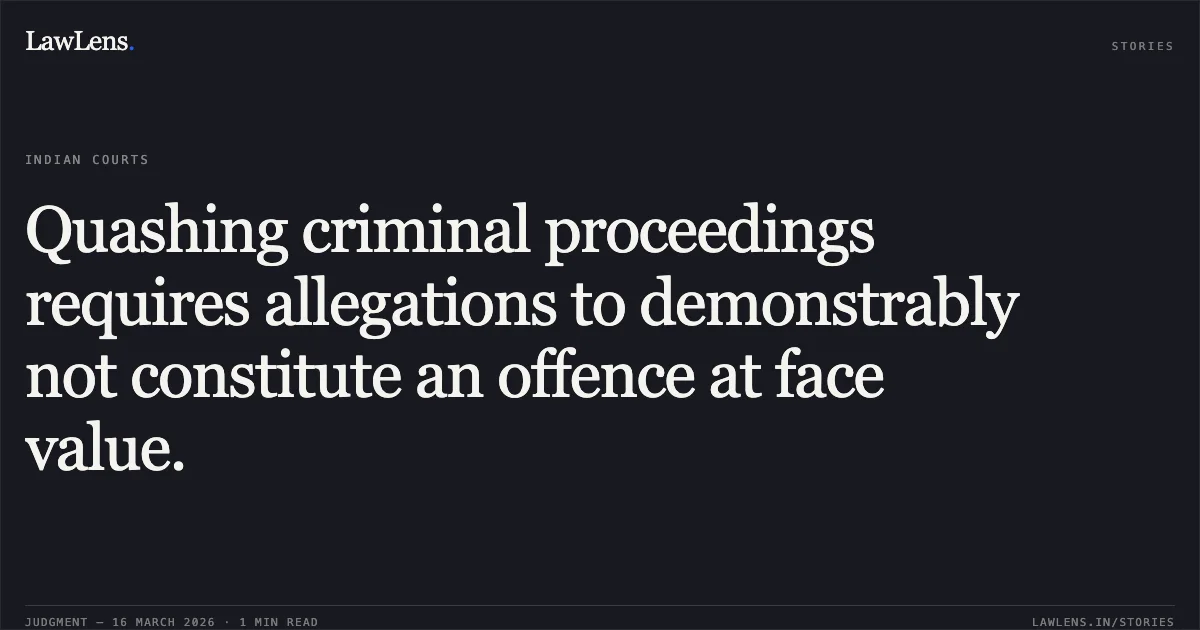
The Court applied the principle that inherent jurisdiction for quashing criminal proceedings is to be exercised sparingly and with great circumspection, only in cases where the allegations, even if taken at their face value, do not constitute any offense or where continuation of proceedings would amount to abuse of the process of law.
Source reference: p.7-8It also recognized that at the stage of considering a petition for quashment, the Court is not required to meticulously examine the probative value or sufficiency of evidence, nor adjudicate upon disputed questions of fact, as these are matters for trial.
Source reference: p.5, p.7Reasoning
The petitioner contended that the allegations, even if accepted, do not constitute an offense under Section 376(2)(n) IPC, citing lack of substantial evidence, a consensual relationship, unexplained delay in filing the FIR, and the medical report not indicating forceful assault.
Source reference: p.4-5The State countered that the FIR and victim's statements clearly disclose a cognizable and serious offense under Section 376(2)(n) IPC, involving physical relations on a false promise of marriage and continuation despite resistance.
Source reference: p.5-6The State argued that the issues of consent, delay, or medical reports are matters of evidence for trial, and quashing at this stage would stifle a legitimate prosecution.
Source reference: p.6-7The Court, upon perusal of the material, found that the FIR and statements recorded during investigation prima facie disclosed the commission of a cognizable offense.
Source reference: p.7It reiterated that a meticulous examination of evidence or adjudication of disputed facts (such as the nature of the relationship, consent, delay, or evidentiary value of medical reports) is not required at the quashing stage, as these are matters to be properly appreciated during trial.
Source reference: p.7Given that the FIR and charge-sheet contained specific allegations attracting the ingredients of the alleged offense, the Court found no grounds to interfere at this threshold stage.
Source reference: p.8Holding
The Court dismissed the petition, finding it to be devoid of merits.
It held that the allegations made in the FIR and the statements recorded during investigation prima facie disclosed the commission of a cognizable offense against the petitioner, and therefore, there was no ground to interfere with the criminal proceedings at this threshold stage.
Source reference: p.7-8Acts & Sections Cited
2 provisions across 2 statutes referred to in this judgment. Each provision opens on LawLens.
Bharatiya Nagarik Suraksha Sanhita, 20231
Indian Penal Code, 18601
Original Court PDF
SHRIRAMvsSTATE OF CHHATTISGARH
Click to open original judgment
Original judgment, available to read, download and summarize on LawLens.in