Facts
The complainant, associated with Vastu Vihar/Technoculture Building Centre Pvt. Ltd., alleged that the petitioner, a Marketing Executive, received money from customers in connection with the company’s business but failed to deposit or account for it properly.
Source reference: paras. 3–5It was further alleged that she admitted receiving ₹25,70,500 and agreed to repay it in instalments; the alleged liability subsequently increased to ₹34,49,900.
Source reference: paras. 3–5The Chief Judicial Magistrate, Bhagalpur, took cognizance against the petitioner under Sections 406 and 420 of the Indian Penal Code and directed issuance of summons by order dated 27 June 2018.
Source reference: para. 2The petitioner sought quashing of the cognizance order, contending that she was merely a Marketing Executive, had handed over all collections to company officials, and that the complaint was a retaliatory counterblast to P.S. Case No. 199 of 2018 earlier instituted by her against company officers.
Source reference: paras. 6–10, 16–19The opposite party argued that the petition raised disputed questions of fact and that the complaint prima facie disclosed receipt and non-accounting of company money.
Source reference: paras. 20–24Issues
1. Whether the allegations in the complaint, taken at face value, disclosed the essential ingredients of offences under Sections 406 and 420 IPC against the petitioner.
Source reference: paras. 25–27, 35–482. Whether the cognizance order was mechanical or lacked application of judicial mind so as to warrant interference in the High Court’s quashing jurisdiction.
Source reference: paras. 51–523. Whether the alleged retaliatory motive, prior FIR, absence of a civil recovery proceeding, and subsequent developments justified quashing the criminal proceeding as an abuse of process.
Source reference: paras. 39–45, 50, 53–57Law Applied
The Court applied Sections 405–406 IPC, concerning criminal breach of trust based on entrustment followed by dishonest misappropriation, and Sections 415–420 IPC, concerning cheating involving deception, dishonest intention and inducement to deliver property.
Source reference: paras. 13–15, 48It relied on S.N. Vijayalakshmi v. State of Karnataka, 2025 SCC OnLine SC 1575, and Arshad Neyaz Khan v. State of Jharkhand, 2025 SCC OnLine SC 2058, for the distinction between cheating and criminal breach of trust and the requirement that foundational criminal ingredients must be disclosed.
Source reference: paras. 13–15, 40The Court also applied the principles in State of Haryana v. Bhajan Lal, 1992 Supp (1) SCC 335, and Neeharika Infrastructure Pvt. Ltd. v. State of Maharashtra, (2021) 19 SCC 401, that quashing is justified in exceptional cases where no offence is disclosed or the proceeding is manifestly mala fide, but disputed facts and defence evidence cannot be assessed through a mini-trial.
Source reference: paras. 26–32Under Vishwa Mitter v. O.P. Poddar, (1983) 4 SCC 701, any person may set the criminal law in motion where the complaint discloses facts constituting an offence, absent a statutory bar.
Source reference: paras. 22, 49The Court further recognised, relying on the principles stated in S.N. Vijayalakshmi, that civil and criminal remedies may coexist where the allegations disclose an element of criminality.
Source reference: para. 13Reasoning
The complaint alleged that the petitioner received customer payments in the course of company business, failed to account for them, and subsequently admitted receipt of a substantial amount and undertook repayment. These allegations furnished a prima facie factual foundation for the alleged offences; whether the money was actually entrusted to her, whether she deposited or handed it over to company officials, whether the alleged admission was made, and whether she acted dishonestly were matters requiring evidence.
Source reference: paras. 35–37, 47–48The petitioner’s explanation that she was only a Marketing Executive and that the complaint was a counterblast constituted a possible defence, but the High Court could not accept it as established at the quashing stage.
Source reference: paras. 33–36The prior FIR against persons who later appeared as witnesses was relevant to the plea of mala fides, but did not conclusively establish that the complaint was false or retaliatory.
Source reference: paras. 41–45Similarly, the absence of a civil recovery proceeding was not determinative, and the Magistrate’s decision to take cognizance only against the petitioner did not, by itself, demonstrate mechanical consideration.
Source reference: paras. 38, 50–52Since the allegations were neither inherently improbable nor devoid of factual foundation, the case did not fall within the exceptional categories warranting quashing.
Source reference: paras. 55–57Holding
The High Court declined to interfere with the order dated 27 June 2018 taking cognizance under Sections 406 and 420 IPC and directing issuance of summons.
The application for quashing was dismissed.
Source reference: paras. 58–59The petitioner was granted liberty to raise all permissible factual and legal pleas before the trial court, which was directed to consider the matter independently and without being influenced by the observations in the High Court’s judgment.
Source reference: para. 60Acts & Sections Cited
6 provisions across 2 statutes referred to in this judgment. Each provision opens on LawLens.
Indian Penal Code, 18604
Code of Criminal Procedure, 19732
Original Court PDF
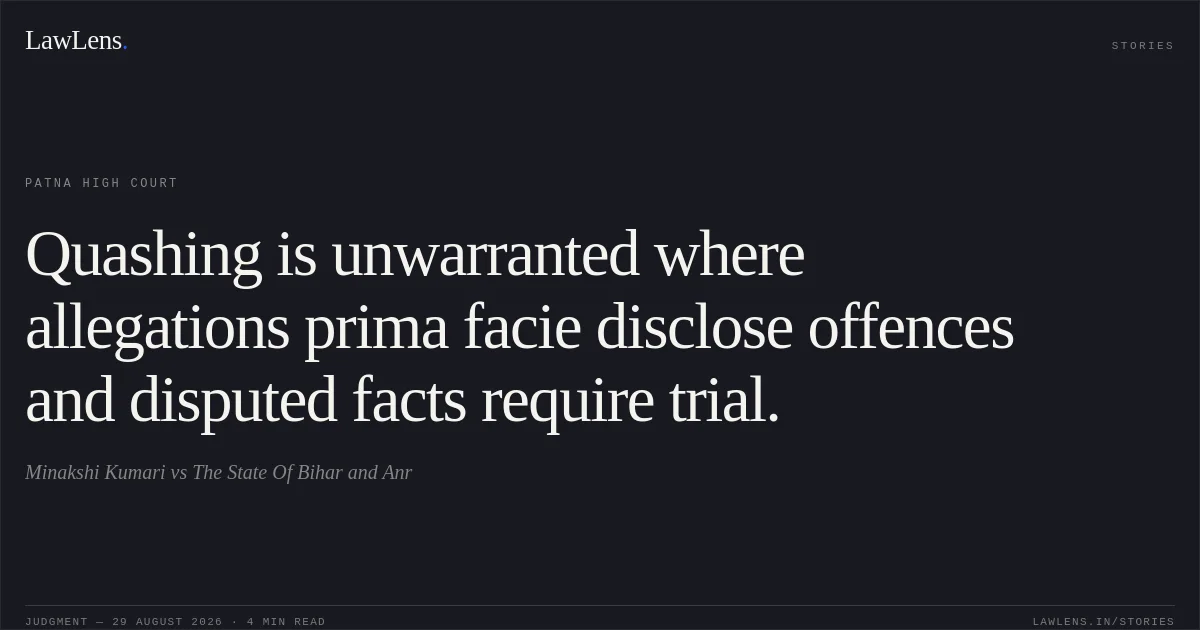
Minakshi KumarivsThe State Of Bihar and Anr
Click to open original judgment
Original judgment, available to read, download and summarize on LawLens.in
![A police constable cannot be removed for unauthorized absence without a Rule 359-compliant inquiry.. Mohammad Sidiq Khan vs D/o Home Ut Of Jammu & Kashmir. CAT - ['Srinagar']. LawLens](/stories/thumbnails/a-police-constable-cannot-be-removed-for-unauthorized-absence-without-a-rule-359-compliant-7b43fc316bd94f22a62676153bbc9d54.webp)
![A Review DPC lacks authority to determine or alter inter se seniority.. SAURABH KUMAR vs REVENUE. CAT - ['Patna']. LawLens](/stories/thumbnails/a-review-dpc-lacks-authority-to-determine-or-alter-inter-se-seniority-4b21640f20af46fcabdfc8273d2ce959.webp)