Facts
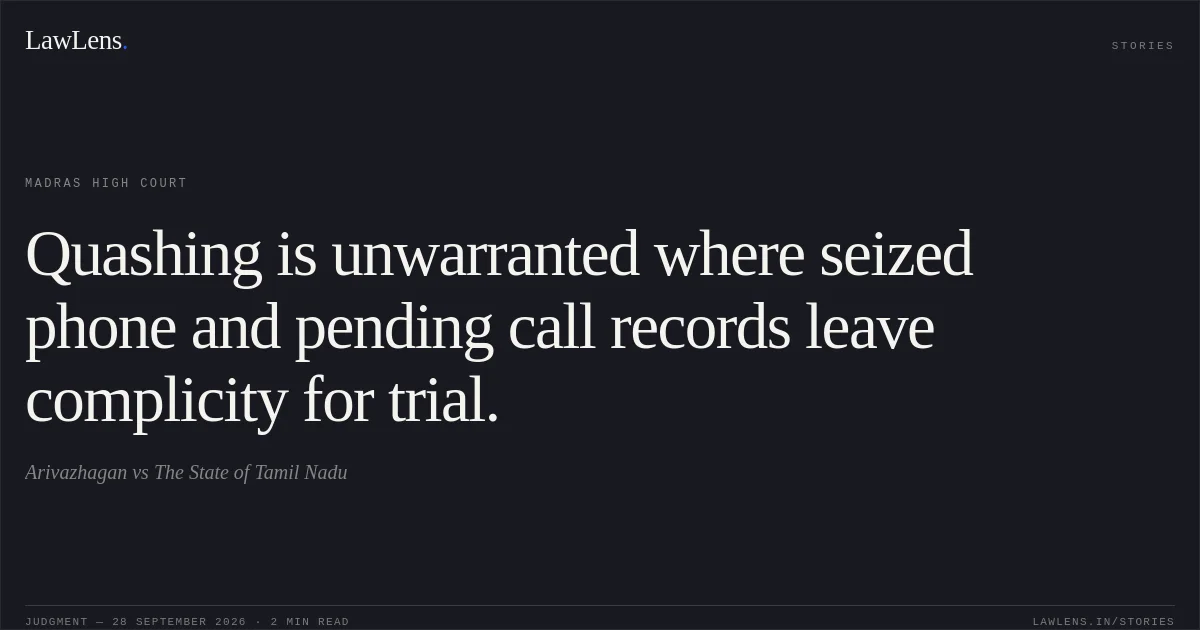
The petitioner, arrayed as A5, sought to quash the proceedings in C.C. No. 72 of 2025, in which he was charged under Sections 8(c), 20(b)(ii)(C), 29(1) and 25 of the NDPS Act.
Source reference: p. 2, paras. 1–4The prosecution alleged that A1–A6 acted together to transport 200 kg of ganja from Andhra Pradesh for smuggling to Sri Lanka; the petitioner argued that no specific overt act or recovery was attributed to him and that he was implicated only through A3’s confession.
Source reference: p. 2, paras. 1–4The prosecution relied on A3’s statement regarding a conference call involving A3, A5 and other accused, the seizure of A5’s mobile phone (M.O.11), and call-detail records (CDRs) that had been requested but were still awaited.
Source reference: pp. 3–4, paras. 5, 7–8Issues
Whether the proceedings against A5 should be quashed where the alleged connection to the offence included A3’s confession and no contraband was recovered from A5.
Source reference: pp. 2–3, paras. 3–4Whether the seized mobile phone and awaited CDRs, together with the prosecution’s allegations, warranted leaving the petitioner’s contentions to be determined at trial.
Source reference: pp. 3–4, paras. 5, 7–8Law Applied
The petition was brought under Section 528 of the Bharatiya Nagarik Suraksha Sanhita, 2023, seeking to quash the criminal proceedings.
Source reference: p. 1The alleged offences were under Sections 8(c), 20(b)(ii)(C), 29(1) and 25 of the Narcotic Drugs and Psychotropic Substances Act, 1985.
Source reference: p. 2, para. 1The order cites no precedent and does not set out a broader legal test for quashing; it holds, on the circumstances before it, that the petitioner’s contentions could be assessed at trial in light of the seized phone and the CDRs awaited by the prosecution.
Source reference: p. 4, paras. 8–9Reasoning
The Court noted that A3’s confession referred to a conference call involving A5, while also recording that A3’s subsequent contact with A5 did not receive a positive response.
Source reference: pp. 3–4, paras. 7–8It further considered that A5’s mobile phone had been seized and marked as M.O.11 and that the CDRs had been sought from the service provider, with the prosecution proposing to place them before the trial court as additional material when received.
Source reference: pp. 3–4, paras. 7–8In those circumstances, the Court declined to determine the evidentiary sufficiency of the prosecution case at the quashing stage and left the petitioner’s objections for consideration during trial.
Source reference: p. 4, para. 8Holding
The Court dismissed the petition, finding no merit in the request to quash the proceedings against A5.
It closed the connected miscellaneous petitions and directed that the trial court decide the case on its own merits, uninfluenced by the observations in the order.
Source reference: p. 4, para. 9Acts & Sections Cited
5 provisions across 2 statutes referred to in this judgment. Each provision opens on LawLens.
Bharatiya Nagarik Suraksha Sanhita, 20231
Narcotic Drugs and Psychotropic Substances Act, 19854
Original Court PDF
ArivazhaganvsThe State of Tamil Nadu
Click to open original judgment
Original judgment, available to read, download and summarize on LawLens.in