Facts
On 23 April 2022, the police raided an alleged illegal IPL betting operation pursuant to secret information and registered FIR No. 170/2022 at Police Station Madan Mahal, Jabalpur, initially for an offence under Section 4-A of the Public Gambling Act.
Source reference: para. 2During investigation, the petitioner, Satish Sanpal, was allegedly identified as the mastermind of the betting racket and was also alleged to have operated fake shell companies and conducted substantial transactions causing loss to the Government.
Source reference: para. 2The police thereafter filed a charge-sheet for offences under Section 4-A of the Public Gambling Act and Sections 109, 112, 114, 120-B and 420 IPC, resulting in RCT No. 5603/2024.
Source reference: para. 2The petitioner sought quashing of the FIR, charge-sheet and consequential proceedings under Section 528 of the Bharatiya Nagarik Suraksha Sanhita, 2023 (“BNSS”).
Source reference: paras. 3–5He contended that he was an NRI residing in Dubai, was absent from India, had no connection with the alleged betting activities or companies, and was implicated only through inadmissible or unreliable Section 161 CrPC statements.
Source reference: paras. 3–5The State opposed the petition, submitting that the charge-sheet disclosed a prima facie case and that the petitioner’s objections involved disputed questions of fact requiring trial.
Source reference: para. 6Issues
1. Whether the FIR, charge-sheet and consequential proceedings should be quashed under Section 528 BNSS on the ground that the material collected during investigation did not disclose the petitioner’s involvement in the alleged betting racket or the commission of any cognizable offence?
Source reference: paras. 8–10, 16–182. Whether the petitioner’s absence from India, residence in Dubai, non-mention in the FIR, alleged lack of connection with the companies and bank accounts, absence of recovery, and challenge to the electronic and witness material justified quashing at the threshold?
Source reference: paras. 10–13, 16–173. Whether the allegations and material were sufficient, at the quashing stage, to warrant examination of the petitioner’s alleged liability under Section 4-A of the Public Gambling Act and the IPC offences of abetment, conspiracy, cheating and related liability?
Source reference: paras. 14–164. Whether the petitioner was entitled to parity with the co-accused whose proceedings arising from the same FIR had earlier been quashed?
Source reference: para. 15Law Applied
The Court applied Section 528 BNSS, corresponding to the inherent jurisdiction formerly exercised under Section 482 CrPC, to determine whether intervention was necessary to prevent abuse of process or secure the ends of justice.
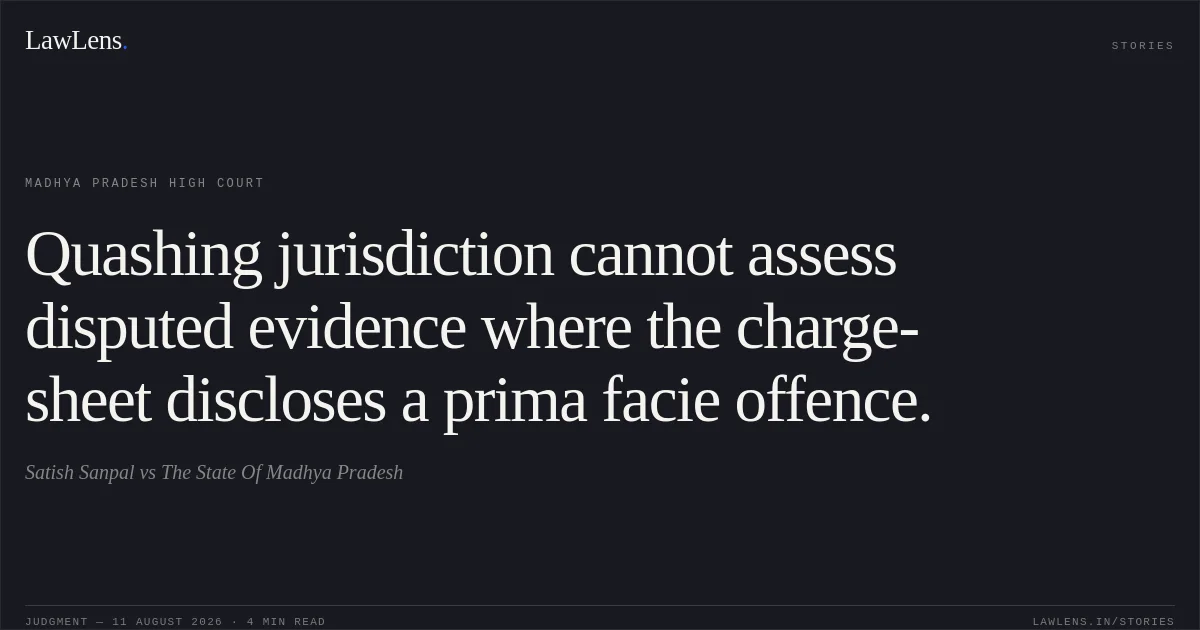
Source reference: paras. 8–9The governing principle is that quashing jurisdiction must be exercised sparingly; the Court may examine whether the allegations and investigation material, taken at face value, disclose a cognizable offence, but it cannot conduct a mini-trial, assess witness credibility, or undertake a detailed appreciation of disputed evidence.
Source reference: paras. 8–9The Court relied on State of Haryana v. Bhajan Lal, Vineet Kumar v. State of U.P., Zandu Pharmaceutical Works Ltd. v. Mohd. Sharaful Haque, and Madhavrao Jiwaji Rao Scindia v. Sambhajirao Chandrojirao Angre for the principles governing quashing of criminal proceedings.
Source reference: para. 5, para. 15It further applied the principle that a person may be implicated during investigation even if not named in the FIR, and that parity is not automatic where the role and evidentiary material against accused persons differ.
Source reference: paras. 11, 15The alleged substantive offences were Section 4-A of the Public Gambling Act and Sections 109, 112, 114, 120-B and 420 IPC.
Source reference: paras. 1, 18Reasoning
The Court held that the charge-sheet contained material which, if accepted at face value, indicated the petitioner’s alleged involvement in the betting operation and therefore warranted adjudication by the trial court.
Source reference: para. 10The petitioner’s reliance on his residence in Dubai and absence from India did not conclusively negate liability because the prosecution alleged involvement through other persons, companies, financial transactions or communications; physical presence at the raid was not an indispensable condition of participation.
Source reference: para. 10His subsequent implication during investigation and the prosecution’s reliance on Section 161 statements did not justify quashing, since the admissibility, credibility and evidentiary value of that material were matters for trial, particularly where other investigative material accompanied the charge-sheet.
Source reference: para. 11Similarly, MCA records, statutory filings by the companies, disputed bank transactions, absence of recovery and alleged lack of electronic links raised factual and evidentiary issues rather than demonstrating that the prosecution was inherently improbable.
Source reference: paras. 12–14The Court also found that the earlier quashing order in favour of a co-accused could not be mechanically extended because parity depends on the specific role and material against each accused.
Source reference: para. 15As the allegations were neither absurd nor inherently improbable and could potentially establish the alleged offences, the case did not fall within the recognised categories for exercise of inherent jurisdiction.
Source reference: paras. 16–18Holding
The Court answered the issues against the petitioner.
It held that the prosecution material disclosed a prima facie case requiring trial and that the petitioner’s defences and challenges to the reliability of the evidence could not be conclusively determined under Section 528 BNSS.
Source reference: paras. 16–18Accordingly, the petition seeking quashing of FIR No. 170/2022, the charge-sheet, RCT No. 5603/2024 and all consequential proceedings was dismissed.
Source reference: paras. 18–19The Court clarified that its observations were confined to the quashing petition and would not prejudice either party during trial; the trial court was directed to decide the case independently on the evidence led before it.
Source reference: para. 19Acts & Sections Cited
8 provisions across 4 statutes referred to in this judgment. Each provision opens on LawLens.
Bharatiya Nagarik Suraksha Sanhita, 20231
Code of Criminal Procedure, 19732
Public Gambling Act, 18671
Indian Penal Code, 18604
Original Court PDF
Satish SanpalvsThe State Of Madhya Pradesh
Click to open original judgment
Original judgment, available to read, download and summarize on LawLens.in