01Facts
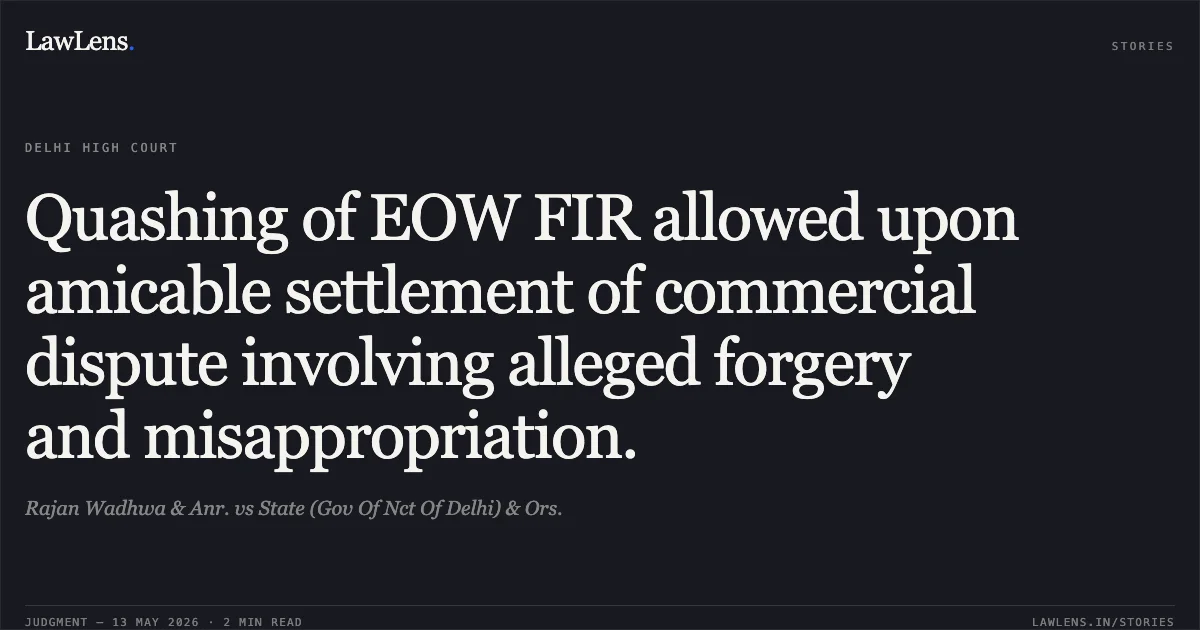
The petitioners sought the quashing of FIR No. 0043/2024 registered at PS Economic Offences Wing involving allegations of cheating, forgery, and criminal breach of trust (Sections 406/409/420/467/468/471/120B IPC).
¶ 1The dispute arose from a joint venture for a road construction project in Rajasthan; PWD funds were allegedly credited to the accused-company’s account instead of the joint venture account based on a purportedly forged General Power of Attorney.
¶ 7–9, 16During the investigation, the parties reached an amicable settlement through the Delhi High Court Mediation & Conciliation Centre, wherein the accused agreed to pay ₹2 crores to the complainant.
¶ 10, 12The Registrar confirmed the settlement was genuine and voluntary.
¶ 302Issues
i.1. Whether the FIR and consequential proceedings should be quashed under Section 528 of the Bharatiya Nagarik Suraksha Sanhita, 2023, on the basis of a compromise between the parties.
¶ 1ii.2. Whether the settlement adversely affects any third-party interest or government organization.
¶ 603Law Applied
The Court exercised its inherent powers under Section 528 of the Bharatiya Nagarik Suraksha Sanhita, 2023 (the successor to Section 482 CrPC), which allows High Courts to quash criminal proceedings to prevent abuse of process or to secure the ends of justice.
¶ 20–21The court relied on the principle that in cases of a predominantly civil or commercial nature, where an amicable settlement has been reached and continued prosecution would be futile, the High Court may quash the FIR.
¶ 19Provisions in the judgment · 7 · Linked ones open on LawLens
Indian Penal Code, 1860 Section 406Section 409Section 420Section 467Section 468Section 471
Bharatiya Nagarik Suraksha Sanhita, 2023 Section 528
04Reasoning
The Court scrutinized the settlement to ensure it was not obtained under pressure.
¶ 3It specifically directed the State to verify if the alleged forgery or financial irregularities caused any loss to public entities like the PWD; the State’s status report confirmed that no loss was caused to any third party or government organization.
¶ 6, 14The court noted that the dispute was essentially between private entities arising from a contractual joint venture and that a substantial portion of the settlement amount (₹1.40 crores) had already been paid, with a clear undertaking for the balance.
¶ 12–13Because the complainant expressed "no objection" and the parties had resolved all related litigations, the court reasoned that continuing the criminal trial would serve no useful purpose and would be an unnecessary burden on the judicial system.
¶ 15, 18, 1905Holding
The Court answered the issues in the affirmative, holding that quashing the FIR was necessary to secure the ends of justice.
¶ 21The Court ordered the quashing of FIR No. 0043/2024 and all consequential proceedings, subject to the petitioners depositing a cost of ₹50,000/- with the Delhi High Court Mediation & Conciliation Centre within four weeks. The petitioners were also directed to submit proof of deposit and original affidavits to the I.O.
¶ 21Original Court PDF
Rajan Wadhwa & Anr.vsState (Gov Of Nct Of Delhi) & Ors.
Click to open original judgment
Original judgment, available to read, download and summarize on LawLens.in