Facts
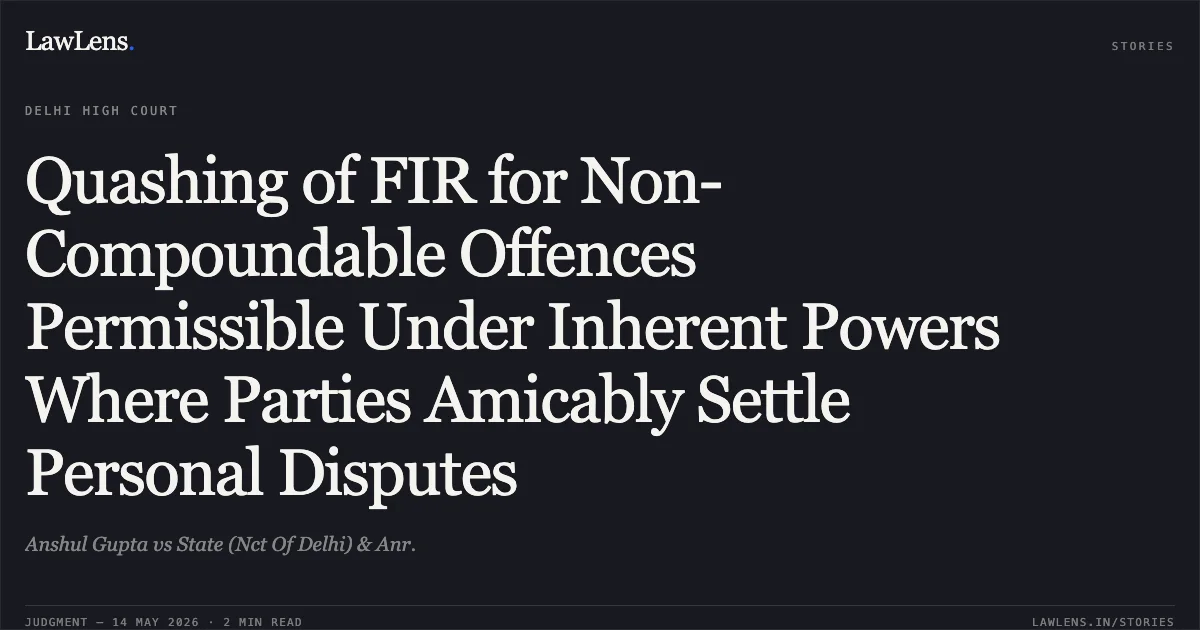
The Petitioner sought the quashing of FIR No. 0137/2020 registered at P.S. Dabri under Sections 354, 506, and 354(D) of the IPC.
Source reference: para. 1The complainant (Respondent No. 2) alleged that the Petitioner, a former friend, threatened her life and intimidated her with the threat of circulating morphed photographs.
Source reference: para. 2Following the filing of the charge-sheet, charges were framed under Sections 354(D) and 506 IPC.
Source reference: para. 4During the trial, the parties entered into a Memorandum of Understanding (MoU) dated 11.03.2026, resolving all disputes amicably without monetary claims.
Source reference: para. 6Both parties have since married and started separate families.
Source reference: paras. 8-9Issues
Whether the High Court should exercise its inherent powers to quash criminal proceedings for non-compoundable offences on the basis of an amicable settlement between the parties.
Source reference: paras. 11-13Law Applied
The Court exercised its inherent powers under Section 528 of the Bharatiya Nagarik Suraksha Sanhita, 2023 (BNSS).
Source reference: para. 13It relied on the principles established in Gian Singh v. State of Punjab & Anr. (2012) 10 SCC 303 and Narinder Singh & Ors. vs. State of Punjab & Anr. (2014) 6 SCC 466, which dictate that proceedings in non-compoundable cases can be quashed if the court is satisfied that continuing the proceedings serves no meaningful purpose and the prospect of conviction is remote or bleak.
Source reference: para. 12Reasoning
The Court observed that the FIR was primarily based on an apprehension of threat, noting that no photographs were actually circulated.
Source reference: para. 3It highlighted that the parties, once friends, had moved on with their respective lives, with Respondent No. 2 having married in 2021.
Source reference: paras. 2, 8The Court took note of the Petitioner’s apology and the Respondent's express forgiveness during the proceedings.
Source reference: para. 10Applying the Narinder Singh doctrine, the Court reasoned that since the parties had settled their private dispute and the complainant no longer wished to pursue the matter, continuing the criminal trial would be a futile exercise and would not serve the ends of justice.
Source reference: paras. 11, 14Holding
The Court answered the issue in the affirmative and quashed FIR No. 0137/2020 and all consequential proceedings.
The holding was made subject to the Petitioner depositing a cost of Rs. 25,000/- with the Delhi High Court Legal Services Committee (DHCLSC) within four weeks and submitting proof of deposit and the original settlement documents to the Trial Court within six weeks.
Source reference: para. 14Acts & Sections Cited
3 provisions across 2 statutes referred to in this judgment. Each provision opens on LawLens.
Indian Penal Code, 18602
Bharatiya Nagarik Suraksha Sanhita, 20231
Original Court PDF
Anshul GuptavsState (Nct Of Delhi) & Anr.
Click to open original judgment
Original judgment, available to read, download and summarize on LawLens.in


