01Facts
The petitioners, former high-ranking officials of Jammu & Kashmir Bank Ltd. (Executive Presidents, President, and VP Law), challenged FIR No. 14/2019.
p. 1, 4An Anti-Corruption Bureau (ACB) verification alleged that the Bank entered into an insurance deal with M/S IFFCO TOKIO General Insurance Co. Ltd. in violation of norms to facilitate the high-salary employment of Asif Manzoor Beigh, a close relative of the then Chairman, Parvez Ahmad Nengroo.
p. 2The FIR alleged that the petitioners, as members of the bid evaluation committee, awarded higher points to IFFCO TOKIO to ensure they secured the contract as part of a conspiracy.
p. 3, 6The deal allegedly caused a loss of Rs. 71.00 lakhs in commission to the Bank.
p. 3The petitioners argued their role was limited to evaluating bids as per IRDA norms and that they had no connection to the beneficiary’s employment.
pp. 7-802Issues
i.1. Whether the allegations in the FIR and the material collected during investigation prima facie constitute a cognizable offence against the petitioners to justify the continuation of criminal proceedings.
¶ 18 / p. 11ii.2. Whether the High Court should exercise its inherent power under Section 528 of the Bhartiya Nagarik Suraksha Sanhita (BNSS) to quash the investigation at this nascent stage.
¶ 27 / p. 2103Law Applied
The court primarily applied the parameters for quashing an FIR as established in State of Haryana v. Bhajan Lal, which permits quashing only if allegations, taken at face value, do not disclose a cognizable offence or are inherently improbable.
¶ 18The court relied on the principles from M/S Neeharika Infrastructure Pvt. Ltd. v. State of Maharashtra, which mandates that courts should not thwart investigations into cognizable offences except in the "rarest of rare cases" and must refrain from embarking on an enquiry into the reliability of evidence at the initial stage.
¶ 19-20The Court also referenced Section 5(1)(d) read with 5(2) of the J&K Prevention of Corruption Act and Section 120-B of the RPC regarding criminal misconduct and conspiracy.
¶ 1, 5Provisions in the judgment · 6 · Linked ones open on LawLens
Bharatiya Nagarik Suraksha Sanhita, 2023 Section 528
Code of Criminal Procedure, 1973 Section 155Section 156Section 173Section 438Section 482
04Reasoning
The Court observed that while the petitioners’ argument regarding the subjectivity of "expert points" in evaluations had prima facie merit, the investigation revealed a "close proximity" and "nexus" between the execution of the Bank-Insurance agreement (12.02.2019) and the appointment of the Chairman’s relative with a significantly hiked salary (13.02.2019).
¶ 23, 21-22The Court found that there were strong incriminating circumstances of a quid pro quo involving the Chairman and the Insurance Company.
¶ 22, 25Regarding the petitioners specifically, the Court held that even if the calculation of financial loss was "imaginary" or variable, the question of whether the Chairman’s presence influenced the committee’s decision or if the petitioners were part of the criminal conspiracy requires a "deeper probe".
¶ 24, 26It reasoned that since facts remain "hazy" and a cognizable offence is prima facie disclosed against the main accused, scuttling the probe against the facilitators at this stage would be premature.
¶ 26-2705Holding
The Court held that when an FIR discloses cognizable offences, the Court cannot usurp the jurisdiction of the police to investigate.
¶ 20, 27The Court refused to quash the proceedings, concluding that the petitioners' role in the alleged conspiracy can only be determined with certainty after a final report is filed.
¶ 27The Court dismissed the petition; liberty was granted to the petitioners to approach the Court afresh after the final report is filed or to seek discharge before the competent trial court.
¶ 28Original Court PDF
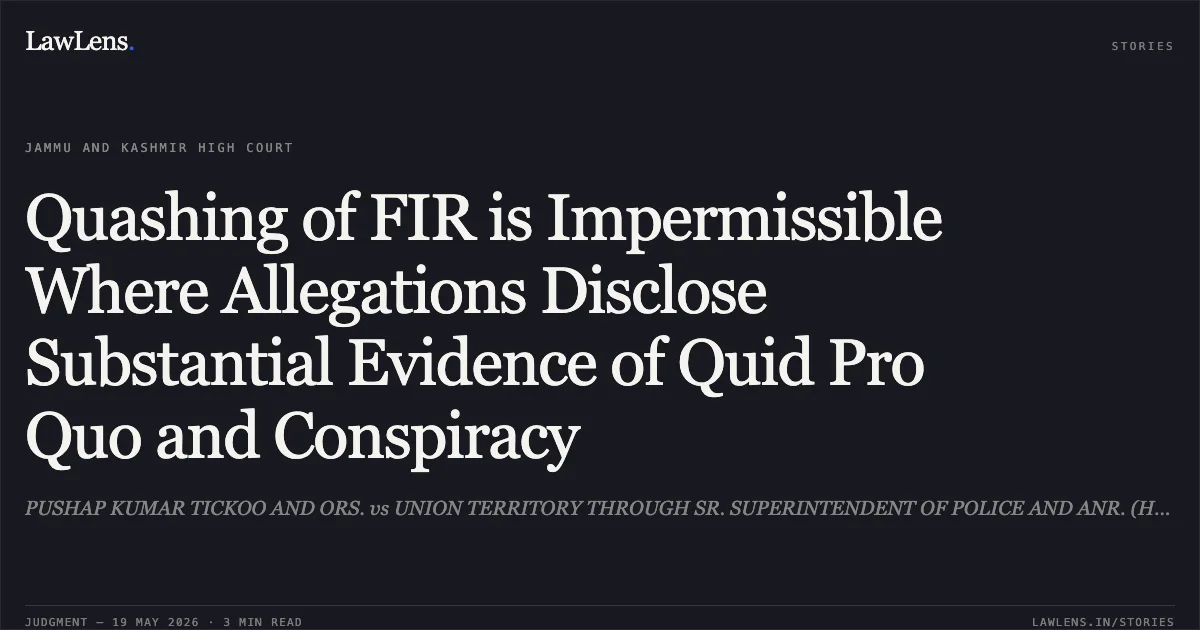
PUSHAP KUMAR TICKOO AND ORS.vsUNION TERRITORY THROUGH SR. SUPERINTENDENT OF POLICE AND ANR. (HOME DEPARTMENT)
Click to open original judgment
Original judgment, available to read, download and summarize on LawLens.in