Facts
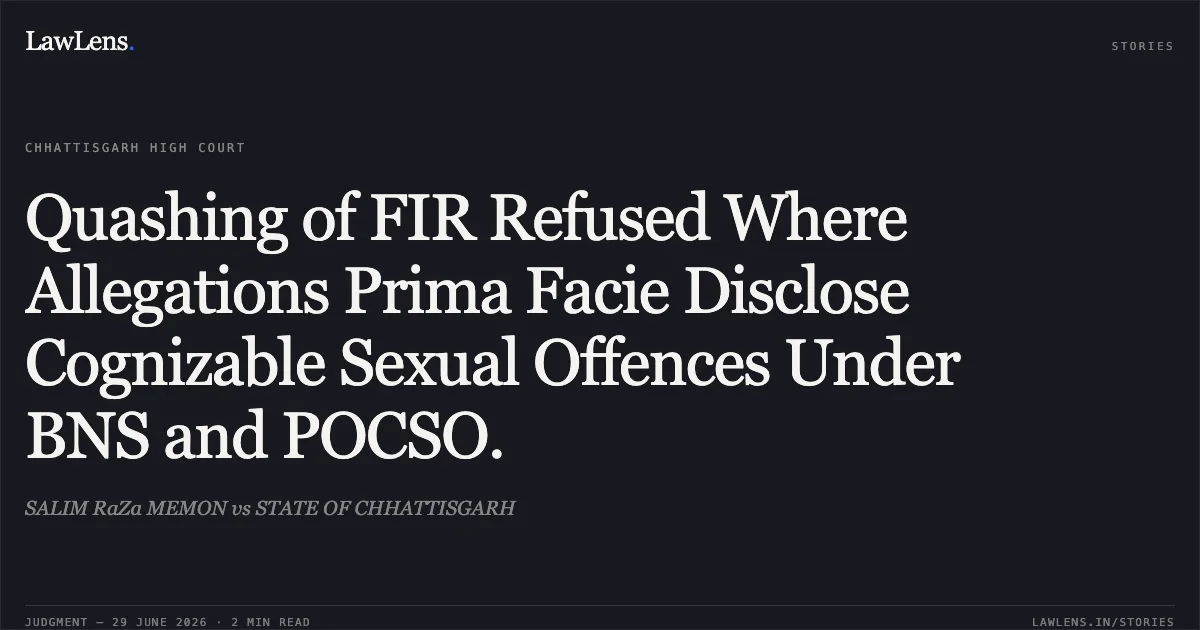
The petitioner sought the quashing of Charge-sheet No. 46/2026 and the order of charges dated 17.04.2026 filed under Sections 62, 64, and 64(2) of the Bharatiya Nyaya Sanhita (BNS) and Sections 6, 7, and 8 of the POCSO Act
Source reference: para 2The prosecution alleged that the petitioner kidnapped and attempted to forcibly disrobe and sexually assault a minor victim in a forest area on 09.11.2025
Source reference: para 3The petitioner contended the FIR was a malicious fabrication by the victim’s family to take vengeance against him for intervening in the victim’s inter-faith marriage
Source reference: para 4He further argued there was a two-month delay in lodging the FIR and pointed to contradictions between the victim’s statements under Sections 180 and 183 of the BNSS
Source reference: para 7, 16Issues
1. Whether the FIR, charge-sheet, and consequential criminal proceedings are liable to be quashed under Section 528 of the BNSS on the grounds of being malicious or failing to disclose a prima facie case
Source reference: para 2, 112. Whether the High Court can conduct a detailed appreciation of evidence or resolve disputed questions of fact regarding contradictions in witness statements during a quashing petition
Source reference: para 13, 14, 18Law Applied
Section 528 of the Bharatiya Nagarik Suraksha Sanhita (BNSS), which grants inherent powers to the High Court to prevent abuse of the process of law
Source reference: para 2, 11The landmark principles from State of Haryana v. Bhajanlal, which established that quashing is permissible only if allegations, taken at face value, do not constitute an offence
Source reference: para 6, 12Neeharika Infrastructure Pvt. Ltd. v. State of Maharashtra, holding that the power to quash must be exercised sparingly and only in "exceptional cases"
Source reference: para 13Pradeep Kumar Kesharwani v. State of U.P., which settled that disputed questions of fact and the reliability of allegations are matters for trial, not a mini-trial at the quashing stage
Source reference: para 14Reasoning
The Court observed that for the purpose of a quashing petition, it must only examine whether the allegations disclose a cognizable offence when taken at face value
Source reference: para 13While the petitioner alleged the case was born of communal vengeance and highlighted contradictions in the victim's Section 183 BNSS statement (where she alleged full intercourse versus earlier claims of attempt), the Court held that these are matters of evidence and "disputed questions of fact"
Source reference: para 16, 18The Court found that the material collected—including the victim’s written complaint, MLC report, and witness statements—indicated a prima facie case
Source reference: para 15, 17It rejected the petitioner’s claim of parity with a co-accused (who received interim relief), noting that the co-accused was an advocate with no direct allegations, whereas the petitioner faced specific allegations of physical assault
Source reference: para 16Holding
The Court answered the issues in the negative, holding that the allegations were not "inherently improbable" or "manifestly frivolous" so as to warrant intervention at the threshold
The High Court is not a trial court and cannot undertake a "roving enquiry" into the admissibility of evidence. Consequently, the petition was dismissed, and the trial court was directed to proceed independently without being influenced by the observations made in this order
Source reference: para 18, 20, 21Acts & Sections Cited
11 provisions across 4 statutes referred to in this judgment. Each provision opens on LawLens.
Bharatiya Nagarik Suraksha Sanhita, 20233
Bharatiya Nyaya Sanhita, 20234
Code of Criminal Procedure, 19731
Original Court PDF
SALIM RaZa MEMONvsSTATE OF CHHATTISGARH
Click to open original judgment
Original judgment, available to read, download and summarize on LawLens.in