Facts
The petitioner (husband) and respondent No. 2 (wife) were married on February 25, 2025. On November 25, 2025, the wife lodged FIR No. 182/2025 at Police Station Deori, alleging physical and mental harassment, specifically an incident where the petitioner beat her during pregnancy.
Source reference: para 2Charges were filed under Sections 296, 115(2), 351(3), 85, 88, and 89 of the Bharatiya Nyaya Sanhita (BNS), 2023, and the matter was committed to the Court of the First Additional Session Judge, Balod as Session Case No. 22/2026.
Source reference: para 2During the pendency of the proceedings, the High Court referred the matter to mediation, where the parties executed a settlement agreement on April 30, 2026, including a permanent alimony payment of ₹4,00,000 and the filing for mutual divorce.
Source reference: paras 3, 6Issues
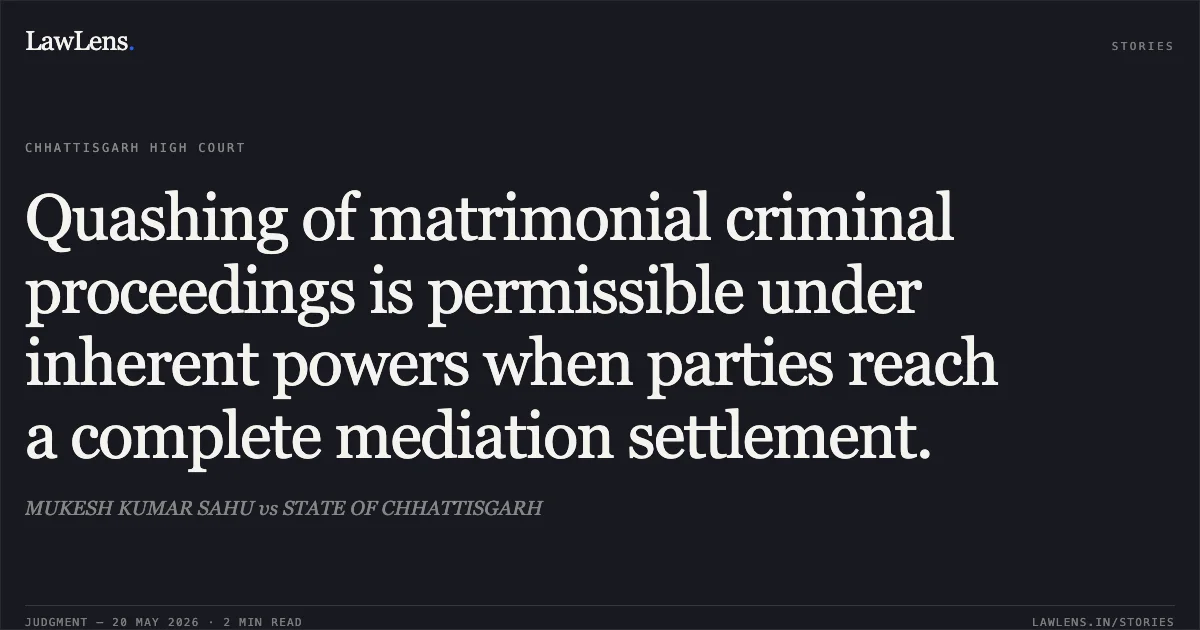
1. Whether the High Court should exercise its inherent power under Section 528 of the BNSS, 2023, to quash criminal proceedings in a matrimonial dispute where the parties have reached a full and final settlement.
Source reference: para 12. Whether the continuation of criminal proceedings would amount to an abuse of the process of law when the chances of conviction are remote due to the compromise.
Source reference: paras 10-11Law Applied
Section 528 of the Bharatiya Nagarik Suraksha Sanhita (BNSS), 2023 (formerly Section 482 of the CrPC), which grants the High Court inherent powers to secure the ends of justice.
Source reference: para 1The landmark principles established in Gian Singh v. State of Punjab [2012 (10) SCC 303], which distinguishes between heinous crimes and private matrimonial disputes for the purpose of quashing.
Source reference: para 8Narinder Singh v. State of Punjab [2014 (6) SCC 466], emphasizing that the timing of a settlement and the remote possibility of conviction are crucial factors in exercising quashing powers.
Source reference: para 9B.S. Joshi v. State of Haryana [2003 (4) SCC 675], which supports the compounding of matrimonial offences to encourage settlement.
Source reference: para 11Reasoning
The Court observed that the dispute between the petitioner and respondent No. 2 was predominantly personal and matrimonial in nature.
Source reference: para 7Applying the Gian Singh doctrine, the Court reasoned that while heinous crimes like murder or rape cannot be quashed via settlement, matrimonial disputes fall into a category where the wrong is private and the parties have resolved their differences.
Source reference: para 8The Court noted that the parties had already appeared before the mediation center and settled the matter on specific financial and legal terms.
Source reference: paras 3-6Consequently, the Court found that forcing the trial to continue would be an exercise in futility, as the wife (complainant) is unlikely to support the prosecution’s case, rendering the possibility of conviction "remote and bleak".
Source reference: para 10Therefore, quashing the proceedings was necessary to prevent the petitioner from facing "great oppression and extreme injustice".
Source reference: para 8Holding
The Court allowed the petition and quashed FIR No. 182/2025, the final report (charge sheet) No. 28/2026, the cognizance order dated March 11, 2026, and the proceedings in Session Case No. 22/2026.
The holding is subject to the parties fulfilling the terms of the compromise agreement dated April 30, 2026. The Court concluded that quashing the case was required to secure the ends of justice and terminate a dispute that the parties had amicably buried.
Source reference: paras 11-13Acts & Sections Cited
10 provisions across 3 statutes referred to in this judgment. Each provision opens on LawLens.
Bharatiya Nagarik Suraksha Sanhita, 20232
Bharatiya Nyaya Sanhita, 20236
Code of Criminal Procedure, 19732
Original Court PDF
MUKESH KUMAR SAHUvsSTATE OF CHHATTISGARH
Click to open original judgment
Original judgment, available to read, download and summarize on LawLens.in


