Facts
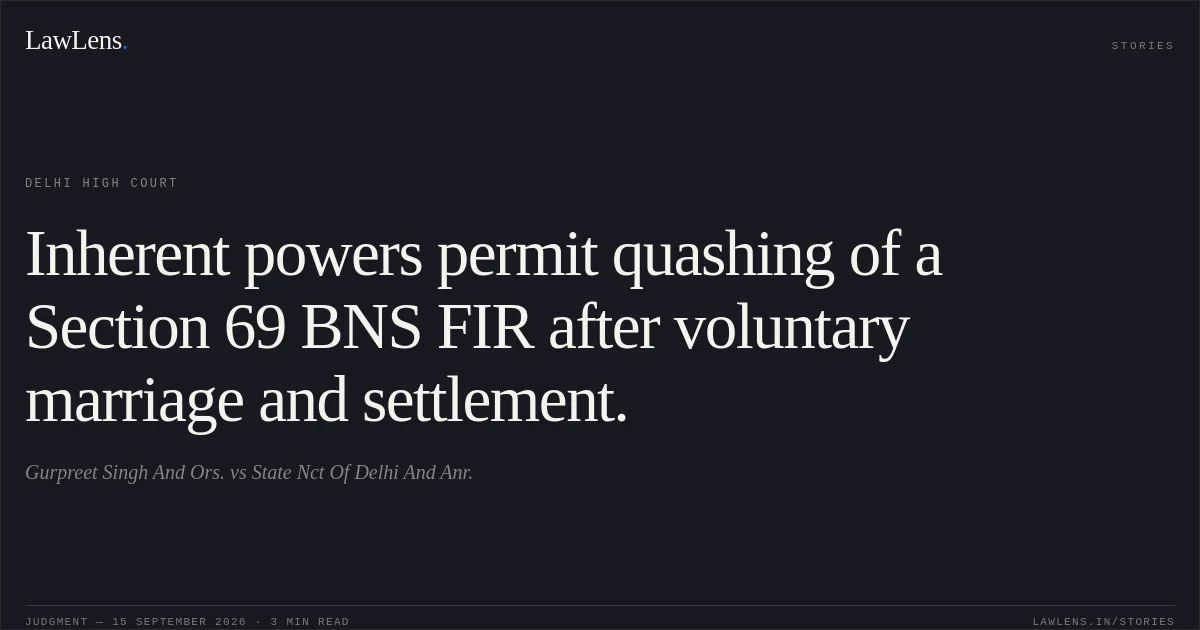
The FIR (No. 177/2021) was initially filed by Petitioner No. 2 (the father) after his daughter (Respondent No. 2) went missing in April 2021
Source reference: p. 1, para. 2Upon recovery, Respondent No. 2 stated u/s 164 Cr.P.C. that she had voluntarily married Petitioner No. 1 and was living happily in Chandigarh
Source reference: p. 1–2, para. 3Although her school certificate suggested she was a major, an investigation into birth records determined her age to be 17 years and 4 months at the time of elopement
Source reference: p. 2, para. 5Consequently, Petitioner No. 1 was charge-sheeted u/s 363/376 IPC and Section 6 of the POCSO Act, while the father was charge-sheeted u/s 323 IPC and Section 75 of the JJ Act
Source reference: p. 2, para. 6The parties subsequently entered into an amicable settlement and approached the High Court for quashing of the proceedings
Source reference: p. 2, para. 9Issues
Whether the High Court should exercise its inherent power to quash criminal proceedings involving non-compoundable and serious offences (POCSO/376 IPC) on the basis of a settlement to protect a subsisting matrimonial life.
Source reference: p. 3–4, paras. 11–13Law Applied
The Court exercised its inherent power under Section 528 of the Bhartiya Nagarik Suraksha Sanhita (BNSS) (corresponding to Section 482 of the Cr.P.C.)
Source reference: p. 3, para. 11It relied on the precedent of Narinder Singh & Ors. vs. State of Punjab & Anr., which establishes that non-compoundable cases can be quashed if the court is satisfied that the scope of conviction is remote and no meaningful purpose is served by continuing the proceedings
Source reference: p. 3, para. 11Furthermore, it followed the approach in XXX v. State of Kerala (2026) and Afsar Ali v. State of Uttarakhand (2026), where proceedings under the POCSO Act were quashed to maintain peaceful matrimonial life after the victim married the accused
Source reference: p. 3, para. 12Reasoning
The Court interacted with Respondent No. 2, who affirmed that she had married Petitioner No. 1 voluntarily and they now have two minor children
Source reference: p. 2–3, para. 9The Court observed that although the Investigating Agency's record placed her age slightly below 18 at the time of the incident, she eloped under the bona fide belief that she was a major based on her 10th-grade certificate
Source reference: p. 3, para. 9The Court noted that the mother of the victim now approved of the marriage and expressed that continuing the prosecution would cause "fear and unrest" for the family
Source reference: p. 3, para. 10Reasoning that the "scope of conviction was remote and bleak" and that quashing was necessary to secure the "ends of justice" and the stability of the matrimonial home, the Court determined that the technicality of the age difference should not override the current welfare of the family
Source reference: p. 3–4, paras. 11–14Holding
The Court answered the issue in the affirmative, holding that to secure the ends of justice and maintain the matrimonial life of the parties, the inherent powers of the High Court must be exercised
The Court quashed FIR No. 177/2021 (P.S. Subzi Mandi) and all consequential proceedings arising therefrom
Source reference: p. 4, para. 14Acts & Sections Cited
5 provisions across 3 statutes referred to in this judgment. Each provision opens on LawLens.
Indian Penal Code, 18603
Bharatiya Nagarik Suraksha Sanhita, 20231
Protection of Children from Sexual Offences Act, 20121
Original Court PDF
S Sarvjeet Singh And AnrvsThe State Govt. Of Nct Of Delhi And Anr.
Click to open original judgment
Original judgment, available to read, download and summarize on LawLens.in