Facts
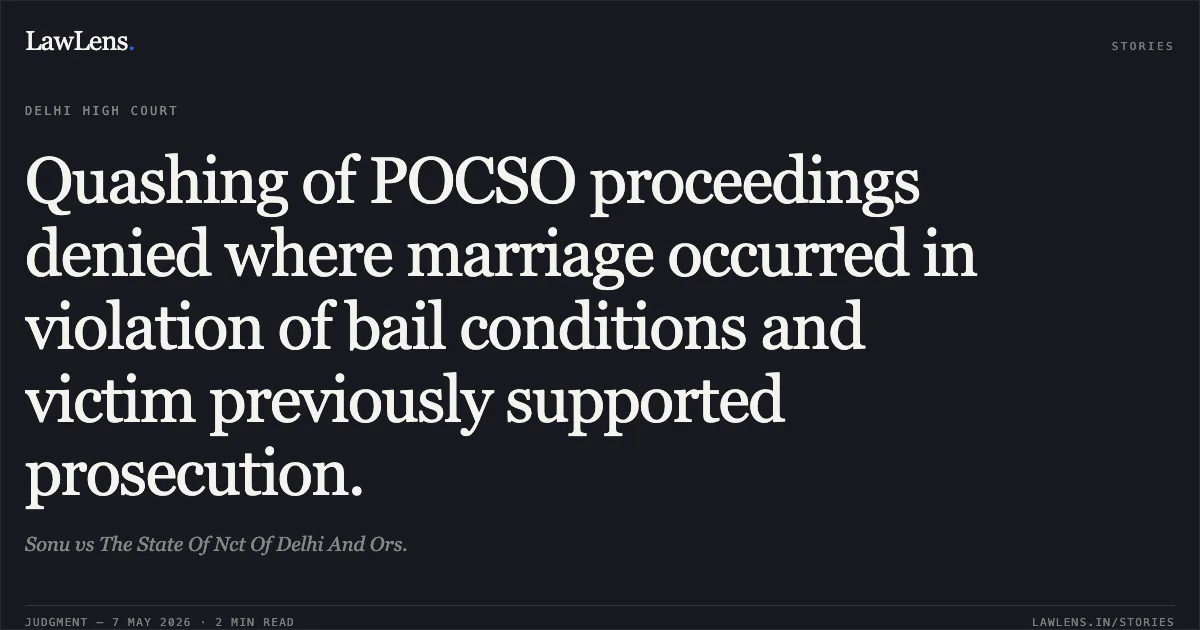
The petitioner sought quashing of FIR No. 269/2022 registered under Section 363 IPC, later expanded to include Sections 376, 506 IPC and Section 4 of the POCSO Act.
Source reference: p. 1-2The FIR was filed after the prosecutrix (then aged 16) went missing; however, she later returned and supported the prosecution’s case in her Section 164 CrPC statement and trial testimony.
Source reference: p. 2, 7The petitioner (aged 21 at the time of the incident) and the prosecutrix married on 10.07.2024 and have a child born on 11.06.2025.
Source reference: p. 2The petitioner moved for quashing on the ground of settlement and marital harmony, despite a previous quashing petition being dismissed without liberty in 2025 and the trial reaching the stage of final judgment.
Source reference: p. 3Issues
1. Whether criminal proceedings involving heinous offences under the POCSO Act can be quashed on the ground of a subsequent marriage and settlement between the accused and the victim
Source reference: p. 4/para. 92. Whether the petitioner’s conduct, including an alleged violation of bail conditions and a prior dismissed petition, precludes the exercise of inherent powers under Section 528 of the Bharatiya Nagarik Suraksha Sanhita (BNSS)
Source reference: p. 7-8/para. 15-16Law Applied
The Court applied Section 528 of the BNSS regarding the inherent powers of the High Court.
Source reference: p. 1It relied on the Supreme Court precedents of Gian Singh v. State of Punjab and Narinder Singh v. State of Punjab, which establish that while inherent powers allow quashing of non-compoundable offences to meet the ends of justice, an exception exists for heinous offences like rape.
Source reference: p. 4Historically, the Court integrated the principles from Harmeet Singh v. State (NCT of Delhi), which provides "guardrails" for POCSO quashing, requiring the court to verify if the victim consistently disclaimed injury, if the marriage is a ruse to evade punishment, and if the acts were truly volitional.
Source reference: p. 4-6Reasoning
The Court conducted a holistic examination of the facts against the Harmeet Singh criteria. It noted that unlike cases where quashing is permissible, the prosecutrix here did not maintain a consistent stand in favor of the petitioner; she supported the prosecution during her Section 164 CrPC statement and trial.
Source reference: p. 7The Court highlighted the significant age gap (16 vs 21) at the time of the incident, casting doubt on the "volitional" nature of the act.
Source reference: p. 7Furthermore, the Court found that the petitioner had "violated with impunity" a specific bail condition dated 03.01.2023 that prohibited him from contacting the victim or her family.
Source reference: p. 7-8Lastly, since the trial was at the "fag end" (fixed for judgment on 11.05.2026) and a prior identical petition had been dismissed without liberty, the Court found no "exceptional circumstances" to justify interference.
Source reference: p. 7-8Holding
The Court answered the issues in the negative and dismissed the petition.
It held that the case did not meet the stringent requirements for quashing POCSO proceedings based on settlement, particularly due to the prosecutrix's initial incriminating testimony, the violation of judicial bail conditions, and the advanced stage of the trial.
Source reference: p. 7-8/para. 17-18The next hearing date was cancelled and dasti copy of the order was authorized.
Source reference: p. 8Acts & Sections Cited
6 provisions across 3 statutes referred to in this judgment. Each provision opens on LawLens.
Bharatiya Nagarik Suraksha Sanhita, 20232
Code of Criminal Procedure, 19732
Original Court PDF
SonuvsThe State Of Nct Of Delhi And Ors.
Click to open original judgment
Original judgment, available to read, download and summarize on LawLens.in