Facts
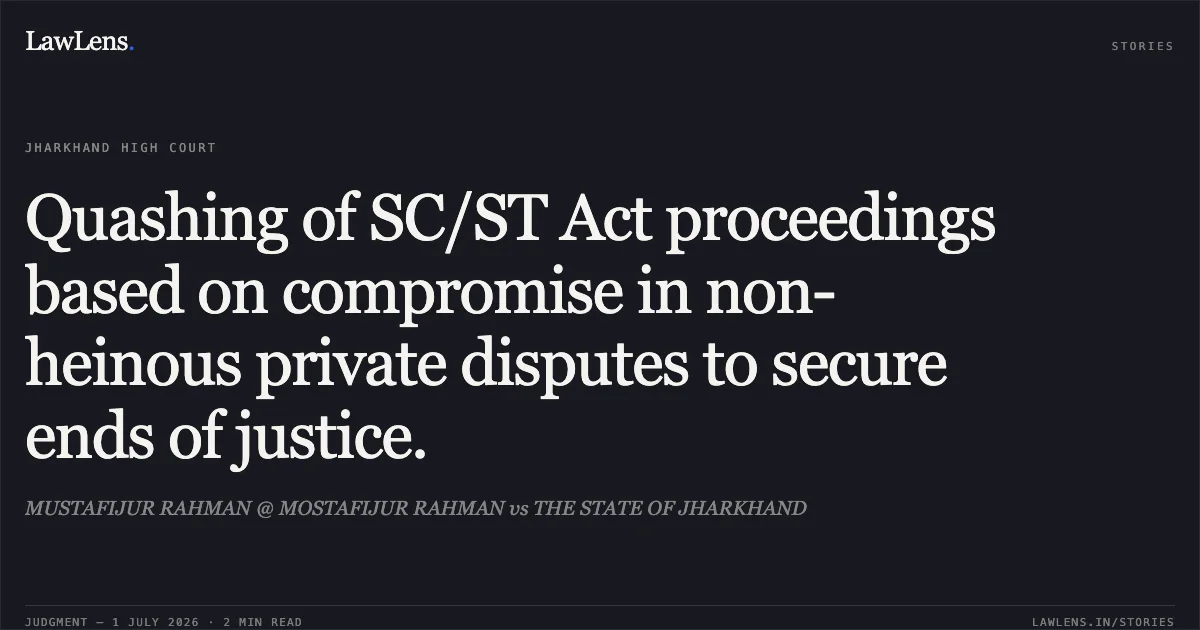
The petitioners moved the High Court to quash the criminal proceedings and FIR in Barharwa P.S. Case No. 79 of 2025.
Source reference: para. 2The case involved allegations under various sections of the Bharatiya Nyaya Sanhita (BNS), 2023, including Sections 190, 191, 126(2), 115(2), 118(1), 352, 351(2), and 109(2), as well as several provisions of the Scheduled Castes and the Scheduled Tribes (Prevention of Atrocities) Act, 1989.
Source reference: para. 2During the pendency of the petition, the parties filed Interlocutory Application No. 7663 of 2026, supported by affidavits, stating that the dispute—originating from a "petty" misunderstanding—had been amicably settled through the intervention of well-wishers and village elders.
Source reference: para. 3The informant (Opposite Party No. 2) expressed her desire not to proceed with the case.
Source reference: para. 3Issues
1. Whether the High Court should exercise its inherent power under Section 528 of the Bharatiya Nagarik Suraksha Sanhita (BNSS), 2023, to quash criminal proceedings involving non-compoundable offences on the basis of a compromise between the parties.
Source reference: para. 2-5Law Applied
The court primarily applied Section 528 of the Bharatiya Nagarik Suraksha Sanhita, 2023 (the successor to Section 482 of the Cr.P.C.), which saves the inherent power of the High Court to prevent abuse of the process of law or to secure the ends of justice.
Source reference: para. 2, 5It relied heavily on the precedent of Parbatbhai Aahir @ Parbatbhai Bhimsinhbhai Karmur and Others v. State of Gujarat and Another (2017) 9 SCC 641, which incorporated principles from Gian Singh v. State of Punjab (2012) 10 SCC 303.
Source reference: para. 5These precedents establish that while heinous crimes (murder, rape, etc.) or offences involving public policy/special statutes like the Prevention of Corruption Act cannot be quashed via compromise, the High Court may quash proceedings of a private or personal nature if the possibility of conviction is remote and continuation would cause extreme injustice.
Source reference: para. 5Reasoning
The court evaluated the transition from a criminal dispute to a compromise by applying the gravity test established in Parbatbhai Aahir.
Source reference: para. 5It observed that although the FIR included provisions of the SC/ST Act, the genesis of the occurrence was a "petty dispute" and a result of misunderstanding rather than deep-seated "mental depravity" or a heinous crime.
Source reference: para. 3, 6Because the parties reached a full settlement, the court reasoned that the chances of conviction were "remote and bleak".
Source reference: para. 3The court concluded that no public policy was at stake and that forcing the criminal trial to continue despite the settlement would result in unnecessary hardship and oppression for the petitioners, thereby failing to "secure the ends of justice".
Source reference: para. 6-7Holding
The High Court answered the issue in the affirmative, holding that the settlement rendered the continuation of proceedings an exercise in futility.
The court quashed the FIR and the entire criminal proceeding in connection with Barharwa P.S. Case No. 79 of 2025 against the petitioners.
Source reference: para. 8Consequently, the Criminal Miscellaneous Petition and the associated Interlocutory Application were allowed and disposed of respectively.
Source reference: para. 9-10Acts & Sections Cited
10 provisions across 3 statutes referred to in this judgment. Each provision opens on LawLens.
Bharatiya Nagarik Suraksha Sanhita, 20231
Bharatiya Nyaya Sanhita, 20238
Scheduled Castes and the Scheduled Tribes (Prevention of Atrocities) Act, 19891
Original Court PDF
MUSTAFIJUR RAHMAN @ MOSTAFIJUR RAHMANvsTHE STATE OF JHARKHAND
Click to open original judgment
Original judgment, available to read, download and summarize on LawLens.in