Facts
The Petitioner, a former director of the Opposite Party (OP) company, resigned on 09.10.2023 after a board resolution where he agreed to transfer shares in exchange for ₹1,30,00,000/-.
Source reference: p. 2The Petitioner claims a debt remains, whereas the OP asserts full payment was made.
Source reference: p. 2On 22.04.2024, the OP's Managing Director was alerted by ICICI Bank regarding a high-value cheque of ₹75,00,000/- presented by the Petitioner.
Source reference: p. 4The OP alleges the Petitioner illegally retained and forged this cheque from a book used in 2022 while he was an authorized signatory.
Source reference: p. 4-5Consequently, the Petitioner filed a complaint (1CC No. 5401 of 2024) under the N.I. Act and IPC, while the OP filed a counter-complaint (1CC No. 6144 of 2024) alleging forgery and criminal breach of trust.
Source reference: p. 5-6The Petitioner approached the High Court seeking to quash the summons issued by the S.D.J.M., Bhubaneswar, in the OP's counter-case.
Source reference: p. 1, 6Issues
1. Whether the criminal proceedings against the Petitioner for forgery and cheating ought to be quashed under Section 482 Cr.P.C. on the ground that the dispute is civil/commercial in nature.
Source reference: p. 62. Whether the court should interfere at the preliminary stage of summoning when factual disputes regarding the validity of a debt and the authenticity of a cheque exist.
Source reference: p. 9-10Law Applied
The court applied the inherent powers of the High Court under Section 482 of the Cr.P.C. (now Section 528 BNSS) meant to prevent abuse of process.
Source reference: p. 9It relied on the landmark principles from State of Haryana v. Bhajan Lal, which define categories where quashing is permissible.
Source reference: p. 7, 9It applied the doctrine from Neeharika Infrastructure Pvt. Ltd. v. State of Maharashtra, prohibiting the High Court from conducting a "mini-trial" at the quashing stage.
Source reference: p. 9It followed Rathish Babu Unnikrishnan v. State (NCT of Delhi), which establishes that when legal presumptions exist and facts are contested, the quashing court should not separate "wheat from the chaff" but allow the trial court to evaluate evidence.
Source reference: p. 10-11Reasoning
The court reasoned that the allegations in the complaint—specifically the fraudulent presentation of a cheque allegedly retained without authority—prima facie disclose cognizable offences including criminal breach of trust (Sec. 406 IPC) and forgery (Sec. 465, 467, 468 IPC).
Source reference: p. 8The Court noted that the Learned S.D.J.M. had conducted the requisite inquiry under Sections 200 and 202 Cr.P.C. before issuing summons.
Source reference: p. 8It observed that the existence of a business transaction or a parallel proceeding under Section 138 of the N.I. Act does not bar prosecution for independent criminal acts like forgery arising from the same transaction.
Source reference: p. 9Per Rathish Babu Unnikrishnan, the Court emphasized that scuttling criminal process at a "nascent stage" when the factual controversy is yet to be canvassed would be injudicious and might grant the accused an unmerited advantage.
Source reference: p. 10-11Holding
The High Court dismissed the CRLMC, refusing to quash the summoning order dated 09.09.2024.
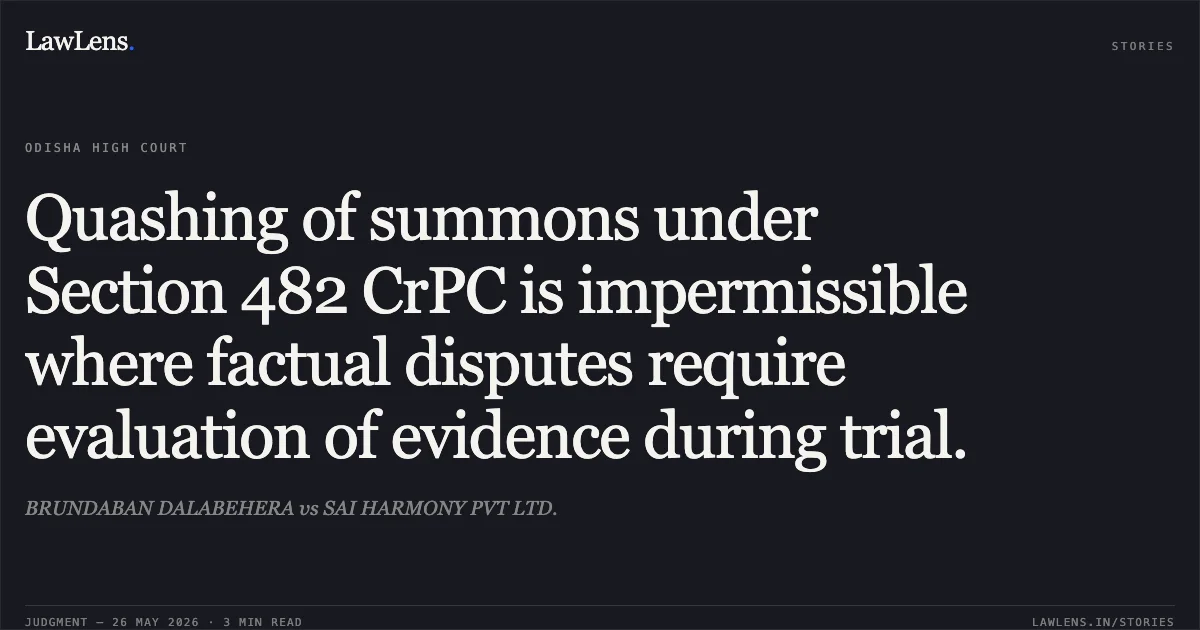
The Court held that at the preliminary stage, if the complaint discloses the commission of an offence, the truth of the allegations must be determined through a trial rather than a summary evaluation of merits by the High Court.
Source reference: p. 10The parties were directed to comply with the summons and any interim orders were vacated.
Source reference: p. 11Acts & Sections Cited
17 provisions across 4 statutes referred to in this judgment. Each provision opens on LawLens.
Bharatiya Nagarik Suraksha Sanhita, 20231
Code of Criminal Procedure, 19733
Indian Penal Code, 1860
Negotiable Instruments Act, 18811
Original Court PDF
BRUNDABAN DALABEHERAvsSAI HARMONY PVT LTD.
Click to open original judgment
Original judgment, available to read, download and summarize on LawLens.in


