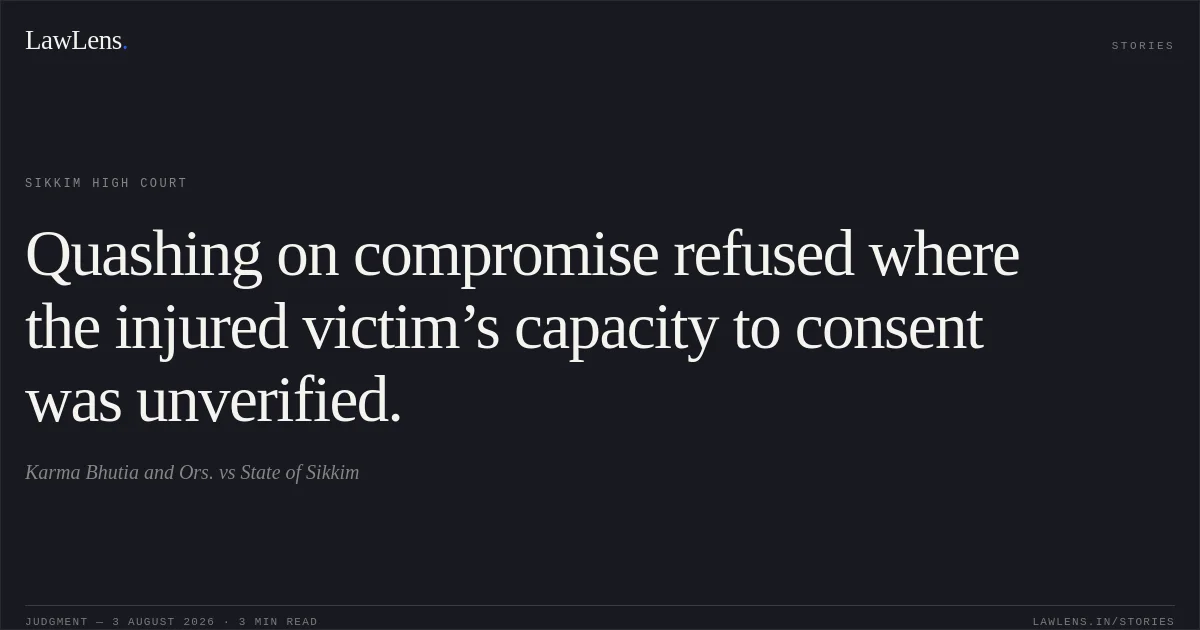
Facts
The petitioners invoked Section 528 of the Bharatiya Nagarik Suraksha Sanhita, 2023 (“BNSS”) seeking quashing of FIR No. Singtam 137/2024 and the consequential charge-sheet.
Source reference: para. 1–3Petitioner No. 1, Karma Bhutia, and Petitioner No. 2, Leela Bhujel @ Neelu Bhutia, were accused of assaulting Petitioner No. 4, an approximately 80-year-old woman and Karma Bhutia’s mother, with a sharp weapon on 11 September 2024, causing injuries to her head and leg.
Source reference: para. 1–3Petitioner No. 3, Sonam Wangdi Bhutia, was the complainant whose complaint resulted in registration of the FIR on 12 September 2024.
Source reference: para. 1–3The police subsequently filed a charge-sheet alleging offences under Sections 118(2) and 3(5) of the Bharatiya Nyaya Sanhita, 2023 (“BNS”).
Source reference: para. 4On 13 January 2026, the accused, the victim, and the complainant allegedly entered into a compromise deed bearing the victim’s thumb impression.
Source reference: para. 5The petition for quashing was filed nearly five months later, on 8 June 2026, and the victim died two days thereafter.
Source reference: para. 5The compromise deed contained no independent assessment of the victim’s mental condition or capacity to understand the document, despite her advanced age and prior head injury.
Source reference: para. 6–7Issues
Whether the High Court should exercise its inherent jurisdiction under Section 528 BNSS to quash the FIR and charge-sheet on the basis of the purported compromise between the accused, the victim, and the complainant.
Source reference: para. 1, 7Whether the purported compromise could be relied upon when the victim’s mental state and capacity to understand the deed had not been independently established.
Source reference: para. 6–7Law Applied
The Court applied Section 528 BNSS, which preserves the High Court’s inherent powers to make orders necessary to give effect to the BNSS, prevent abuse of the process of any court, or otherwise secure the ends of justice.
Source reference: para. 1, 7It also considered Section 118(2) BNS, concerning voluntarily causing grievous hurt by means of an instrument capable of causing death, an offence punishable with imprisonment for life or imprisonment ranging from one to ten years and fine.
Source reference: para. 4Section 3(5) BNS was applied as the provision imposing joint liability where a criminal act is committed by several persons in furtherance of their common intention.
Source reference: para. 4The Court recognised that inherent powers may be exercised to secure complete justice, but declined to quash the prosecution where the purported settlement was surrounded by uncertainty regarding the victim’s capacity and voluntariness.
Source reference: para. 7Reasoning
The Court found that the alleged offence involved a serious assault on an elderly victim with a sharp weapon and that a charge-sheet had already been filed under Section 118(2) read with Section 3(5) BNS.
Source reference: para. 2–4Although the petitioners relied on the compromise deed, the Court noted that it was executed by obtaining the victim’s thumb impression and did not contain, or arise from, any independent assessment of her mental state or capacity to comprehend its contents.
Source reference: para. 6–7Her advanced age and serious head injury made it difficult to determine whether the compromise was informed and voluntary.
Source reference: para. 6–7The delay between the alleged compromise and the filing of the quashing petition, followed by the victim’s death two days after filing, further prevented the Court from safely relying on the settlement.
Source reference: para. 5, 7In these circumstances, exercising inherent jurisdiction to terminate the prosecution would not secure the ends of justice; the accused were instead required to face trial and establish their defence before the competent court.
Source reference: para. 5, 7Holding
The Court answered the issues against the petitioners and held that this was not a fit case for exercising the inherent jurisdiction under Section 528 BNSS.
The purported compromise was insufficient to justify quashing the FIR and charge-sheet because the victim’s mental capacity and comprehension at the time of execution had not been independently established.
Source reference: para. 7The petition was accordingly rejected, leaving the accused to face trial before the competent court.
Source reference: para. 8Acts & Sections Cited
3 provisions across 2 statutes referred to in this judgment. Each provision opens on LawLens.
Bharatiya Nagarik Suraksha Sanhita, 20231
Bharatiya Nyaya Sanhita, 20232
Original Court PDF
Karma Bhutia and Ors.vsState of Sikkim
Click to open original judgment
Original judgment, available to read, download and summarize on LawLens.in
![Relief is made contingent on the Supreme Court’s eventual determination in the analogous pending case.. Ashok Tolani vs REVENUE. CAT - ['Jaipur']. LawLens](/stories/thumbnails/relief-is-made-contingent-on-the-supreme-courts-eventual-determination-in-the-analogous-pe-0a05b6600e0644cf9facfda571d15955.webp)