Facts
The applicants invoked Section 528 of the Bharatiya Nagarik Suraksha Sanhita, 2023, seeking quashing of FIR C.R. No. 06 of 2020 registered at the ACB Police Station, Ahmedabad City, and the consequential charge-sheet in ACB Case No. 04 of 2021, concerning alleged offences under Sections 7, 12, 13(1) and 13(2) of the Prevention of Corruption Act, 1988.
Source reference: p.1Before approaching the High Court, the applicants had filed applications under Section 227 of the Code of Criminal Procedure before the Trial Court. By orders dated 11 June 2026, the Trial Court discharged them from the offences under Sections 13(1) and 13(2) of the Prevention of Corruption Act but rejected their applications concerning Sections 7(a), 7(b), 7(c) and 12.
Source reference: pp.3–4Those orders were not challenged and consequently attained finality.
Source reference: p.4The prosecution material included an audio recording and transcript indicating that Applicant No. 1 allegedly demanded illegal gratification and Applicant No. 2 accepted it; the FSL report stated that the recorded voices probably belonged to the applicants.
Source reference: p.5Issues
Whether the application under Section 528 of the BNSS was maintainable after the applicants had unsuccessfully sought discharge under Section 227 CrPC in respect of the offences under Sections 7 and 12 of the Prevention of Corruption Act, and had not challenged the Trial Court’s orders?
Source reference: pp.3–4Whether the FIR, charge-sheet and consequential proceedings were liable to be quashed on the grounds that the recording device had not been seized, the FSL opinion was not conclusive, and there was allegedly insufficient material showing demand and acceptance of illegal gratification?
Source reference: pp.2–3, 4–5Law Applied
The Court applied Section 528 of the BNSS, 2023, concerning the High Court’s inherent jurisdiction to prevent abuse of process and secure the ends of justice, alongside Section 227 CrPC governing discharge at the trial stage and Sections 7 and 12 of the Prevention of Corruption Act, 1988.
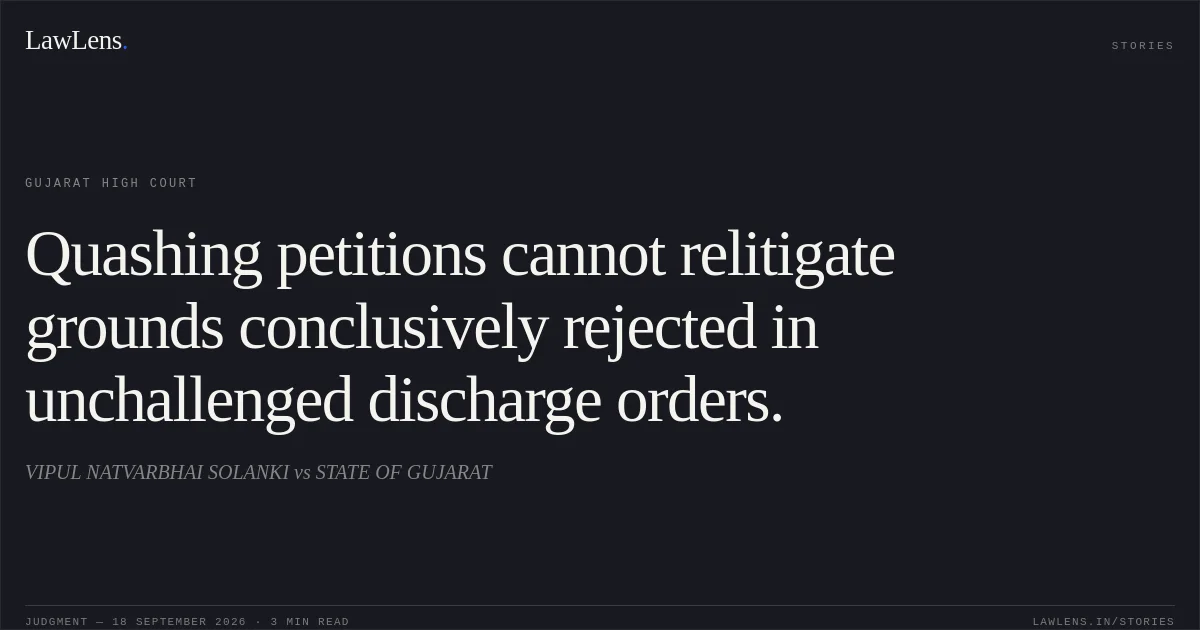
Source reference: pp.1, 3–4The Court proceeded on the principle that issues already considered and rejected by the Trial Court, where the relevant order has attained finality, cannot ordinarily be re-agitated in a subsequent quashing petition.
Source reference: p.4It further held that questions concerning the authenticity, source, admissibility and evidentiary weight of an audio recording—including the non-seizure of the recording device and the probative value of an FSL voice opinion—are matters for appreciation of evidence at trial, rather than grounds for quashing at the threshold.
Source reference: p.5The applicants relied on Sanjaysinh Ramrao Chavan v. Dattatray Gulabrao Phalke, (2015) 3 SCC 123, drawing upon the principle in Anvar P.V. v. P.K. Basheer concerning source and authenticity of electronic evidence; the Court held that the precedent did not assist the applicants because the recording had been examined by the FSL.
Source reference: pp.5–6Reasoning
The Court held that the applicants’ principal contention—that there was no material establishing demand of illegal gratification—had already been raised and rejected by the Trial Court in the Section 227 proceedings.
Source reference: p.4Since the applicants did not challenge the orders dated 11 June 2026 insofar as the charges under Sections 7 and 12 were retained, those findings had attained finality and could not be reopened through the present application.
Source reference: p.4Independently, the charge-sheet material contained the audio recording, its transcript and an FSL opinion indicating that the voices probably belonged to the applicants. The transcript allegedly showed demand by Applicant No. 1 and acceptance by Applicant No. 2.
Source reference: p.5The Court considered the objection regarding non-seizure of the recording device and the non-conclusive nature of the FSL opinion to be matters requiring evaluation of evidence during trial, not grounds for exercising inherent jurisdiction to quash the proceedings.
Source reference: p.5Accordingly, Sanjaysinh Ramrao Chavan was distinguished because, in the present case, the recording itself had been examined by the FSL.
Source reference: pp.5–6Holding
The High Court answered the issues against the applicants. It held that the applicants could not re-agitate contentions already rejected by the Trial Court in unchallenged orders that had attained finality, and that the available audio, transcript and FSL material disclosed sufficient grounds for the proceedings to continue.
The application under Section 528 BNSS was therefore dismissed, and the prayer to quash FIR C.R. No. 06 of 2020, ACB Case No. 04 of 2021, the charge-sheet and all consequential proceedings was refused.
Source reference: p.6Acts & Sections Cited
5 provisions across 3 statutes referred to in this judgment. Each provision opens on LawLens.
Bharatiya Nagarik Suraksha Sanhita, 20231
Prevention of Corruption Act, 19883
Code of Criminal Procedure, 19731
Original Court PDF
VIPUL NATVARBHAI SOLANKIvsSTATE OF GUJARAT
Click to open original judgment
Original judgment, available to read, download and summarize on LawLens.in