Facts
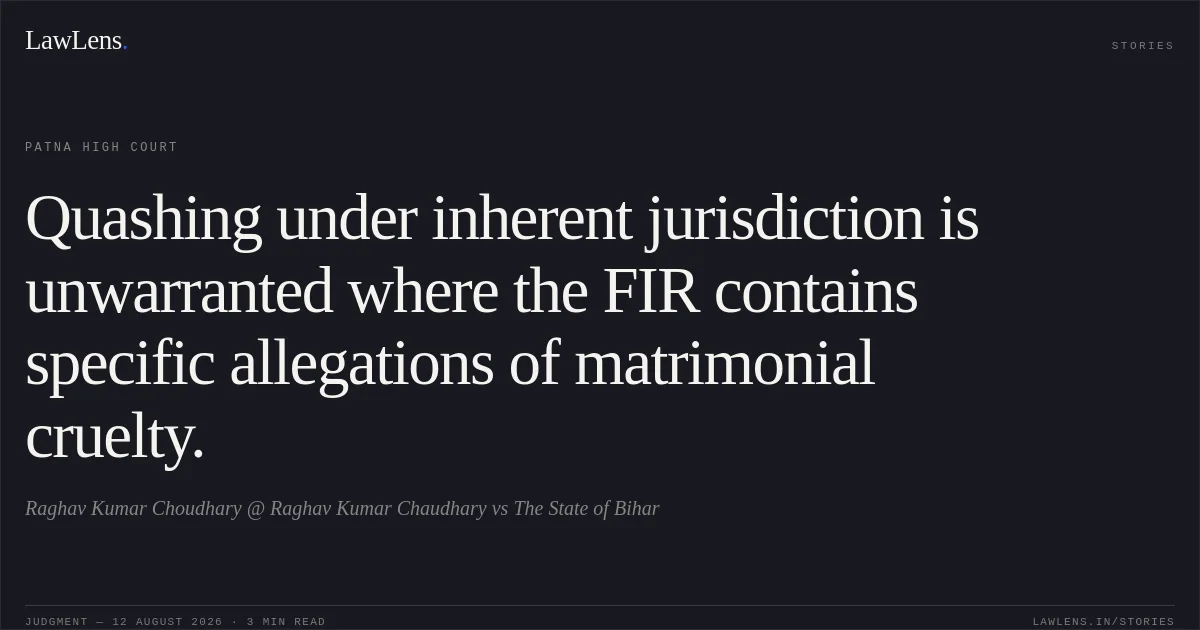
The petitioner-husband challenged the order dated 1 June 2023 passed by the Sub-Divisional Judicial Magistrate, Darbhanga, taking cognizance against him and other accused under Sections 341, 323, 498A and 34 of the Indian Penal Code, and Sections 3/4 of the Dowry Prohibition Act, and issuing summons.
Source reference: p.1, para.2The FIR alleged that the petitioner and his family members subjected Opposite Party No. 2, his wife, to cruelty, physical assault and harassment for non-fulfilment of dowry demands.
Source reference: p.2, para.3The petitioner contended that the allegations were general and omnibus, that his wife had stayed with him for only four days and left the matrimonial home voluntarily, and that he had initiated matrimonial and other proceedings.
Source reference: p.2, para.4The wife opposed the application, relying on specific allegations in the FIR, the petitioner’s alleged failure to pay maintenance of Rs.15,000 per month, and his non-appearance in related proceedings.
Source reference: p.2–3, para.5During the pendency of the application, charges had already been framed on 20 September 2024, but that order was not separately challenged.
Source reference: p.2, para.5Issues
Whether the order dated 1 June 2023 taking cognizance of offences under Sections 341, 323, 498A and 34 IPC and Sections 3/4 of the Dowry Prohibition Act suffered from illegality warranting interference under the inherent jurisdiction of the High Court?
Source reference: p.1, para.2; p.4–5, paras.8–9Whether the petitioner was entitled to quashing of the criminal proceedings when the FIR contained specific allegations of dowry demand, physical assault and cruelty, and charges had already been framed without challenge?
Source reference: p.3–4, paras.5–6Law Applied
The Court applied Sections 341, 323, 498A and 34 of the Indian Penal Code, concerning wrongful restraint, voluntarily causing hurt, cruelty by the husband or his relatives, and acts done in furtherance of common intention, respectively, along with Sections 3/4 of the Dowry Prohibition Act concerning giving, taking and demanding dowry.
Source reference: p.1, para.2It applied the principle that, at the stage of taking cognizance, the Court is required only to determine whether a prima facie case exists and is not required to conduct a detailed evaluation of the evidence.
Source reference: p.3–4, para.6The Court also exercised its inherent jurisdiction to quash criminal proceedings but held that such jurisdiction should not be invoked where the allegations disclose specific offences and no compelling ground for interference is established.
Source reference: p.4–5, paras.6–8The fact that charges had already been framed, without the petitioner challenging the framing order, was treated as a relevant procedural circumstance against granting relief.
Source reference: p.2, para.5; p.4, para.6Reasoning
The Court found that the FIR contained specific allegations against the petitioner regarding unlawful dowry demands, physical assault and mental and physical cruelty, rather than merely vague or omnibus allegations.
Source reference: p.3–4, para.6These allegations were sufficient to disclose a prima facie case under the invoked provisions at the cognizance stage.
Source reference: p.3–4, para.6The petitioner’s factual defence—that the wife stayed with him for only four days and left voluntarily—could not justify quashing at that stage because it required assessment of disputed facts.
Source reference: p.3–4, para.6The Court further considered that charges had already been framed and had not been challenged, while the petitioner had allegedly failed to comply with the maintenance direction and had not demonstrated bona fides in the related proceedings.
Source reference: p.3–4, paras.5–6Although the Court recognised that matrimonial disputes under Section 498A IPC may warrant a sensitive approach and efforts toward resolution, it held that the petitioner’s conduct and the specific allegations did not justify the exercise of inherent powers in his favour.
Source reference: p.4, para.7Holding
The High Court held that the order dated 1 June 2023 taking cognizance did not suffer from any illegality and that the petitioner was not entitled to quashing of the proceedings.
The criminal miscellaneous application was accordingly dismissed.
Source reference: p.4–5, para.8Since charges had already been framed, the trial court was permitted to proceed with the trial against the petitioner.
Source reference: p.5, para.9Acts & Sections Cited
5 provisions across 2 statutes referred to in this judgment. Each provision opens on LawLens.
Indian Penal Code, 18603
Original Court PDF
Raghav Kumar Choudhary @ Raghav Kumar ChaudharyvsThe State of Bihar
Click to open original judgment
Original judgment, available to read, download and summarize on LawLens.in