Facts
The petitioner, an Estate Manager employed by Shri Banarsidas Chandiwala Sewa Smarak Trust Society, was responsible for the upkeep, maintenance, renovation, construction and supervision of the Society’s properties, and claimed to have no role in wage payment or statutory labour compliance.
Source reference: p. 2; para. 2Shyam Kumar, a Lift Operator employed by the Society, resigned with effect from 30 September 2018 and subsequently complained to the Labour Department alleging non-payment of minimum wages.
Source reference: p. 2–3; paras. 4–5Following a notice and inspection, the Labour Inspector filed a complaint on 25 June 2019 alleging offences under Sections 18 and 19(4), read with Rules 26(1), 26(2), 26(5), 21(4), 21(4A) and 25(2), punishable under Section 22A of the Minimum Wages Act, 1948.
Source reference: p. 3; para. 6The Magistrate took cognizance and summoned the petitioner on the same date.
Source reference: p. 3; para. 6The petitioner approached the High Court under Section 482 Cr.P.C., seeking quashing of the complaint, summoning order and consequential proceedings, contending that the complaint was time-barred, that Section 22C was not satisfied, that the Society was not impleaded as an accused, and that no offence was disclosed against him.
Source reference: p. 3–4; paras. 7–10Issues
Whether the complaint was barred by limitation under Section 22B(2)(b) of the Minimum Wages Act, 1948, on the ground that it was filed more than six months after the petitioner was relieved from service on 30 September 2018?
Source reference: p. 5–7; paras. 13–19Whether the petitioner could be prosecuted under Section 22C of the Minimum Wages Act in the absence of specific averments that he was in charge of and responsible for the conduct of the Society’s business?
Source reference: p. 7; paras. 20–22Whether the non-impleadment of the Society, and the alleged absence of the basic ingredients of the offences, warranted quashing of the complaint and summoning order under Section 482 Cr.P.C.?
Source reference: p. 4, 7–8; paras. 9–10, 20–26Law Applied
The Court applied Section 22B(2)(b) of the Minimum Wages Act, which bars cognizance of an offence punishable under Section 22A unless the complaint is made within six months from the date of commission of the alleged offence.
Source reference: p. 5; para. 14The relevant date of limitation must be determined by reference to the nature and date of the particular statutory violation, rather than mechanically from the date on which an employee left service.
Source reference: p. 6–7; paras. 16–19Section 22C imposes liability on persons who, at the time of the offence, were in charge of and responsible to the company for the conduct of its business; whether a particular accused occupied that role ordinarily depends on the facts and material before the trial court.
Source reference: p. 7; paras. 20–22Relying on JKumar–CRTV JV v. Regional Labour Commissioner, 2021:DHC:1431, the Court held that statutory limitation cannot be disregarded merely because the Minimum Wages Act is welfare legislation.
Source reference: p. 5–6; para. 15The principles in Aneeta Hada v. Godfather Travels & Tours (P) Ltd., (2012) 5 SCC 661, and Dayle De’Souza v. Government of India, 2021 SCC OnLine SC 1012, concerning vicarious liability, were held not to justify quashing at the preliminary stage without examining the statutory context and allegations.
Source reference: p. 7; para. 22In exercising Section 482 Cr.P.C. jurisdiction, the High Court cannot conduct a mini-trial or determine disputed factual defences at the summoning stage.
Source reference: p. 7–8; para. 23Reasoning
The Court rejected the petitioner’s limitation argument because 30 September 2018, the date of his discharge from service, could not automatically be treated as the date of commission of every alleged offence.
Source reference: p. 6–7; paras. 18–19The complaint also concerned continuing or distinct obligations relating to maintenance and production of statutory records and other compliances under the Minimum Wages Act and Rules; therefore, limitation had to be assessed with reference to the specific violations alleged.
Source reference: p. 6–7; paras. 18–19The petitioner’s assertion that his duties were confined to estate management raised a disputed factual question regarding his actual role and responsibility, which could not be conclusively adjudicated in a Section 482 petition.
Source reference: p. 7; paras. 20–23Similarly, the effect of the Society not being arraigned as an accused and the applicability of vicarious-liability principles under Section 22C required consideration in the factual and statutory context of the complaint.
Source reference: p. 7–8; paras. 21–24Since the complaint and summoning order were not ex facie untenable, the Court declined to undertake a detailed examination of the evidence or the petitioner’s defence.
Source reference: p. 7–8; paras. 21–24Holding
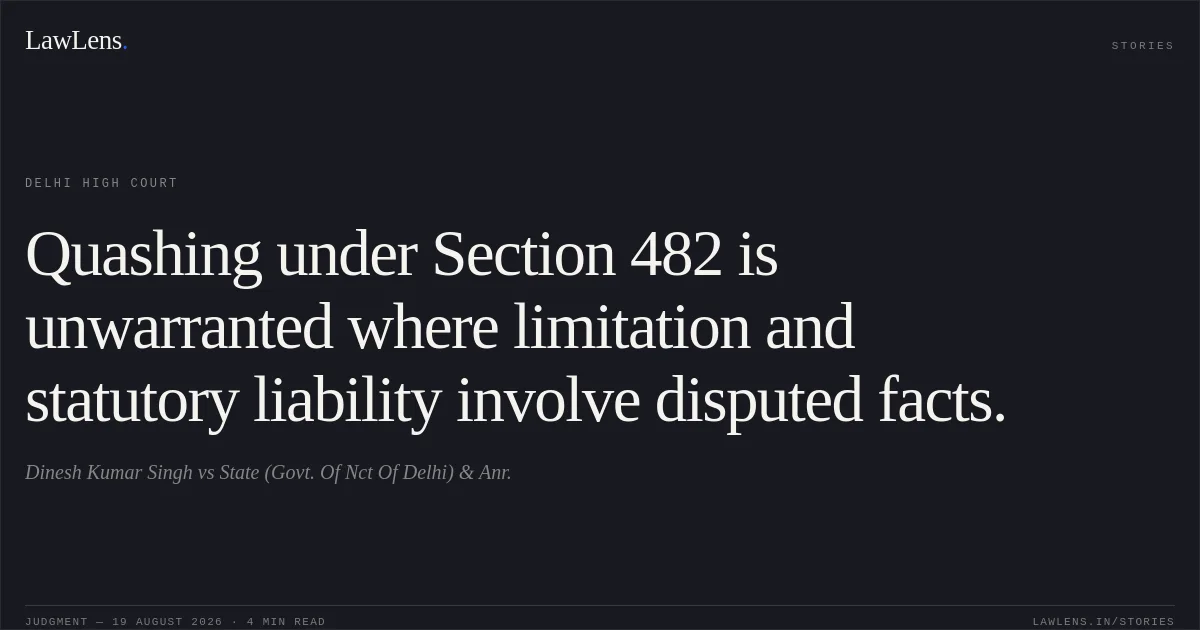
The High Court held that the complaint could not be declared ex facie time-barred merely by computing six months from 30 September 2018, and that the petitioner’s contentions concerning his limited role, Section 22C, non-impleadment of the Society and absence of offence involved matters unsuitable for determination in proceedings under Section 482 Cr.P.C.
The petition seeking quashing of Complaint Case No. 17353/2019, the summoning order dated 25 June 2019 and all consequential proceedings was dismissed.
Source reference: p. 8; paras. 24–27Pending applications were also disposed of, with the clarification that the observations would not prejudice the trial court’s independent determination on merits.
Source reference: p. 8; paras. 24–27Acts & Sections Cited
2 provisions across 2 statutes referred to in this judgment. Each provision opens on LawLens.
Code of Criminal Procedure, 19731
Negotiable Instruments Act, 18811
Original Court PDF
Dinesh Kumar SinghvsState (Govt. Of Nct Of Delhi) & Anr.
Click to open original judgment
Original judgment, available to read, download and summarize on LawLens.in