Facts
The applicant, a former Section Officer, was subjected to disciplinary proceedings under Rule 14 of the CCS (CCA) Rules, 1965, resulting in his removal from service in 2009
Source reference: para. 4-5In a previous round of litigation (OA No. 462/2010), the Tribunal found the penalty disproportionate and remanded the matter
Source reference: para. 7Consequently, the respondents issued an order dated April 17, 2012, modifying the penalty to "Compulsory Retirement," explicitly stating this would allow the applicant to avail terminal benefits
Source reference: para. 8However, through subsequent orders dated September 30, 2015, and March 8, 2017, the respondents "interpreted" and modified the 2012 order to restrict benefits to 75% pension and full gratuity, rather than full terminal benefits
Source reference: para. 9-10The applicant challenged these subsequent modifications, arguing the authority became functus officio after the 2012 order was communicated
Source reference: para. 11Issues
1. Whether the disciplinary authority became functus officio after passing and communicating the penalty modification order dated April 17, 2012
Source reference: para. 11, 162. Whether the respondents had the legal authority to subsequently curtail the terminal benefits of the applicant in the absence of an express power of review under the relevant service rules
Source reference: para. 13, 17Law Applied
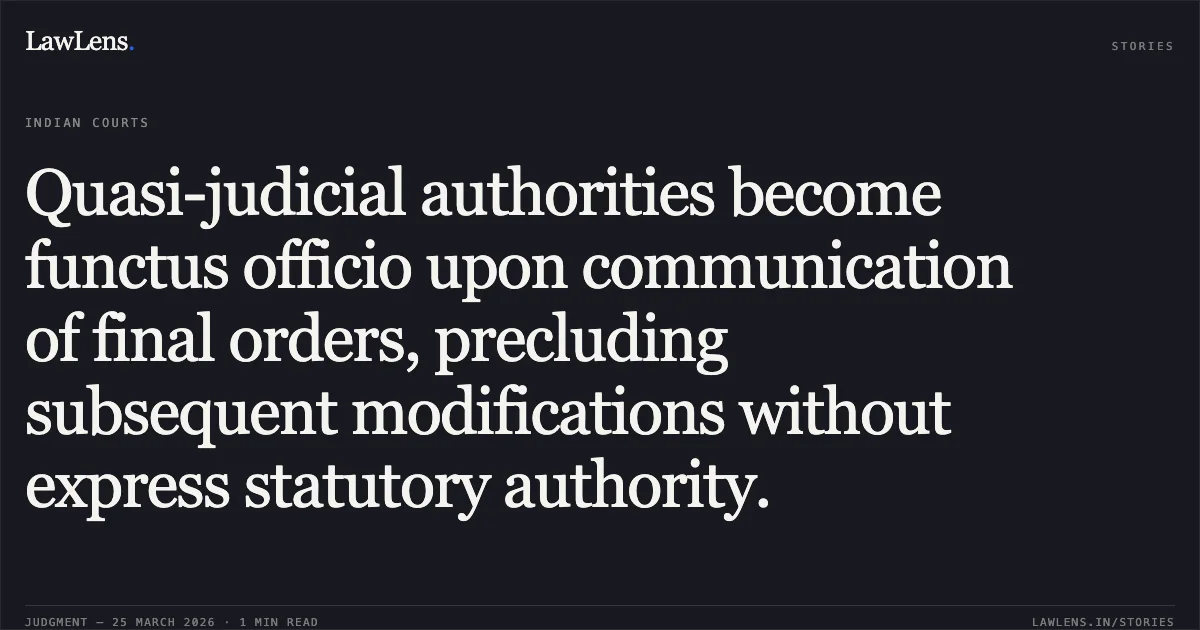
The court primarily applied the doctrine of functus officio, as elucidated by the Supreme Court in State Bank of India and Others v. S. N. Goyal (2008), which establishes that a quasi-judicial authority cannot review its own decision once it is pronounced, published, or communicated, unless the relevant statute expressly permits such a review
Source reference: para. 11The court also referred to Rule 40(1) of the CCS (Pension) Rules, 1972, regarding the grant of pension and gratuity upon compulsory retirement
Source reference: para. 9Reasoning
The Tribunal observed that the order dated April 17, 2012, passed in the name of the President of India, was a final decision intended to grant the applicant terminal benefits that are otherwise denied in cases of removal
Source reference: para. 14The court noted that once this order was notified and communicated, the authority fulfilled its function and possessed no further power to alter the decision
Source reference: para. 11, 16The respondents failed to produce any specific provision under the CCS (CCA) Rules or CCS (Pension) Rules that permitted a review or modification of a final penalty order years after its issuance
Source reference: para. 13The Tribunal found that the 2015 and 2017 orders, which attempted to reinterpret the 2012 order to curtail benefits, were not in consonance with the original intent and were issued in a casual manner without proper application of mind
Source reference: para. 15, 19-20Holding
The Tribunal allowed the OA, quashing and setting aside the impugned orders dated March 8, 2017, and September 30, 2015
The court held that the respondents could not legally modify the 2012 order after becoming functus officio
Source reference: para. 16-17The respondents were directed to release all withheld terminal benefits and consequential dues within three months, failing which the amount would carry an interest rate of 7.1%
Source reference: para. 18Additionally, the Tribunal imposed a token cost of Rs. 10,000 on Respondent No. 1 for causing avoidable and repetitive litigation
Source reference: para. 20Acts & Sections Cited
3 provisions across 1 statute referred to in this judgment. Each provision opens on LawLens.
Code of Civil Procedure, 19083
Original Court PDF
Satish KumarvsM/o Human Resource Development
Click to open original judgment
Original judgment, available to read, download and summarize on LawLens.in