Facts
The petitioner was appointed as an 'Amin' in 1988
Source reference: para. 2Due to his wife's mental illness and hospitalization, he remained absent from duty and applied for leave through proper channels, which the respondents allegedly ignored
Source reference: para. 2Following a show-cause notice and a charge-sheet dated July 20, 2006, a departmental enquiry was conducted
Source reference: para. 2Despite the petitioner's reply, the Disciplinary Authority imposed the punishment of dismissal from service
Source reference: para. 2The petitioner preferred an appeal (Annexure P-10) raising nine distinct factual and legal grounds
Source reference: para. 2However, the Appellate Authority rejected the appeal on October 8, 2015, via an order the petitioner contended was non-speaking and unreasoned
Source reference: para. 2, 5The petitioner subsequently challenged the dismissal and the appellate order under Article 226 of the Constitution of India
Source reference: para. 1Issues
1. Whether the Appellate Authority, while exercising quasi-judicial powers, is mandated to pass a speaking order supported by valid and justifiable reasons
Source reference: para. 6, 72. Whether the impugned appellate order dated October 8, 2015, was arbitrary and capricious for failing to address the specific grounds raised in the appeal memo
Source reference: para. 8, 9Law Applied
The court primarily relied on the principles of administrative law and natural justice, emphasizing that quasi-judicial authorities must pass "speaking orders"
Source reference: para. 6It applied Rule 10(9) of the M.P. Civil Services (Classification, Control and Appeal) Rules, 1966, regarding the imposition of penalties
Source reference: para. 5The court cited State of Punjab v. Bandip Singh (2016) 1 SCC 724, which establishes that administrative decisions must be self-sustaining and impregnated with reasons to avoid being arbitrary
Source reference: para. 8, 9Furthermore, it relied on Kranti Associates Pvt. Ltd. v. Masood Ahmed Khan (2010) 9 SCC 496, which holds that recording reasons is an indispensable component of the decision-making process and a facet of human rights and fairness
Source reference: para. 10Reasoning
The court observed that the Appellate Authority, when reviewing the dismissal of a government servant, functions as a quasi-judicial body
Source reference: para. 6Upon perusing the impugned order dated October 8, 2015, the court found it to be non-speaking
Source reference: para. 6Although the State counsel argued that the authority was satisfied with the disciplinary findings, they conceded that no independent reasoning was assigned in the appellate order
Source reference: para. 3The court reasoned that the "face of an order" must speak so the affected party understands how their defense was considered
Source reference: para. 7By failing to address the petitioner’s specific grounds—particularly the medical exigencies regarding his wife—and merely concurring with the lower authority without analysis, the Appellate Authority acted in a mechanical and capricious manner
Source reference: para. 5, 9The court emphasized that reason is the "lifeblood of judicial decision-making" and essential for sustaining faith in the justice system
Source reference: para. 10Holding
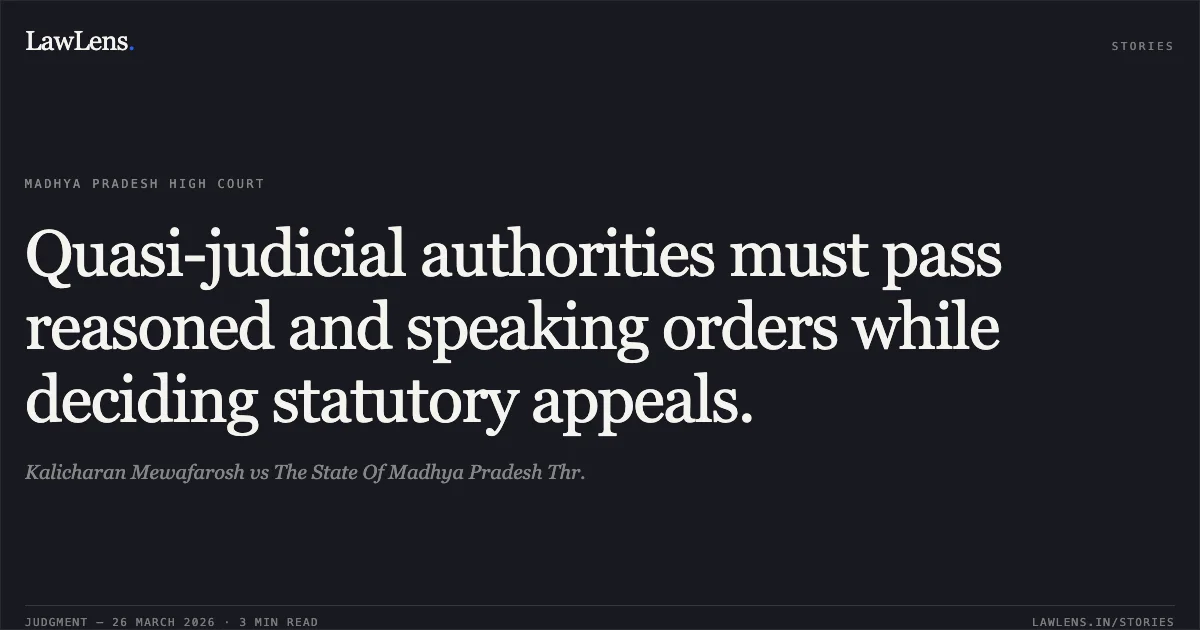
The High Court held that the appellate order lacked the necessary legal requirement of being a reasoned and speaking order
Consequently, the court set aside the appeal rejection order dated October 8, 2015 (Annexure P/2)
Source reference: para. 11The petitioner was directed to submit a fresh, detailed appeal within one month from the date of the order
Source reference: para. 12The Appellate Authority was further directed to decide the fresh and earlier appeals by passing a reasoned and speaking order after providing the petitioner a personal hearing, within a period of three months from the receipt of the certified copy
Source reference: para. 12The petition was disposed of with these directions
Source reference: para. 13Original Court PDF
Kalicharan MewafaroshvsThe State Of Madhya Pradesh Thr.
Click to open original judgment
Original judgment, available to read, download and summarize on LawLens.in