Facts
The petitioner, a Junior Engineer at the Badoda Distribution Centre, was issued a show-cause notice on October 15, 2009, alleging a failure to maintain a 3.15 MBA transformer, which subsequently failed.
Source reference: para. 2The petitioner replied on August 21, 2010, contending that under a 1983 circular, the Assistant Engineer—not the Junior Engineer—was responsible for such maintenance.
Source reference: para. 2On December 1, 2010, the Disciplinary Authority (DA) issued an order withholding two annual increments without cumulative effect, stating simply that the petitioner's reply was "unsatisfactory".
Source reference: para. 2, 5On appeal, the Appellate Authority (AA) reduced the punishment to withholding one annual increment for one year without cumulative effect via an order dated May 30, 2011.
Source reference: para. 2, 7The petitioner challenged both orders under Article 226 of the Constitution, arguing they were non-speaking and unreasoned.
Source reference: para. 2Issues
Whether the disciplinary and appellate orders passed against the petitioner were "speaking orders" that demonstrated an objective consideration of the facts and defenses raised.
Source reference: para. 6, 8Whether a quasi-judicial authority is mandated to record valid and justifiable reasons in support of its conclusions.
Source reference: para. 9, 12Law Applied
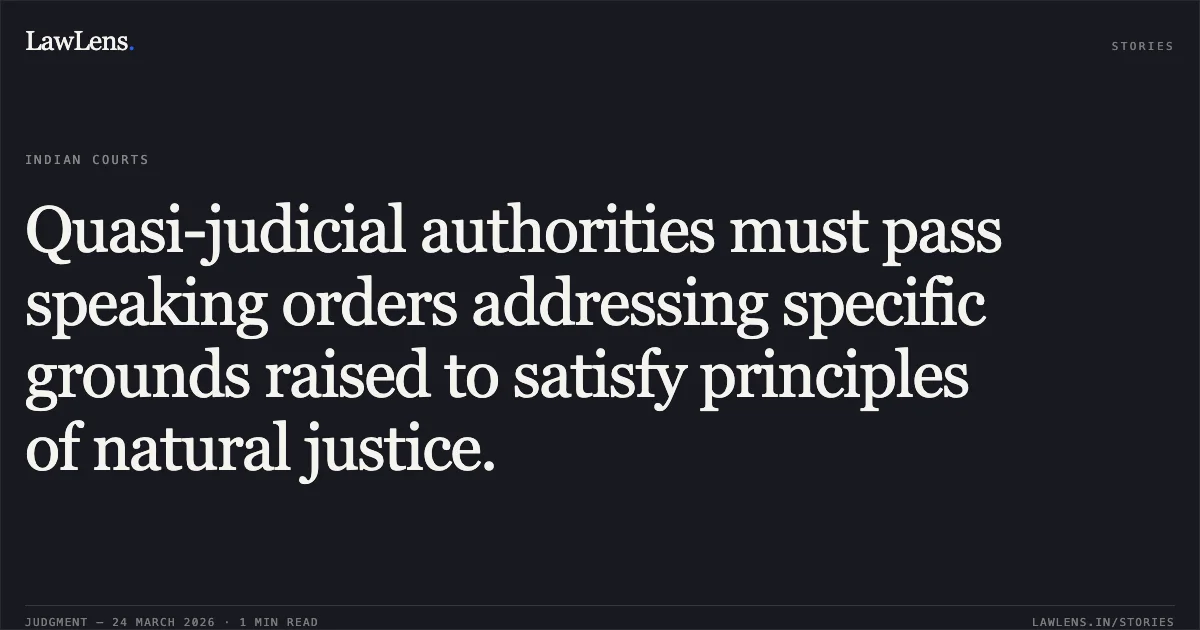
The court applied the principle that authorities exercising quasi-judicial or administrative powers affecting the rights of parties must pass "speaking orders".
Source reference: para. 6, 9It relied on State of Punjab v. Bandip Singh (2016) 1 SCC 724, which establishes that executive decisions must be self-sustaining and impregnated with reasons rather than being capricious or arbitrary.
Source reference: para. 10-11It further cited Kranti Associates Pvt. Ltd. v. Masood Ahmed Khan (2010) 9 SCC 496, which held that recording reasons is an indispensable component of the decision-making process and the "lifeblood of judicial decision-making".
Source reference: para. 12Reasoning
The Court observed that the Disciplinary Authority’s order dated December 1, 2010, failed to address the specific grounds raised in the petitioner's reply, such as the 1983 circular regarding maintenance responsibility.
Source reference: para. 2, 6By merely stating the reply was "unsatisfactory," the DA failed to exercise its quasi-judicial power in a rational manner.
Source reference: para. 6The Appellate Authority's order was found to be non-speaking as it did not record justifiable reasons for its conclusion, despite reducing the quantum of punishment.
Source reference: para. 8The Court emphasized that an affected party must know how their defense was considered.
Source reference: para. 9Applying the Kranti Associates standard, the Court determined that the orders resembled the "inscrutable face of a sphinx" rather than reasoned judicial opinions.
Source reference: para. 12Because the petitioner had already retired, the Court noted that remanding the case for a fresh inquiry was not appropriate.
Source reference: para. 14Holding
The Court allowed the petition and quashed the punishment order dated December 1, 2010, and the appellate order dated May 30, 2011.
The Court held that the authorities failed to pass reasoned orders as required by law.
Source reference: para. 6, 8The respondents were directed to provide all consequential benefits to the petitioner within three months.
Source reference: para. 14Given the petitioner’s retirement, the Court explicitly denied the respondents liberty to take any further disciplinary action.
Source reference: para. 14-15Original Court PDF
Shrimohan SharmavsM.P.Madhya Kshetra Vidyut Vitran Com. Ltd.
Click to open original judgment
Original judgment, available to read, download and summarize on LawLens.in


