Facts
The petitioner, an employee of the Border Security Force (BSF), was dismissed from service via an order dated 10-12-2003
Source reference: p.1He preferred an appeal against this dismissal to the Inspector General, BSF, raising various factual grounds and justifications for his absence
Source reference: p.2The Appellate Authority rejected the appeal on 23-06-2004 through a brief order stating that the petition was "devoid of merit" after "carefully considering all the points"
Source reference: p.2, para. 5The petitioner challenged both the dismissal and the appellate order under Article 226 of the Constitution, contending that the appellate order was non-speaking and unreasoned
Source reference: p.1, 2Issues
1. Whether the appellate order dated 23-06-2004, passed by a quasi-judicial authority, was legally sustainable despite being non-speaking and lacking specific reasoning.
Source reference: p.2-3, para. 62. Whether the failure to record reasons in an administrative or quasi-judicial order violates the principles of natural justice and the right to a fair decision-making process.
Source reference: p.3-4, para. 7-10Law Applied
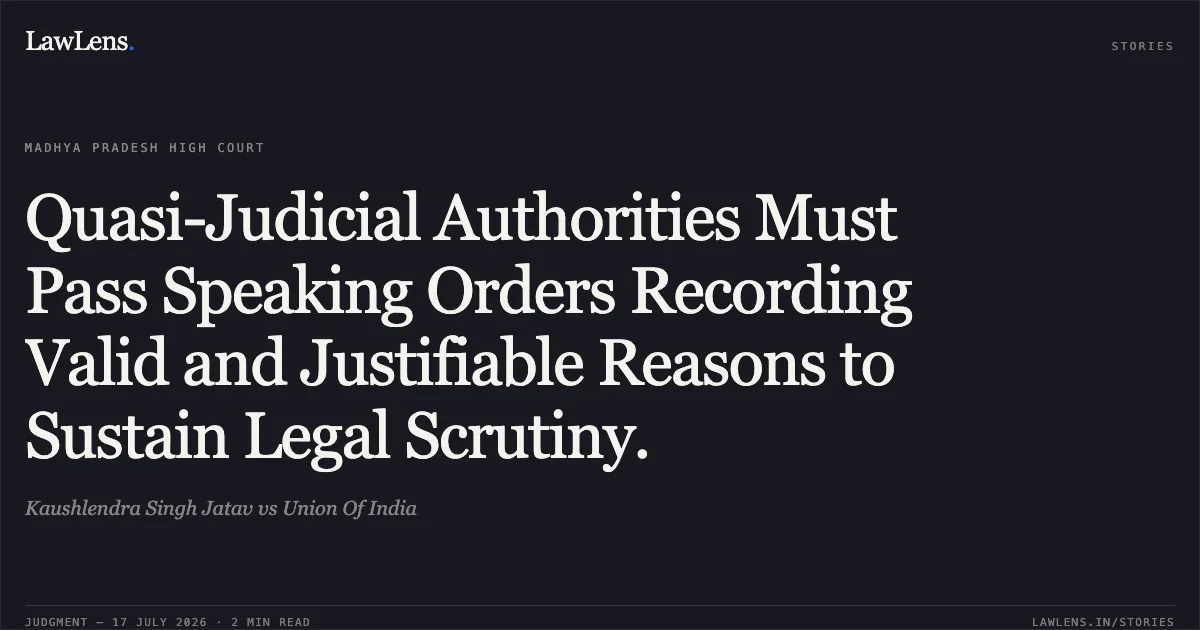
quasi-judicial and administrative authorities affecting the rights of parties must pass "speaking orders" supported by valid and justifiable reasons
Source reference: p.3, para. 6The court relied on State of Punjab v. Bandip Singh, which held that executive decisions must be composite, self-sustaining, and impregnated with reasons to avoid being arbitrary or capricious
Source reference: p.3, para. 8-9It applied Kranti Associates Pvt. Ltd. v. Masood Ahmed Khan, which established that recording reasons is an indispensable component of natural justice and the "lifeblood" of judicial decision-making
Source reference: p.4, para. 10The court also referenced Krushnakant B. Parmar v. Union of India regarding the consideration of "compelling circumstances" in cases of unauthorized absence
Source reference: p.5, para. 11Reasoning
The court found that the Appellate Authority, while exercising quasi-judicial powers, failed to apply its mind to the specific facts and grounds raised in the petitioner’s appeal
Source reference: p.2, para. 6By merely stating that the appeal was “devoid of merit,” the authority produced an order that was "inscrutable" and lacked the transparency required for the affected party to understand why his defense was rejected
Source reference: p.3-4, para. 7, 10The court reasoned that since the order prejudicially affected the petitioner's rights (dismissal from service), the "doctrine of fairness" mandated a reasoned conclusion
Source reference: p.5, para. 10(n)The court determined that the existing order did not meet the standards of a "self-sustaining" administrative decision as it failed to demonstrate an objective consideration of relevant factors
Source reference: p.4-5Holding
The court allowed the petition in part, setting aside the impugned appellate order dated 23-06-2004
The court held that the order was non-speaking and violated the principles of natural justice. The Court directed the petitioner to file a fresh appeal within one month and ordered the Appellate Authority to decide the matter on its merits within three months. The Authority was specifically directed to pass a speaking and reasoned order, providing a personal hearing to the petitioner and considering whether his absence was due to "compelling circumstances" as per the Krushnakant B. Parmar precedent
Source reference: p.5, para. 11(b-c)Original Court PDF
Kaushlendra Singh JatavvsUnion Of India
Click to open original judgment
Original judgment, available to read, download and summarize on LawLens.in