Facts
The petitioners purchased 8.35¾ acres of land in Village Sero via a registered sale deed in 1997, following permission granted under Section 46 of the Chotanagpur Tenancy (CNT) Act, 1908
Source reference: para. 9(vii), 13Subsequently, the original landholder (Respondent No. 3) filed SAR Appeal No. 217(R) 15 of 1999–2000, alleging the transfer was obtained through fraud and impersonation
Source reference: para. 9(xi), 14The Deputy Commissioner, acting as the appellate authority, annulled the transfer based on an inquiry report without issuing notice to the petitioners
Source reference: para. 9(xii), 18, 61The petitioners filed a revision application (SAR Revision No. 47 of 2007) before the Divisional Commissioner after an eight-month delay, claiming they only learned of the ex-parte order during a field inspection
Source reference: para. 9(xvi), 20The revisional authority dismissed the application solely on the ground of limitation, stating the explanation for the delay was unsatisfactory
Source reference: para. 21Issues
1. Whether the revisional authority was justified in dismissing the revision application on the grounds of limitation without providing specific reasons for rejecting the explanation of delay
Source reference: para. 22, 522. Whether an order passed by an appellate authority without notice to the affected parties (ex-parte) constitutes a valid ground for condoning delay in filing a statutory revision
Source reference: para. 21, 59Law Applied
The Court applied the principles of "Sufficient Cause" under the Limitation Act, 1963, as interpreted in Basawaraj v. Spl. Land Acquisition Officer and Ram Nath Sao v. Gobardhan Sao, which mandate a liberal construction of limitation rules to ensure substantial justice, provided there is no gross negligence or lack of bona fides.
Source reference: para. 44, 46It further relied on Chairman, LIC v. A. Masilamani, which defines "consideration" as the active application of mind and requires that statutory orders reveal such application through reasoned findings
Source reference: para. 55, 57The procedural hierarchy and right to appeal/revision under the Chotanagpur Tenancy Act, 1908, were also central
Source reference: para. 33Reasoning
The Court observed that the revisional authority’s order was "mechanical" because it failed to assign any cogent reasons for finding the petitioners’ explanation for the eight-month delay unsatisfactory
Source reference: para. 22, 58Reasoned orders are the "soul" of judicial proceedings, reflecting the application of mind; their absence renders an order invalid
Source reference: para. 54Critically, the Court found that the appellate authority had annulled the land transfer without issuing notice to the petitioners, violating principles of natural justice
Source reference: para. 61-63The Court reasoned that even if fraud is alleged, the accused party must be given an opportunity to defend
Source reference: para. 64Since the petitioners were unaware of the ex-parte proceeding, their claim of having no knowledge until eight months later constituted a potential "sufficient cause" that the revisional authority failed to judiciously evaluate
Source reference: para. 62-63Holding
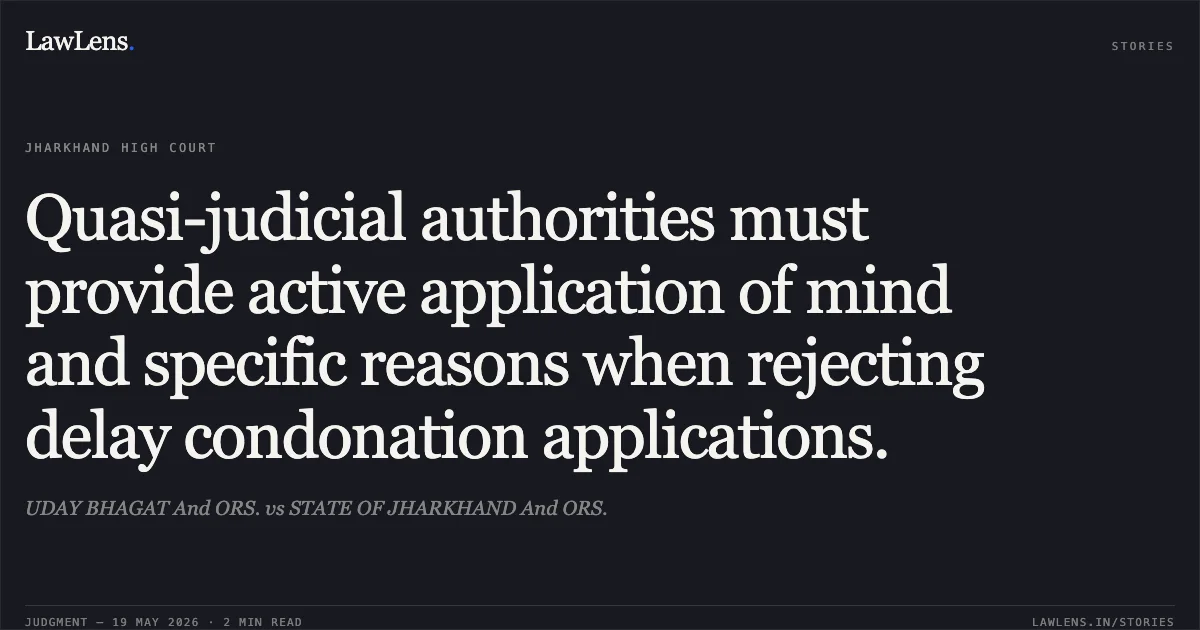
The Court held that a quasi-judicial authority must provide specific reasons when rejecting a condonation of delay application, especially when the underlying order was passed ex-parte
The High Court allowed the writ petition and quashed the order dated April 17, 2007, restored SAR Revision Case No. 47 of 2007 and directed the revisional authority to first decide the issue of limitation in accordance with the law within two months, and subsequently the merits within another two months. The parties were directed to appear before the Divisional Commissioner on May 20, 2026.
Source reference: para. 66, 67-69, 73Acts & Sections Cited
6 provisions across 3 statutes referred to in this judgment. Each provision opens on LawLens.
Code of Criminal Procedure, 19732
Indian Penal Code, 18602
Limitation Act, 19632
Original Court PDF
UDAY BHAGAT And ORS.vsSTATE OF JHARKHAND And ORS.
Click to open original judgment
Original judgment, available to read, download and summarize on LawLens.in


